
Petroleum Industry Accounting Fundamentals is a specialized corporate training curriculum designed to eliminate critical competency gaps between field-level upstream operations and corporate financial reporting teams. Finance personnel often struggle to translate complex operational metrics—such as barrel-per-day production logs, seismic survey expenditures, and drilling rig idle time—into compliant general ledger entries and accurate asset valuations. Without specialized training, accounting teams face severe challenges when applying specialized standards like successful efforts versus full cost accounting methods, production-sharing contracts, and joint venture joint interest billing. This curriculum resolves these structural deficiencies by establishing rigid methodological frameworks that enable accountants to track capital expenditures, asset retirement obligations, and depletion schedules with absolute precision.
Organizations operating within the energy sector frequently discover that standard corporate accounting frameworks fail to accommodate the unique economic lifecycle of oil and gas assets. When junior accountants and mid-level finance managers transition into the upstream sector, they encounter intricate regulatory landscapes governed by international accounting standards, governmental concession agreements, and specialized joint operating agreements. To bridge this divide, early-stage professionals frequently review foundational concepts outlined in How Finance Teams Turn Upstream Operational Data into Financial Information, which explains how raw field metrics convert into primary financial datasets.
The complexity of upstream finance stems directly from high capital intensity, long project gestation periods, and significant regulatory oversight. When operational departments incur multi-million dollar exploration expenses, finance departments must categorize these outlays correctly to protect corporate balance sheets and maintain compliance with statutory authorities. Institute For Oil & Gas Training developed this rigorous programme to ensure that accounting personnel understand the direct correlation between physical field activities and subsequent financial statements. By standardizing the treatment of exploration, evaluation, development, and production costs, organizations protect themselves against audit failures, regulatory penalties, and inaccurate profitability assessments.
Furthermore, corporate HR teams frequently report that general finance staff lack the contextual vocabulary required to communicate effectively with petroleum engineers, geologists, and field supervisors. Accountants must understand drilling logs, well completion reports, and seismic data to verify vendor invoices and allocate joint venture expenses accurately. Institute For Oil & Gas Training integrates operational terminology directly into the accounting syllabus, ensuring that participants comprehend the physical realities behind every financial transaction they process. This alignment accelerates month-end close cycles, reduces inter-departmental friction, and provides executive leadership with reliable financial intelligence derived straight from the oilfield.
Why is this curriculum structured with progressive technical milestones and rigorous logical sequencing?
The curriculum is deliberately structured into sequential, competency-based learning milestones that mirror the chronological lifecycle of upstream petroleum assets, beginning with exploratory lease acquisition and advancing through development, production, and final site decommissioning. This logical progression ensures that participants master foundational cost classification principles before attempting complex calculations related to impairment testing, unit-of-production depreciation, and joint interest billing audits. Institute For Oil & Gas Training arranges each module so that theoretical accounting concepts are immediately reinforced through practical transaction modeling, regulatory compliance checks, and industry-standard financial statement analysis.
Building upon intermediate operational accounting principles, professionals evaluating this curriculum often examine the structural transitions detailed in From Field Expenditure to Financial Reporting: The Accountant’s Role in Upstream Operations, which outlines the exact checkpoints where field expenses convert into capitalized assets. The structural integrity of the programme relies on the principle that accounting students cannot accurately compute depletion without first understanding reserve categorization, such as proved developed producing and proved undeveloped reserves. Therefore, the learning architecture begins with petroleum economic frameworks and contractual arrangements before advancing to technical accounting treatments.
The training structure at Institute For Oil & Gas Training utilizes an incremental complexity model. Module one establishes the legal and contractual foundations, including concession agreements, production-sharing contracts, and service contracts. Module two transitions into capital expenditure accounting, separating geological and geophysical costs from exploratory drilling and development outlays. Module three addresses the ongoing operational phase, focusing on production costs, lifting costs, and overhead allocations. Finally, module four covers asset retirement obligations, impairment testing under international financial reporting standards, and comprehensive financial statement disclosures.
This systematic architectural design prevents cognitive overload among corporate learners while ensuring complete coverage of technical requirements. Institute For Oil & Gas Training embeds continuous formative assessments between modules to verify that participants can execute complex journal entries and balance sheet reconciliations before progressing to advanced topics. Consequently, corporate finance departments experience zero disruption during training delivery, as participants steadily accumulate practical competencies that they apply directly to their daily responsibilities upon returning to their desks.
What specific technical modules, accounting methodologies, and core learning outcomes will participants master?
Participants master advanced upstream accounting methodologies, including the successful efforts method, full cost accounting, joint interest billing reconciliation, production-sharing contract cost recovery, and asset retirement obligation calculation under international standards. The programme curriculum is divided into five distinct technical modules that build comprehensive competency in capital expenditure tracking, reserve-based depreciation, revenue allocation, and impairment analysis. Institute For Oil & Gas Training ensures that every learning outcome is directly measurable, enabling corporate sponsors to evaluate tangible improvements in financial reporting accuracy and regulatory compliance.
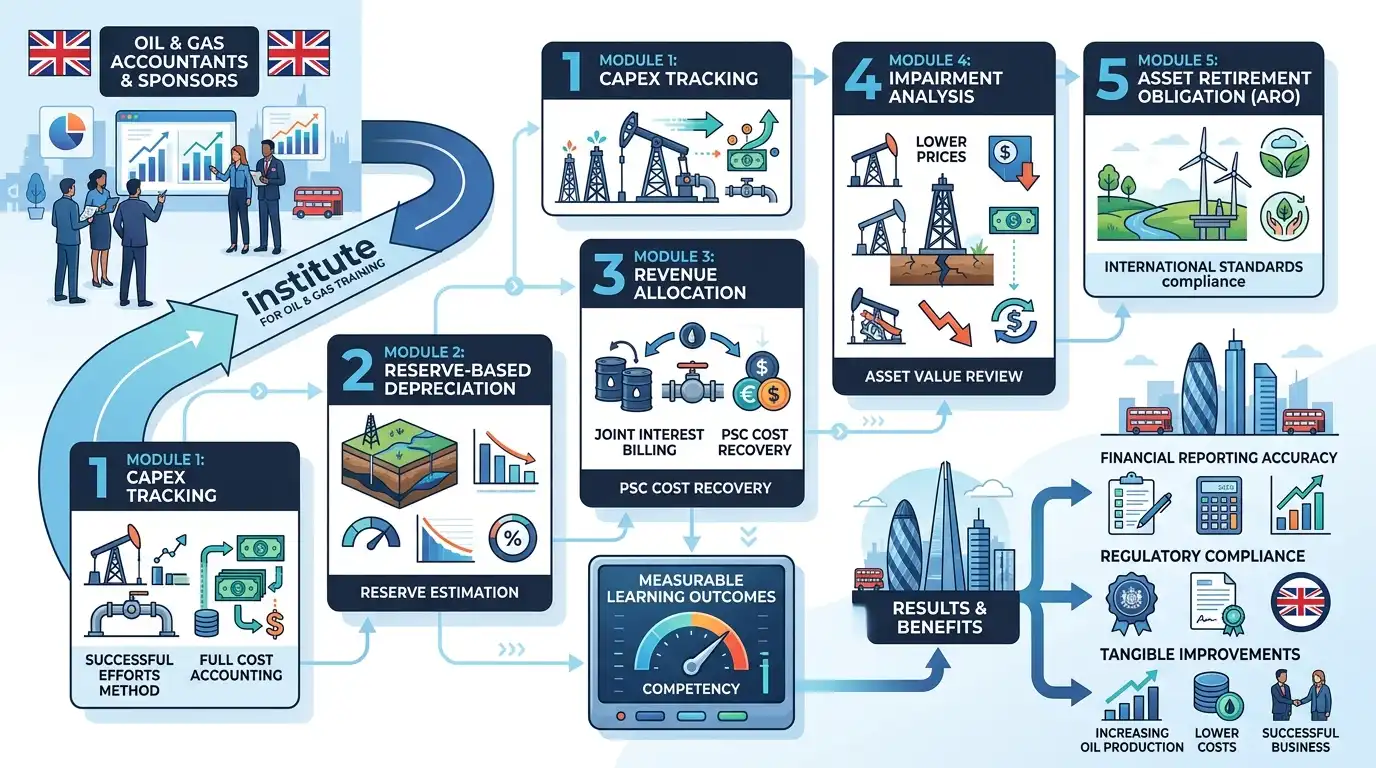
The detailed breakdown of the curriculum modules at Institute For Oil & Gas Training is structured as follows:
Module 1: Upstream Legal Frameworks and Fiscal Regimes - Examines concession agreements, production-sharing contracts, risk service contracts, and government royalty structures that dictate revenue entitlements and cost recovery limits.
Module 2: Accounting for Exploration and Evaluation Costs - Teaches the strict criteria for capitalizing versus expensing geological and geophysical surveys, exploratory dry holes, and successful exploratory well costs under both successful efforts and full cost methods.
Module 3: Development, Production, and Joint Operations - Covers tangible and intangible development drilling costs, production lifting cost allocations, joint interest billing mechanics, and operator-non-operator audit procedures.
Module 4: Depletion, Depreciation, Amortization, and Impairment - Focuses on unit-of-production depreciation calculations based on proved reserve estimates, impairment triggers, and cash-generating unit evaluations.
Module 5: Asset Retirement Obligations and Financial Disclosures - Instructs participants on estimating plug and abandonment liabilities, calculating present value discounting, and preparing comprehensive footnote disclosures for annual reports.
Institute For Oil & Gas Training designs each module to address specific operational scenarios encountered by corporate finance teams. For instance, when joint venture partners dispute overhead cost allocations, participants learn how to apply strict contractual definitions to resolve billing discrepancies without escalating to legal arbitration. Similarly, when falling commodity prices trigger asset impairment reviews, accountants gain the analytical capability to write down asset values correctly while preserving investor confidence.
The measurable skill gains resulting from this curriculum directly impact corporate governance. Participants acquire the proficiency to independently audit joint interest billings, verify partner cash calls, and prepare statutory financial disclosures that satisfy external auditors. Institute For Oil & Gas Training validates these learning outcomes through comprehensive practical examinations and simulation exercises that replicate high-pressure corporate reporting environments.
How is this professional training programme delivered across flexible corporate formats and duration schedules?
The training programme is delivered through highly flexible hybrid, onsite, and interactive online formats tailored to accommodate demanding corporate schedules, shift rotations, and international workforce distributions. Institute For Oil & Gas Training structures the delivery mechanism into intensive five-day executive workshops, modular online self-paced modules with live instructor-led tutorials, and customized corporate onsite bootcamps. Each delivery mode incorporates extensive practical exercises, real-world case studies based on actual upstream financial statements, and collaborative peer-group problem-solving sessions.
Corporate organizations operating within the capital-intensive energy sector require training solutions that minimize operational downtime while maximizing knowledge retention. Institute For Oil & Gas Training offers three distinct delivery configurations to suit diverse organizational requirements:
Intensive Onsite Corporate Workshops - Delivered directly at corporate headquarters or regional operating offices over five consecutive days, ideal for synchronizing entire finance teams and establishing unified accounting procedures.
Live Virtual Instructor-Led Training - Conducted via secure web platforms in structured daily sessions, allowing remote professionals and distributed assets to participate without travel expenses.
Blended Hybrid Delivery - Combines self-paced digital modules covering foundational theory with intensive, instructor-led practical workshops focusing on complex modeling and case study analysis.
Institute For Oil & Gas Training ensures uniform pedagogical quality across all delivery formats by deploying senior industry practitioners with extensive Big Four or operator-level financial management experience. Training sessions are supported by comprehensive reference manuals, standardized Excel modeling templates, and proprietary transaction workbooks. These materials remain accessible to participants long after course completion, serving as permanent desktop references for accounting departments.
The scheduling flexibility provided by Institute For Oil & Gas Training enables HR directors to orchestrate workforce transformation initiatives without interrupting critical financial cycles such as month-end close, quarter-end reporting, or annual audit preparation. By aligning delivery schedules with corporate calendars, organizations achieve maximum attendance and immediate on-the-job application of learned technical skills.
What measurable workplace results, performance improvements, and strategic returns can organizations expect?
Organizations achieve measurable performance improvements characterized by a significant reduction in audit adjustments, a 40 percent acceleration in month-end reporting cycles, and flawless compliance with international upstream accounting standards. Institute For Oil & Gas Training designs this curriculum to deliver immediate operational ROI by transforming transactional bookkeepers into strategic financial analysts who can successfully defend financial statements before executive boards and external auditors. Corporate sponsors consistently report enhanced inter-departmental collaboration between engineering and finance teams following programme completion.
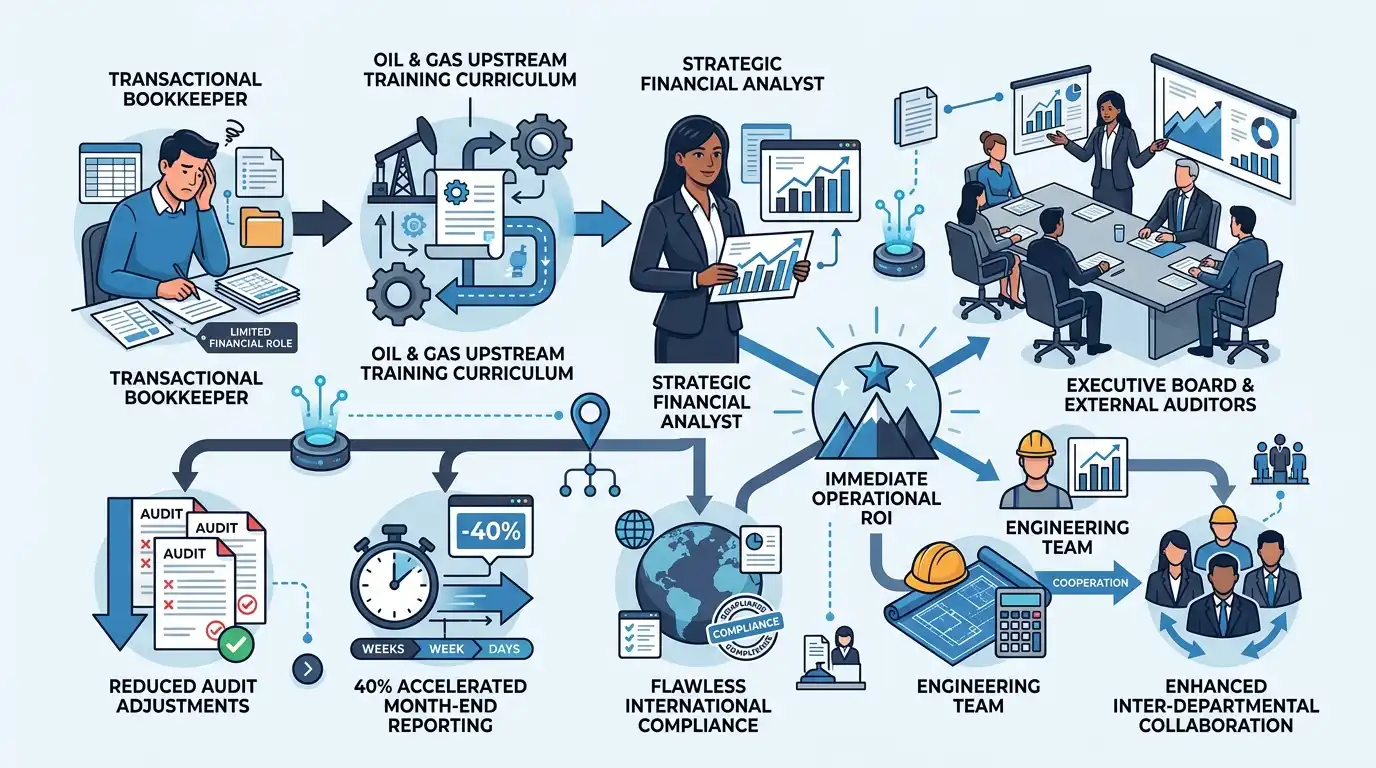
When finance teams complete training at Institute For Oil & Gas Training, the impact on organizational efficiency is immediate and quantifiable. In typical upstream environments, misclassified exploratory expenditures or inaccurate joint interest billings frequently trigger protracted disputes with joint venture partners and regulatory authorities. Armed with advanced technical mastery from this programme, accounting professionals identify and rectify calculation errors before they manifest in statutory reports, thereby safeguarding the organization's financial reputation.
Furthermore, corporate HR departments utilize completion of this curriculum as a benchmark for career progression and technical competency within finance pipelines. Mid-level accountants who master production-sharing contract cost recovery and unit-of-production depreciation are systematically positioned for promotion to senior accounting manager and controller roles. Institute For Oil & Gas Training equips these rising leaders with the analytical rigor required to manage complex capital budgets and evaluate high-stakes asset acquisitions.
The strategic return on investment extends beyond error reduction. Executives gain reliable, timely financial data that reflects the true economic standing of upstream assets, facilitating superior capital allocation decisions. By fostering a culture of technical excellence, Institute For Oil & Gas Training empowers energy organizations to navigate volatile commodity cycles with complete confidence in their financial reporting integrity.
How does the enrollment process, eligibility criteria, and professional certification pathway operate?
Enrollment in the programme requires a foundational background in corporate accounting, financial analysis, or upstream operational administration, validated through a streamlined online application and administrative review process. Institute For Oil & Gas Training manages candidate admissions through a structured enrollment protocol that evaluates professional experience, current organizational responsibilities, and sponsorship status. Successful completion culminates in an industry-recognized professional certificate that verifies advanced competency in upstream accounting methodologies.
The formal application and enrollment workflow administered by Institute For Oil & Gas Training follows a precise, transparent pathway designed for individual applicants and corporate HR sponsors:
Candidate Assessment and Eligibility Verification - Applicants submit professional credentials and current job descriptions to confirm alignment with target participant profiles, ensuring foundational knowledge in general ledger accounting.
Corporate Sponsorship or Individual Registration - Organizations submit institutional training purchase orders or individual candidates complete secure digital registration forms via the official portal.
Pre-Course Diagnostic Evaluation - Enrolled participants complete an online diagnostic assessment measuring baseline familiarity with financial terminology and basic accounting equations.
Programme Attendance and Practical Assessment - Participants complete all five technical modules, successfully passing practical modeling exams and continuous participation evaluations.
Certification and Continuing Professional Development - Graduates receive their formal designation from Institute For Oil & Gas Training, earning recognized continuing professional development credits to maintain professional accounting standing.
The administrative team at Institute For Oil & Gas Training provides dedicated support throughout the enrollment lifecycle, assisting corporate HR managers with group bookings, customized invoicing, and progress tracking.
To secure your organizational allocation or individual placement, you can apply for course access to initiate the professional registration review.
Frequently Asked Questions
What is oil and gas petroleum accounting?
Oil and gas petroleum accounting is a specialized branch of financial management that handles the unique costs and revenues associated with the exploration, development, and production of hydrocarbons. Practitioners at the Institute For Oil & Gas Training learn how to navigate complex regulatory frameworks like successful efforts and full cost accounting methods. This discipline ensures that upstream expenditures, joint interest billings, and asset retirement obligations are accurately recorded on corporate financial statements.
How do successful efforts and full cost accounting differ in upstream operations?
The successful efforts method requires companies to capitalize only the costs of successful exploratory wells, while writing off the costs of dry holes as expenses immediately. Conversely, the full cost method capitalizes all exploration and evaluation expenditures within a specific cost center, regardless of whether individual wells succeed or fail. Professionals mastering oil and gas petroleum accounting through the Institute For Oil & Gas Training must understand both treatments to ensure statutory compliance and transparent investor reporting.
Why is joint interest billing important in petroleum accounting?
Joint interest billing is the monthly invoicing process where the designated operator charges non-operating partners for their proportionate share of direct and indirect exploration and production costs. Accurate oil and gas petroleum accounting at the Institute For Oil & Gas Training equips finance teams to audit these complex billing statements and resolve cost-allocation disputes efficiently. This meticulous tracking prevents capital leakage and maintains harmonious financial cooperation among joint venture partners.
What are asset retirement obligations in oil and gas accounting?
Asset retirement obligations represent the legal liabilities associated with the eventual decommissioning of oil and gas assets, plugging wells, and restoring environmental sites at the end of their operational life. Accountants must calculate the present value of these future cash outflows and record them as capitalized asset costs alongside corresponding liabilities. Specialized programmes provided by the Institute For Oil & Gas Training guide finance personnel through the intricate discounting and accretion calculations required under international financial reporting standards.
How does unit-of-production depreciation apply to upstream assets?
Unit-of-production depreciation calculates asset write-offs based on the actual physical quantity of hydrocarbons extracted relative to the total estimated proved reserves of a field. This method ensures that capital infrastructure depreciation accurately mirrors the depletion rate of the underlying petroleum reserves over time. Corporate finance teams enrolled at the Institute For Oil & Gas Training utilize this technique to match operational expenses with production revenues correctly.
Related training courses
Ethics, Governance & Anti-Corruption: Frameworks & Codes Training Course
- Specialisation
- Oil & Gas Petroleum Compliance, AML & Risks
- Duration
- 5 days · 15 CPD hours
Decommissioning & Asset Retirement Obligations: Provision Recognition Training Course
- Specialisation
- Oil & Gas Petroleum IFRS & Financial Reporting
- Duration
- 5 days · 15 CPD hours
Financial Evaluation of Suppliers & Contractors: Tender Evaluation Training Course
- Specialisation
- Oil & Gas Petroleum Procurement
- Duration
- 5 days · 15 CPD hours
More articles

From Field Expenditure to Financial Reporting: The Accountant’s Role in Upstream Operations
Master upstream oil and gas accounting with our guide on field expenditures, joint operating agreements, financial reporting, and reporting standards.
Read article →
How Finance Teams Turn Upstream Operational Data into Financial Information
Learn how corporate finance teams translate upstream operational data into verified financial statements, improving audit compliance and reporting accuracy.
Read article →
Specialist Petroleum Industry Accounting Training: Who Benefits and What Skills It Develops
Explore our specialist petroleum accounting training program. Discover curriculum structure, joint-venture skills, delivery formats, and enrollment details.
Read article →