
Accountants working within upstream oil and gas operations operate at the critical intersection of physical field expenditure and regulatory financial reporting. They translate complex operational activities such as drilling, seismic surveying, and well completions into compliant financial statements that satisfy international accounting standards and stakeholders.
Understanding this workflow requires examining foundational principles, which are explored in detail within the introductory guide on How Finance Teams Turn Upstream Operational Data into Financial Information. This operational translation directly impacts corporate financial health, capital allocation, and statutory compliance across the energy sector.
How do upstream expenditures transform into financial statements?
Upstream expenditure transforms into financial statements through a rigorous accounting lifecycle that begins with capital and operating cost capture at the asset level, flows through joint venture billing and overhead allocations, and terminates in capitalized asset depreciation or immediate expense recognition.
The journey of a dollar spent in the oilfield starts with operational activities. Exploration and evaluation expenditures, development costs, and production expenses must be classified accurately under specific accounting frameworks. Under international standards such as IFRS 6, exploration and evaluation assets are recognized separately from development and production assets. Accountants evaluate each expenditure item to determine whether it provides future economic benefits. If an expense maintains production, it hits the income statement immediately as a lifting cost. If the expenditure extends reserves or drills a successful development well, the cost is capitalized on the balance sheet.
This classification relies heavily on close collaboration with operational engineers and project managers. Accountants interpret technical field logs, service company invoices, and production reports to assign costs to specific cost centers or Cost Pooling Areas (CPAs). Joint operating agreements (JOAs) further complicate this transformation. Non-operated ventures require accountants to review billing statements from the operator, verify partner shares, and record joint interest billings accurately. Once costs reside in the correct ledgers, depreciation, depletion, and amortization (DD&A) calculations convert capitalized assets into period expenses using units-of-production methods based on proven reserves.
Why does the successful application of the successful efforts and full cost methods matter?
The choice between the successful efforts method and the full cost method dictates how exploration risks affect corporate earnings volatility, balance sheet asset valuations, and investor perceptions of upstream financial performance.
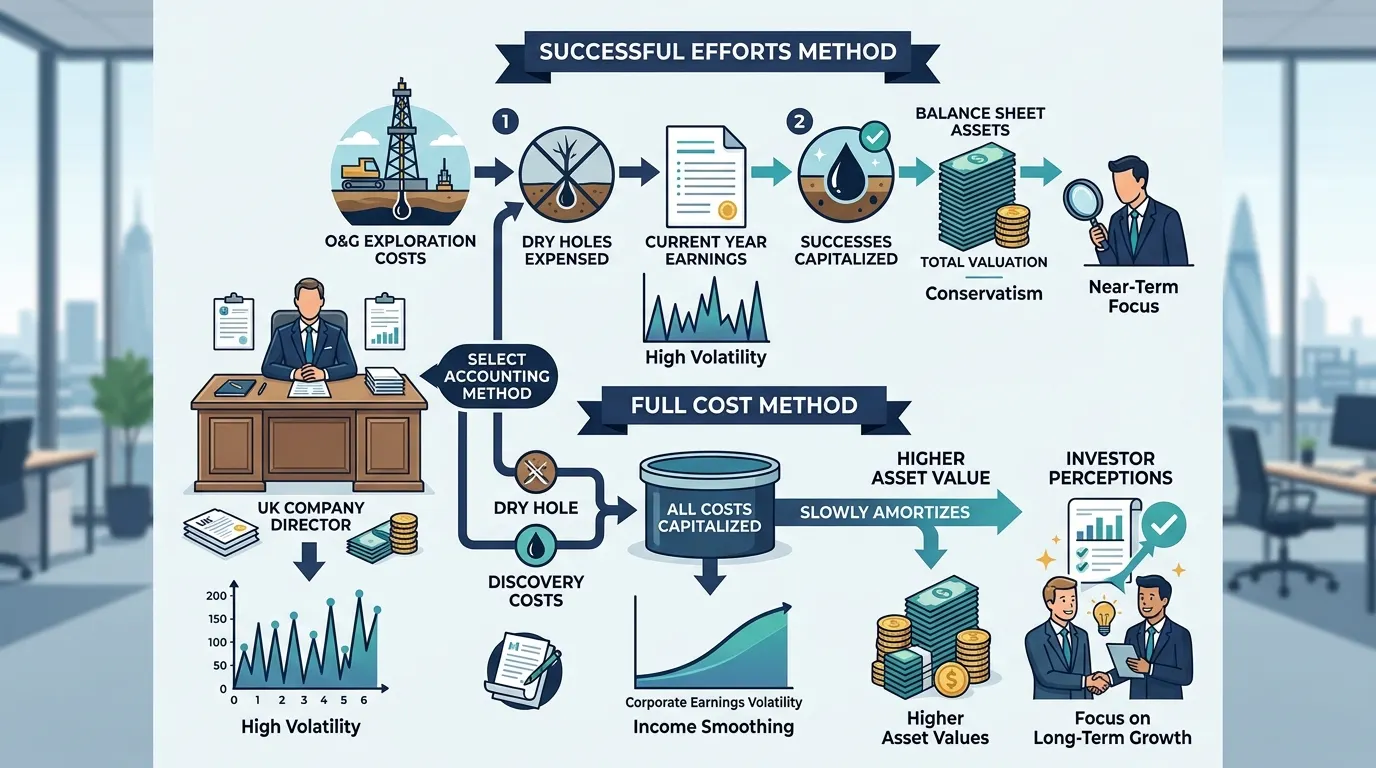
Upstream accounting utilizes two primary regulatory methods for handling exploration and dry hole costs. The successful efforts method requires companies to capitalize only the costs of successful exploratory wells and commercially viable discoveries. Dry holes and unsuccessful geological and geophysical surveys are expensed immediately as losses in the period they occur. This approach creates higher earnings volatility for exploration-heavy firms but provides a conservative, realistic view of asset value on the balance sheet.
Conversely, the full cost method allows companies to capitalize all exploration and development expenditures within a designated cost center, regardless of whether individual wells succeed or fail. Unsuccessful exploration costs pool together with successful finds and amortize over the total reserves of that country or region. This method smooths earnings volatility and appeals to smaller exploration and production (E&P) firms that require steady balance sheet metrics to secure debt financing.
Selecting the appropriate method influences tax liabilities, borrowing base calculations with commercial lenders, and compliance with securities regulators. Financial controllers must evaluate corporate strategy, risk appetite, and capital structure before committing to an accounting policy. Accountants manage this policy framework by maintaining robust ledger controls, auditing technical reserve reports from independent petroleum engineers, and ensuring consistent application across reporting periods to maintain audit readiness.
How do joint operating agreements complicate financial accounting and reporting?
Joint operating agreements complicate financial accounting by introducing multi-party cost sharing, complex overhead recoveries, net profit interests, and cash call mechanisms that require meticulous reconciliation across disparate accounting systems.
Upstream oil and gas projects require massive capital investments, prompting energy companies to form consortia and sign joint operating agreements to share financial risks. One partner acts as the operator, executing field activities, incurring expenses, and issuing monthly cash calls to non-operating partners for their respective working interest shares. Accountants at non-operator firms must audit these cash calls against authorized expenditures, joint venture billing statements, and the original authorization for expenditure (AFE) limits. Discrepancies trigger joint venture audits, requiring accountants to trace cost allocations down to individual vendor invoices and field service tickets.
Revenue distribution under JOAs follows entitlement methods rather than cash sales methods. Each partner is entitled to lift and sell a specific percentage of oil and gas production corresponding to their working interest. Accountants must reconcile equity liftings against actual sales volumes to calculate underlift and overlift positions at the reporting date. An underlift position occurs when a partner lifts less than their entitled share, creating a receivable asset, while an overlift position creates a liability. Managing these imbalances demands continuous coordination with marketing departments, pipeline operators, and tax authorities to ensure accurate revenue recognition and royalty distributions to host governments.
What methods ensure operational accuracy between field assets and financial ledgers?
Operational accuracy between field assets and financial ledgers is maintained through integrated enterprise resource planning systems, automated asset tagging, continuous inventory reconciliations, and rigorous AFE variance analysis.
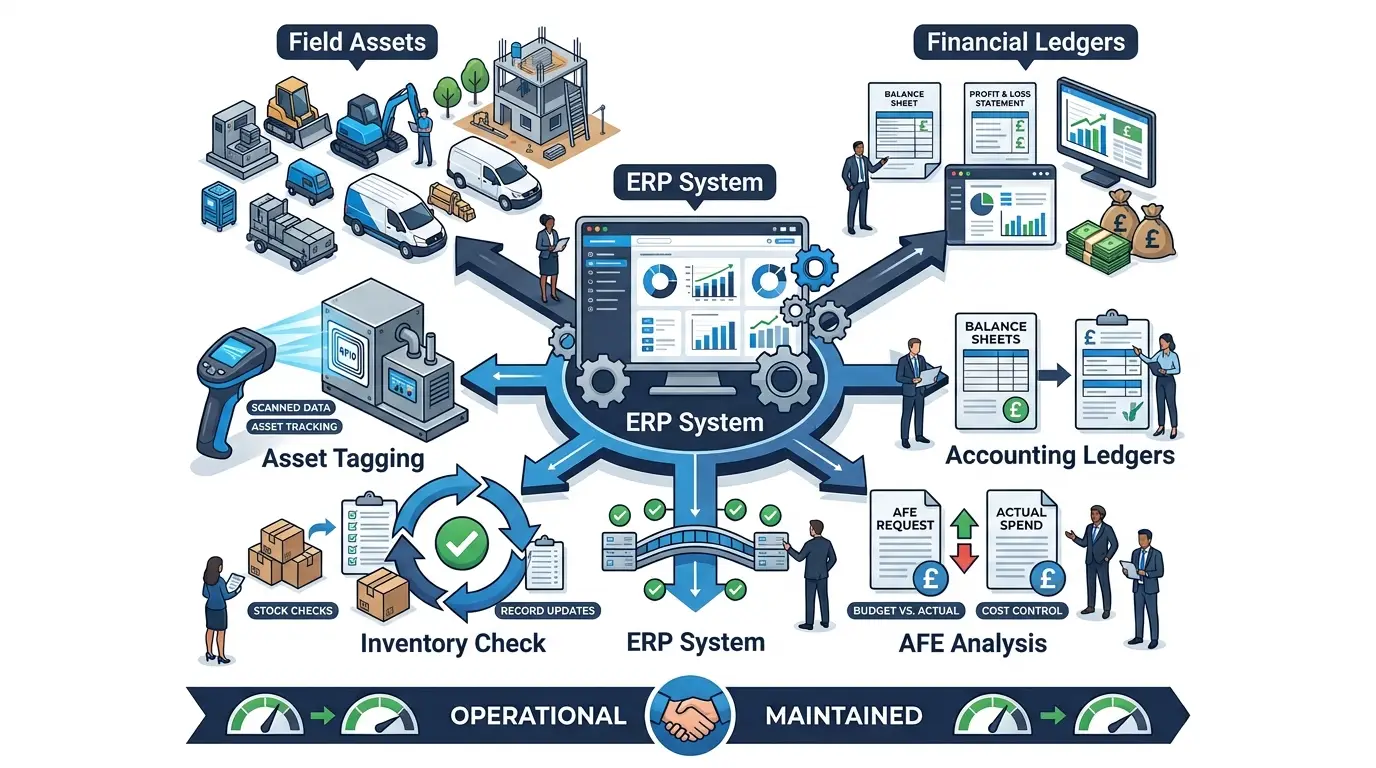
Bridging the physical oilfield and the corporate finance department requires robust internal controls and standardized data workflows. Traditional manual data entry between field tickets and financial software introduces errors that multiply across multi-million-dollar capital projects. Modern upstream finance teams deploy specialized enterprise resource planning (ERP) modules that link supply chain management, rig time tracking, and production accounting directly into the general ledger.
When materials arrive at a remote drilling site, field personnel log receipt via mobile asset management tools, triggering automated purchase order matching and inventory valuation. Accountants review daily drilling reports alongside financial commitments to monitor actual spend against authorized AFE budgets. If project costs exceed authorized thresholds by predetermined variance percentages, automated alerts require formal AFE supplements before further commitments occur.
Training finance personnel to master these integrated workflows is essential for modern energy organizations. To bridge workforce skill gaps and accelerate operational proficiency, HR and finance leaders utilize structured professional development pathways such as Petroleum Industry Accounting Fundamentals at Institute For Oil & Gas Training: Programme Focus and Professional Relevance to equip accountants with industry-specific competencies. This targeted skill acquisition directly reduces reporting cycle times and mitigates the risk of costly compliance errors during external audits.
How do production sharing contracts alter revenue recognition and tax accounting?
Production sharing contracts alter revenue recognition by granting host governments ownership of extracted hydrocarbons while compensating contractors with cost oil and profit oil allocations that require intricate fiscal modeling.
Unlike concessionary systems where companies own extracted resources and pay standard royalties and taxes, production sharing contracts (PSCs) establish a partnership between the host government and international oil companies. Under a PSC, the contractor funds all exploration and production risks. If a commercial discovery occurs, the contractor recovers operational and capital costs from a designated share of production volume, known as cost oil. The remaining production, termed profit oil, splits between the government and the contractor according to sliding scales tied to daily production rates or internal rates of return.
Accounting for PSCs demands specialized knowledge of entitlement revenues versus gross production volumes. Accountants do not record gross production revenue on the income statement; instead, they record only the contractor's net share of profit oil plus cost oil recovery. Furthermore, host governments often settle corporate income tax liabilities on behalf of the contractor out of the government's share of profit oil, creating complex gross-up calculations for financial reporting under IFRS and US GAAP. Accountants must model these fiscal terms accurately to report true net earnings and maintain compliance with anti-corruption regulations such as the Extractive Industries Transparency Initiative (EITI).
Frequently Asked Questions
What is oil and gas petroleum accounting in the upstream sector?
Oil and gas petroleum accounting involves tracking and reporting specialized financial transactions unique to the energy sector, including exploration outlays, joint operating agreements, and asset depreciation. Institute For Oil & Gas Training equips finance professionals with the skills needed to manage these complex upstream ledgers and ensure strict regulatory compliance.
How does the successful efforts method differ from full cost accounting?
The successful efforts method capitalizes only commercial discoveries and expenses dry holes immediately, whereas full cost accounting pools all exploration expenditures across a region regardless of success. Financial teams rely on targeted oil and gas petroleum accounting courses at Institute For Oil & Gas Training to master these distinct reporting methodologies and their impact on corporate balance sheets.
What role do accountants play in managing joint operating agreements?
Accountants oversee multi-party cost sharing, audit monthly cash calls, and reconcile joint venture billings against authorized expenditure limits. Professionals trained through Institute For Oil & Gas Training learn to navigate these intricate agreements to prevent revenue leakages and resolve inter-company discrepancies efficiently.
Why is specialized training important for energy sector accountants?
Standard corporate accounting frameworks do not cover complex energy-specific mechanisms like production sharing contracts, DD&A calculations, and reserve-based valuations. Specialized programs in oil and gas petroleum accounting from Institute For Oil & Gas Training bridge critical workforce skill gaps by delivering practical, industry-aligned education for finance teams.
How do production sharing contracts impact financial reporting?
Production sharing contracts require accountants to manage cost oil recovery limits and profit oil splits rather than recording standard concessionary revenues. Through targeted training at Institute For Oil & Gas Training, energy accountants learn to accurately model these fiscal terms to meet international financial reporting standards.
Related training courses
Month-End Close Process Design: Accruals & Reconciliations Training Course
- Specialisation
- Oil & Gas Petroleum Accounting
- Duration
- 5 days · 15 CPD hours
Ethics, Governance & Anti-Corruption: Frameworks & Codes Training Course
- Specialisation
- Oil & Gas Petroleum Compliance, AML & Risks
- Duration
- 5 days · 15 CPD hours
Cash Calls, AFEs & Work Program/Budget Control: Preparation Training Course
- Specialisation
- Oil & Gas Petroleum Budgeting & Cost Control
- Duration
- 5 days · 15 CPD hours
More articles

Petroleum Industry Accounting Fundamentals at Institute For Oil & Gas Training: Programme Focus and Professional Relevance
Master upstream financial reporting and cost control. Enroll in Petroleum Industry Accounting Fundamentals at Institute For Oil & Gas Training.
Read article →
How Finance Teams Turn Upstream Operational Data into Financial Information
Learn how corporate finance teams translate upstream operational data into verified financial statements, improving audit compliance and reporting accuracy.
Read article →
Specialist Petroleum Industry Accounting Training: Who Benefits and What Skills It Develops
Explore our specialist petroleum accounting training program. Discover curriculum structure, joint-venture skills, delivery formats, and enrollment details.
Read article →