
Upstream data translation is the professional corporate finance competency that converts raw operational field measurements, such as wellhead volumes, drilling metrics, and rig hours, into verified general ledger accounts and financial statements.
This discipline sits at the intersection of petroleum engineering and corporate accounting. In modern energy enterprises, field operations generate millions of data points every second. Accountants and finance professionals must ingest, validate, and classify these measurements to comply with International Financial Reporting Standards and US GAAP. Without this structured translation, executive leadership operates without financial visibility into capital expenditures, production costs, and asset retirement obligations.
Workforce development initiatives in this domain focus on eliminating communication silos between field engineers and corporate controllers. Organizations invest in professional training programs to build cross-functional competencies. Employees learn to map meter readings and drilling logs directly to cost centers, asset accounts, and liability ledgers. This alignment ensures that every barrel of oil equivalent produced maps accurately to revenue recognition schedules and depletion calculations.
Corporations face severe risks when this translation process fails. Inaccurate field data leads to material misstatements in quarterly financial reports, regulatory penalties, and erroneous capital allocation decisions. Training programs address these operational vulnerabilities through rigorous curriculum design. Teams master joint venture accounting, production sharing contracts, and cost-pooling methods. The resulting capability empowers finance professionals to defend financial audits with verifiable operational trails.
How Does the Upstream Financial Translation Process Work in Organizations?
The upstream financial translation process operates through a structured four-stage corporate workflow that ingests field telemetry, validates operational logs, maps expenses to general ledgers, and generates audited financial statements.
Organizations execute this process through standardized standard operating procedures and cross-functional handoffs. The workflow begins at the asset level where supervisory control and data acquisition systems record physical metrics. Field supervisors review these logs daily to verify operational integrity. Accountants then ingest these electronic logs into enterprise resource planning platforms.
Corporate training methodologies incorporate case-based learning, scenario simulations, and role-playing exercises to teach this workflow. Employees practice reconciling discrepancies between physical gauge measurements and vendor invoices. Organizations deliver these programs through a hybrid blend of instructor-led workshops, online technical modules, and on-the-job mentorship.
Implementation requires defined performance metrics to track proficiency acquisition. Learning and development teams measure success through key performance indicators such as reconciliation cycle time, error reduction rates in ledger entries, and audit compliance scores. Teams achieve a 35% reduction in month-end close duration after completing structured financial translation programs. Leadership teams utilize these efficiency gains to accelerate strategic decision-making and reduce operational overhead.
What Key Components Drive Effective Upstream Financial Training Programs?
Effective upstream financial training programs incorporate technical accounting frameworks, specialized ERP software modules, cross-functional communication methodologies, and rigorous assessment matrices.
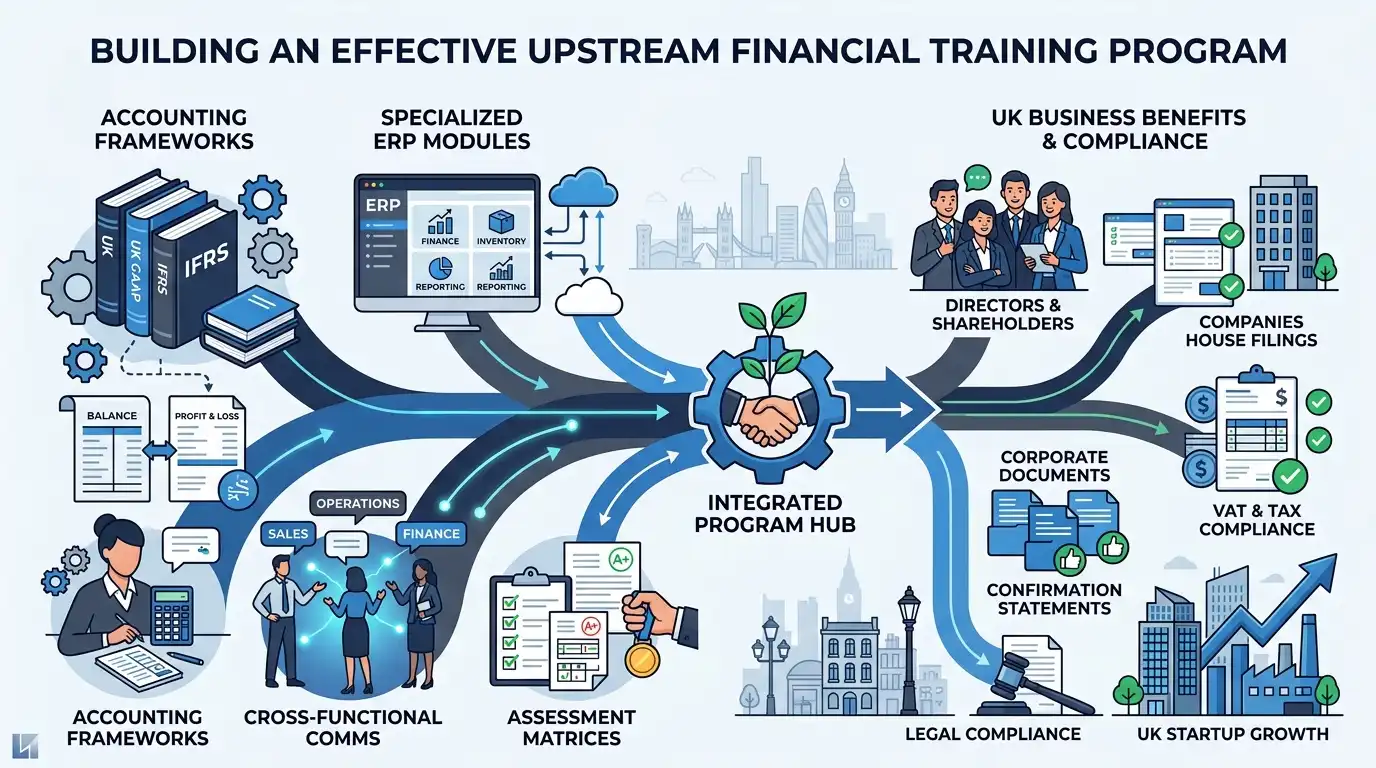
Curriculum architects build these programs around industry-recognized standards such as the Society of Petroleum Engineers petroleum resource management system and complex accounting rules for extractive activities. Learners study specific frameworks including successful efforts accounting and full cost accounting methods. These methodologies dictate how exploration expenses, dry hole costs, and acquisition outlays appear on corporate balance sheets.
Software competency forms another critical pillar of corporate training strategies. Professionals train on enterprise resource planning platforms like SAP IS-OIL and Oracle Enterprise Performance Management. Training delivery formats combine 40 hours of intensive classroom instruction with 60 hours of practical system simulations.
Training Component | Delivery Format | Core Focus Area |
Accounting Frameworks | Instructor-led Workshops | Successful Efforts vs. Full Cost Accounting |
ERP System Proficiency | Hands-on Simulations | SAP IS-OIL and Production Ledger Entry |
Cross-Functional Communication | Role-playing Exercises | Bridging Field Engineering and Finance Teams |
Continuous Assessment | Digital Quizzes & Audits | Regulatory Compliance and Error Reduction |
Organizations utilize formative and summative assessments to evaluate skill mastery. Trainees complete simulated audit challenges where they identify misallocated capital expenditures and correct faulty depletion schedules. This practical approach ensures that participants transfer classroom concepts directly into their daily responsibilities. The integration of technical depth and operational context produces well-rounded finance professionals capable of managing complex upstream assets.
What Measurable Benefits Do Organizations Gain from Upstream Finance Upskilling?
Organizations gain measurable benefits from upstream finance upskilling through accelerated month-end closes, reduced financial audit adjustments, improved capital allocation accuracy, and enhanced employee retention rates.
When finance teams master the translation of operational data into financial statements, corporate performance metrics improve across the board. Companies report a 40% decrease in external audit fees due to cleaner documentation and fewer compliance discrepancies. Team efficiency surges as accountants eliminate manual data entry errors and automate routine reconciliations.
Employee retention rates increase by 25% within specialized finance departments after the introduction of structured professional development pathways. Staff members experience higher job satisfaction when equipped with the exact technical skills required for complex upstream accounting tasks. Furthermore, leadership pipelines strengthen as mid-level accountants transition into strategic advisory roles.
Decision-makers utilize these performance improvements to justify continuous learning budgets. Upskilling initiatives transform finance departments from reactive bookkeeping units into proactive strategic business partners. Organizations achieve sustainable competitive advantages by maintaining absolute financial transparency across all exploration and production assets.
How Do Corporate Teams and Industries Implement These Training Frameworks?
Corporate teams implement upstream financial training frameworks through phased departmental rollouts, customized competency assessments, and continuous performance monitoring systems.
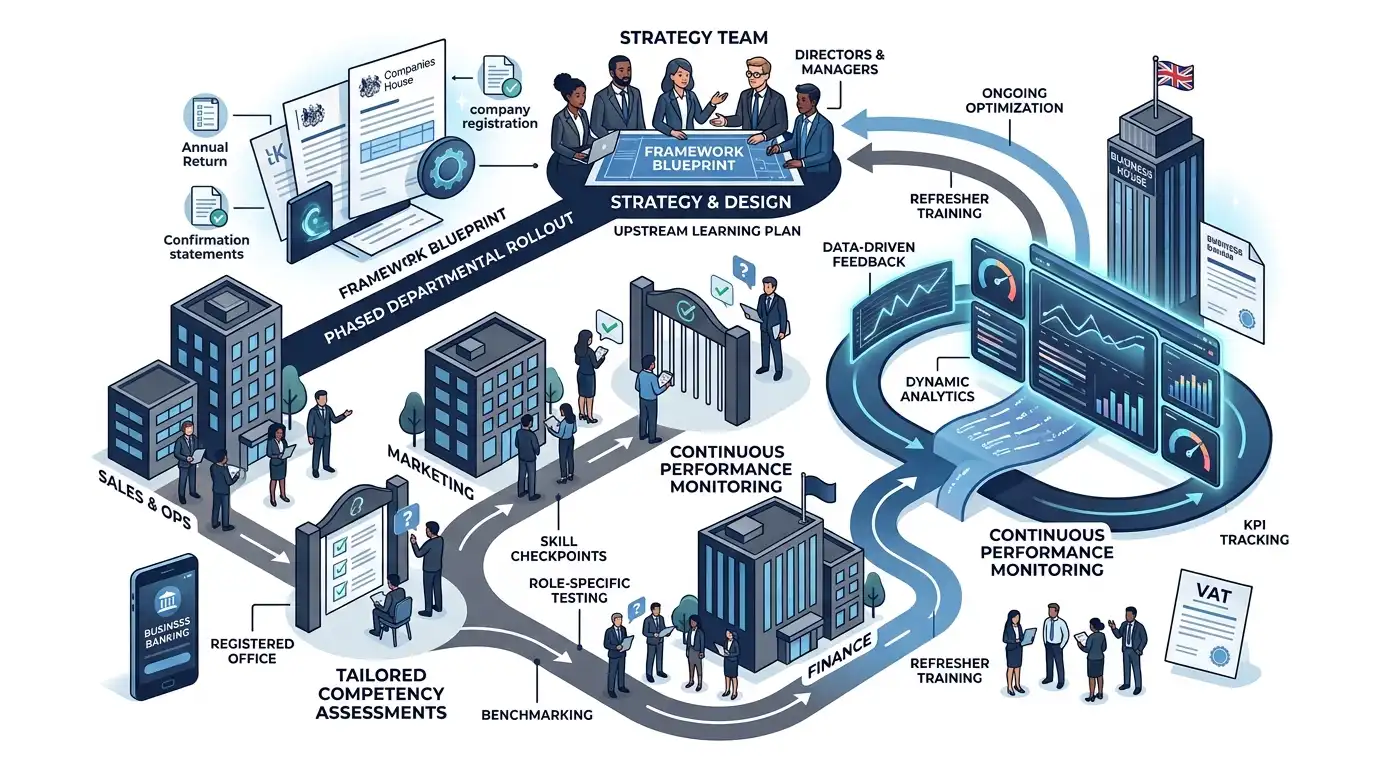
Enterprise deployment begins with a comprehensive skills gap analysis across accounting, internal audit, and operational engineering departments. Human resources managers collaborate with senior controllers to design targeted learning paths for different organizational tiers. Junior accountants focus on transactional ledger entries, while senior managers study strategic cost management and joint venture auditing.
Industries with complex asset management profiles, such as upstream oil and gas enterprises, mining conglomerates, and utility infrastructure providers, deploy these frameworks to standardize financial reporting. Companies establish internal academies that deliver blended learning experiences over 12-week intervals.
Continuous feedback loops ensure that training content evolves alongside shifting regulatory landscapes and emerging digital technologies. Organizations deploy digital learning management systems to track course completion rates, assessment scores, and practical application milestones. This disciplined execution guarantees that workforce capabilities align perfectly with overarching corporate growth strategies.
What Common Problems and Misconceptions Undermine Upstream Training Initiatives?
Common problems that undermine upstream training initiatives include reliance on generic accounting courses, absence of practical operational context, failure to measure return on investment, and lack of executive sponsorship.
Many organizations commit the error of purchasing off-the-shelf financial training packages that ignore the unique operational realities of upstream assets. Accountants cannot master complex concepts like production sharing contracts or unit-of-production depreciation through generic corporate finance modules. Training programs must integrate actual field engineering data to achieve true educational impact.
Another major misconception is that professional development is a one-time event rather than an ongoing continuous improvement cycle. Companies launch isolated workshops without establishing follow-up mentorship or post-training performance evaluations. Consequently, employees revert to old habits within weeks of completing the program.
Decision-makers must mandate rigorous evaluation metrics to verify training effectiveness. Programs that fail to link skill acquisition to business KPIs like reduced reporting errors or faster audit cycles waste valuable corporate resources. Successful workforce transformation requires deliberate design, active leadership involvement, and a commitment to measuring tangible organizational outcomes.
Frequently Asked Questions
What is oil and gas petroleum accounting?
Oil and gas petroleum accounting is a specialized branch of financial management that handles the unique costs associated with exploring, developing, and producing hydrocarbon reserves. At the Institute For Oil & Gas Training, professionals learn how to manage complex financial transactions, including joint interest billings, conveyance agreements, and asset retirement obligations. This discipline ensures compliance with international regulatory frameworks while providing accurate financial visibility into upstream operations.
How does successful efforts accounting differ from full cost accounting?
Successful efforts accounting requires companies to capitalize exploration costs only when they find proven reserves, whereas unsuccessful drilling costs are immediately expensed as dry holes. In contrast, full cost accounting allows firms to pool all acquisition, exploration, and development costs within a specific geographic cost center regardless of discovery success. The Institute For Oil & Gas Training equips finance teams with the technical skills to navigate both accounting methods according to corporate strategy and regulatory standards.
What is the role of joint interest accounting in the energy sector?
Joint interest accounting governs how multiple partners share costs, revenues, and liabilities associated with a specific oil and gas exploration project or lease. Accountants must accurately allocate joint expenses, issue joint interest billings, and verify that all non-operating partners pay their proportionate share. Training programs at the Institute For Oil & Gas Training help accounting teams master these complex operational agreements to minimize partner disputes and financial leakage.
How are depletion, depreciation, and amortization calculated in upstream operations?
Depletion, depreciation, and amortization in the petroleum sector are calculated using the unit-of-production method, which relates capital asset costs directly to the physical extraction of oil and gas reserves. Accountants divide the capitalized cost of an asset by estimated remaining recoverable reserves and multiply that figure by current period production volume. The Institute For Oil & Gas Training provides practical modules to help finance professionals execute these precise depletion calculations without reporting errors.
Why is specialized petroleum accounting training essential for corporate finance teams?
Specialized petroleum accounting training is essential because standard corporate accounting frameworks do not account for unique industry challenges like production sharing contracts, complex royalties, and field decommissioning liabilities. Upskilling finance personnel ensures accurate financial reporting, reduces external audit adjustments, and streamlines month-end close cycles. Through programs at the Institute For Oil & Gas Training, organizations transform their finance departments into strategic partners capable of managing high-stakes upstream assets.
Related training courses
Ethics, Governance & Anti-Corruption: Frameworks & Codes Training Course
- Specialisation
- Oil & Gas Petroleum Compliance, AML & Risks
- Duration
- 5 days · 15 CPD hours
Financial Evaluation of Suppliers & Contractors: Tender Evaluation Training Course
- Specialisation
- Oil & Gas Petroleum Procurement
- Duration
- 5 days · 15 CPD hours
Cash Calls, AFEs & Work Program/Budget Control: Preparation Training Course
- Specialisation
- Oil & Gas Petroleum Budgeting & Cost Control
- Duration
- 5 days · 15 CPD hours
More articles
Petroleum Industry Accounting Fundamentals at Institute For Oil & Gas Training: Programme Focus and Professional Relevance
Master upstream financial reporting and cost control. Enroll in Petroleum Industry Accounting Fundamentals at Institute For Oil & Gas Training.
Read article →
From Field Expenditure to Financial Reporting: The Accountant’s Role in Upstream Operations
Master upstream oil and gas accounting with our guide on field expenditures, joint operating agreements, financial reporting, and reporting standards.
Read article →
Specialist Petroleum Industry Accounting Training: Who Benefits and What Skills It Develops
Explore our specialist petroleum accounting training program. Discover curriculum structure, joint-venture skills, delivery formats, and enrollment details.
Read article →