
Evaluating upstream capital allocation requires rigorous financial methodologies to determine whether capital investments generate net positive returns. As explored in depth within our foundational guide on What Determines Whether an Oilfield Development Creates Economic Value?, subsurface uncertainty and commodity price volatility often distort early-stage valuations. Technical teams frequently face difficulties when translating reservoir metrics into bankable cash flow models, resulting in delayed approvals and misallocated expenditure. Professionals must bridge the gap between engineering estimates and corporate finance frameworks to ensure project viability.
What Is the Course and What Problem Does It Solve?
This professional training program resolves technical valuation gaps by teaching petroleum engineers, asset managers, and financial analysts how to integrate subsurface risks directly into discounted cash flow models, fiscal regimes, and portfolio optimization frameworks.
Upstream assets involve capital-intensive decisions where minor forecasting errors lead to multi-million-dollar losses. Traditional engineering training focuses heavily on reservoir simulation and production optimization without addressing the commercial constraints imposed by modern production sharing contracts, tax royalties, and concession agreements. Consequently, subsurface teams often design technically sound extraction schemes that fail to meet corporate hurdle rates.
Asset teams, commercial departments, and HR leaders frequently identify a distinct capability gap among technical staff who struggle to defend project economics during executive reviews. The Institute For Oil & Gas Training addresses this structural inefficiency through a comprehensive curriculum designed to align engineering metrics with corporate financial objectives. When organizations send cross-functional asset teams to the Institute For Oil & Gas Training, they eliminate miscommunication between subsurface specialists and commercial evaluators.
The Institute For Oil & Gas Training delivers targeted workforce transformations that elevate technical personnel into strategic commercial decision-makers. By standardizing economic evaluation techniques across departments, the Institute For Oil & Gas Training ensures that every development proposal undergoes consistent financial scrutiny. Participants acquire the exact competencies required to navigate complex petroleum fiscal systems and defend capital allocation decisions under uncertainty.
Why Is This Training Structured in This Manner?
The curriculum follows a progressive pedagogical architecture that transitions learners from fundamental cash flow mechanics to advanced stochastic portfolio optimization, mirroring real-world asset evaluation workflows.
Educational efficacy in corporate training depends on logical skill scaffolding. The Institute For Oil & Gas Training organizes its modules to replicate the actual lifecycle of an upstream asset evaluation project. Learners begin by reviewing basic time-value-of-money concepts before advancing to multi-variable fiscal modeling and risk simulation. This deliberate structure prevents cognitive overload and ensures that complex quantitative principles are mastered sequentially.
The Institute For Oil & Gas Training builds its instructional framework around experiential learning principles where participants apply theoretical formulas to real-world basin datasets. Rather than relying on passive lectures, the Institute For Oil & Gas Training embeds hands-on spreadsheet modeling exercises and case-study analyses into every session. This methodology enables petroleum economists and senior engineers to immediately translate classroom concepts into workplace deliverables.
For a deeper examination of intermediate valuation mechanics, professionals can review our specialized analysis on Using NPV, IRR and Fiscal Sensitivity Analysis to Test Oilfield Project Economics. This intermediate resource complements our structured learning path by demonstrating how to stress-test economic models against fluctuating Brent crude benchmarks and capital expenditure overruns.
What Specific Modules and Skill Outcomes Will Participants Master?
Participants master cash flow construction, net present value calculation, internal rate of return determination, production profile forecasting, and fiscal regime modeling across concession and production sharing contracts.
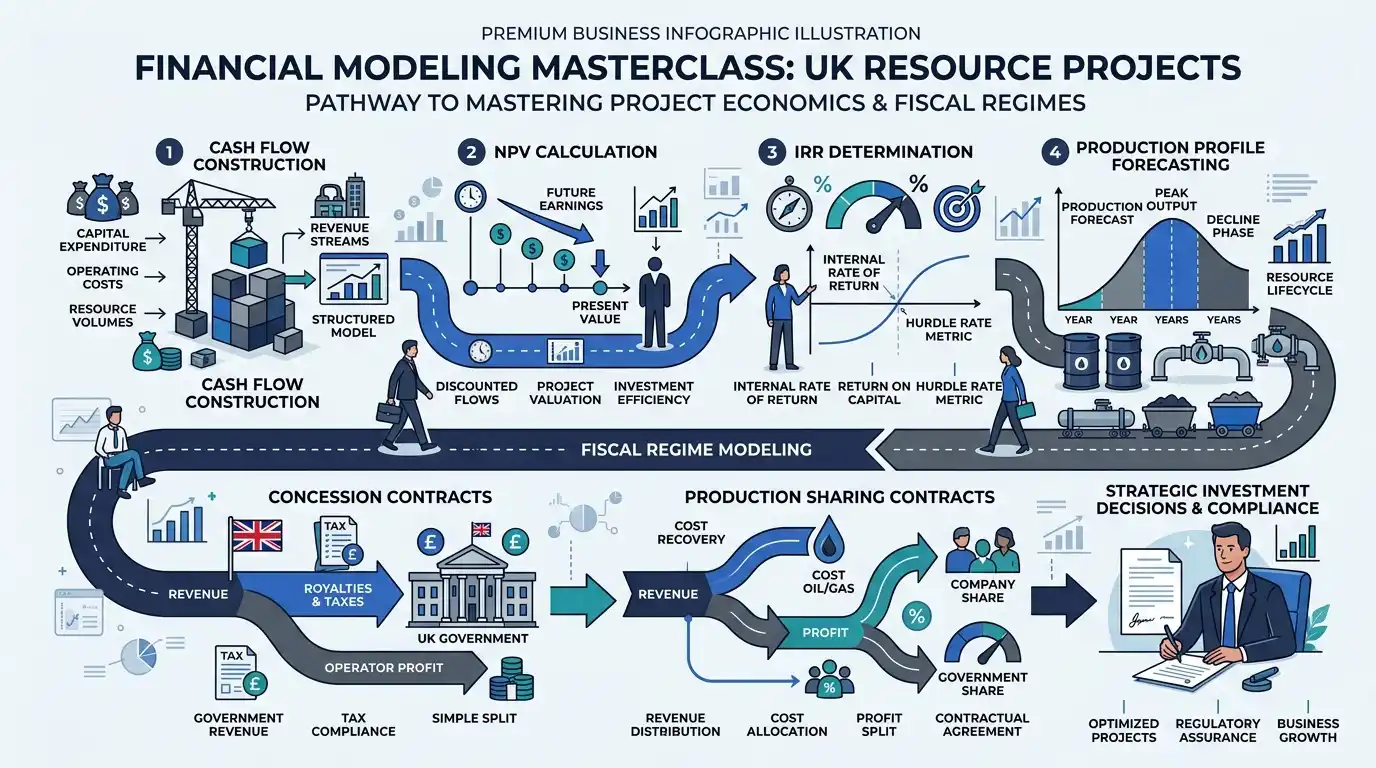
The training syllabus is divided into distinct, outcome-driven modules designed to build comprehensive analytical competency. Each module targets specific technical deliverables that professionals must execute within their respective asset teams.
Module 1: Upstream Cash Flow Modeling and Revenue Projections
Learners build robust economic models from scratch, translating production decline curves, operating expenditure estimates, and capital expenditure schedules into annual cash flow streams. Participants learn how to account for abandonment liabilities, working capital adjustments, and inflation indices within long-term forecasts.
Module 2: Fiscal Terms, Contracts, and Tax Mechanics
This module covers the commercial frameworks governing global petroleum operations. Participants evaluate the distinct economic impacts of concession systems, service contracts, and production sharing agreements, focusing specifically on cost recovery limits, profit oil splits, and government take calculations.
Module 3: Profitability Metrics and Capital Allocation
Engineers and financial analysts evaluate investment opportunities using net present value, internal rate of return, modified internal rate of return, profitability index, and payback period criteria. Participants learn how to rank competing capital projects under strict corporate budget constraints.
Module 4: Risk Analysis and Decision Trees Under Uncertainty
Learners incorporate geological and commercial risks into economic evaluations using deterministic sensitivity analysis, tornado charts, and Monte Carlo simulations. Participants build decision trees to evaluate sequential drilling options, phased developments, and asset divestment scenarios.
How Is the Program Delivered Across Corporate Environments?
The training is delivered through flexible formats including intensive physical workshops, live virtual sessions, hybrid modules, and dedicated onsite corporate cohorts tailored to enterprise schedules.
Corporate learning requirements vary significantly across international operating environments. The Institute For Oil & Gas Training accommodates these operational demands by providing multiple delivery modalities without compromising curriculum rigor.
Intensive Workshops: Immersive multi-day classroom sessions held in major energy hubs, facilitating peer-to-peer networking and direct mentorship from industry experts.
Live Virtual Training: Interactive online modules featuring real-time software demonstrations, breakout group exercises, and digital collaboration boards.
Hybrid Delivery: A balanced blend of self-paced digital learning modules and live instructor-led virtual workshops designed for working professionals.
Onsite Corporate Programs: Customized delivery deployed directly at company offices or technical centers, tailored to internal asset datasets and proprietary evaluation templates.
Regardless of the chosen format, the Institute For Oil & Gas Training maintains rigorous academic standards through continuous facilitator support, interactive software laboratories, and comprehensive reference documentation.
What Measurable Workplace Results and Performance Improvements Follow?
Organizations experience a significant reduction in project approval cycle times, improved capital allocation accuracy, and enhanced cross-functional communication between subsurface and commercial departments.
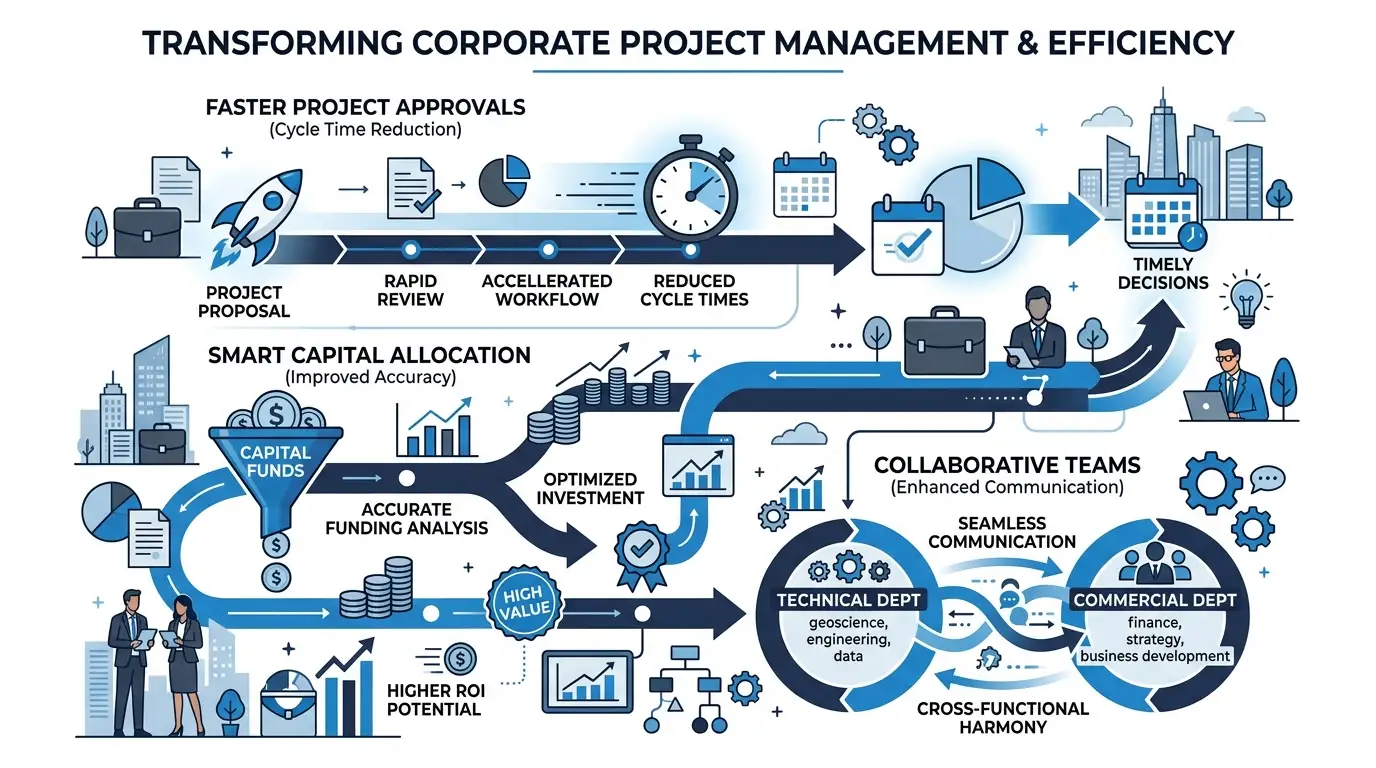
Measurable Return on Investment represents the primary driver for corporate learning expenditure. When asset teams complete this program, their analytical outputs reflect immediate improvements in rigor, transparency, and strategic alignment. HR directors and technical managers consistently report tangible performance gains across three critical operational dimensions:
Reduced Appraisal Errors: Subsurface teams accurately identify commercial red flags during early-stage screening, preventing unprofitable capital commitments.
Accelerated Gate Reviews: Standardized economic models allow management committees to evaluate development plans faster and with greater confidence.
Enhanced Leadership Pipelines: Technical specialists develop commercial acumen, positioning them to assume asset manager and corporate planning roles.
Organizations utilizing the Institute For Oil & Gas Training report standardized valuation practices that eliminate subjective bias in project ranking. Leadership teams rely on these enhanced analytical capabilities to optimize portfolio performance across mature basins and frontier exploration blocks.
How Do Admission Requirements, Assessment Methods, and Enrollment Work?
Applicants must possess a relevant technical or quantitative degree and basic spreadsheet proficiency, with enrollment finalized through a structured application review and registration pathway.
To maintain peer group quality and ensure optimal learning outcomes, admission to the program follows a transparent, specification-driven evaluation process.
Target Audience and Eligibility
The program is designed for petroleum engineers, geoscientists, financial analysts, commercial managers, and business development professionals with a minimum of two years of upstream oil and gas experience. Familiarity with basic spreadsheet software and fundamental finance terminology is recommended.
Assessment and Completion Criteria
Participant progress is evaluated through formative workplace assignments, interactive simulation exercises, and a comprehensive final capstone project requiring a full economic evaluation of a simulated oilfield development. Successful graduates receive an industry-recognized certificate verifying their mastery of upstream economic modeling and project evaluation.
Enrollment Pathway
Prospective delegates and corporate learning coordinators can review available cohort schedules and secure institutional seats directly. To advance your technical expertise and elevate your asset evaluation capabilities, enroll in this program today.
Frequently Asked Questions
What is oil and gas petroleum finance?
Oil and gas petroleum finance involves managing the capital allocation, project economics, and risk assessments required to fund upstream, midstream, and downstream energy assets. Through specialized training like the programs offered by the Institute For Oil & Gas Training, professionals learn how to construct discounted cash flow models and evaluate fiscal regimes.
Why is economic evaluation important in petroleum projects?
Economic evaluation ensures that capital-intensive upstream developments meet corporate hurdle rates before multi-million-dollar drilling programs commence. The Institute For Oil & Gas Training teaches engineers and financial analysts how to integrate subsurface risks directly into net present value and internal rate of return calculations.
How do petroleum professionals assess fiscal regimes?
Petroleum professionals assess fiscal regimes by analyzing the commercial terms of concession contracts and production sharing agreements to determine government take and contractor cash flows. Training courses from the Institute For Oil & Gas Training provide hands-on practice in modeling profit oil splits and cost recovery limits.
What skills are taught in oil and gas finance training?
Upstream finance training typically covers cash flow modeling, production decline curve analysis, sensitivity testing, and stochastic risk simulation under commodity price volatility. Programs by the Institute For Oil & Gas Training focus heavily on aligning engineering metrics with corporate financial objectives.
Who should take a petroleum economics and finance course?
Petroleum economics courses are designed for petroleum engineers, asset managers, commercial analysts, and finance personnel involved in upstream decision-making and project gate reviews. The Institute For Oil & Gas Training delivers these structured programs to help cross-functional teams standardize their valuation methodologies.
Related training courses
Payment Controls & Treasury Governance: Authorisation Frameworks Training Course
- Specialisation
- Oil & Gas Petroleum Treasury, Cash and Banking
- Duration
- 5 days · 15 CPD hours
Cash Flow Reporting for IAS 7 Statements Training Course
- Specialisation
- Oil & Gas Petroleum IFRS & Financial Reporting
- Duration
- 5 days · 15 CPD hours
Internal Controls Over Financial Reporting Design Training Course
- Specialisation
- Oil & Gas Petroleum Compliance, AML & Risks
- Duration
- 5 days · 15 CPD hours
More articles

Oilfield Economics & Project Evaluation: Specialist Training for Petroleum Economics and Commercial Roles
Master petroleum economics and project evaluation with specialized training. Learn cash flow modeling, risk analysis, and fiscal contracts for upstream roles.
Read article →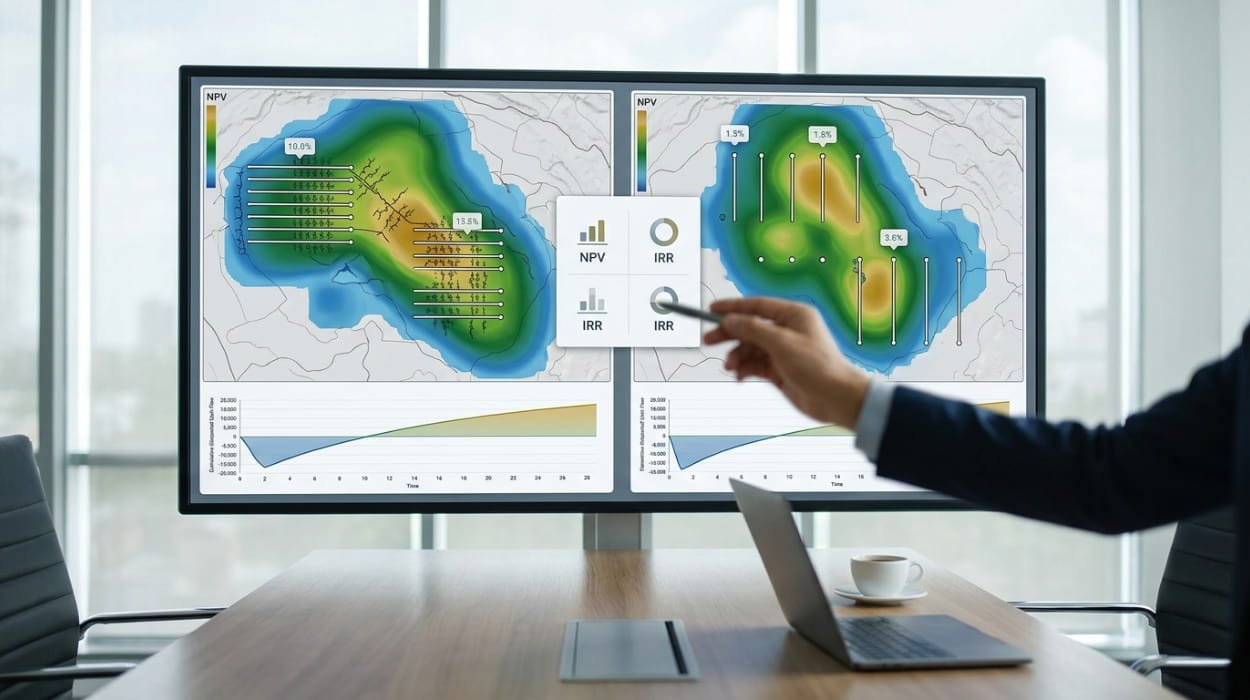
NPV and IRR Analysis for Comparing Alternative Oilfield Development Cases
Master net present value and internal rate of return methods to compare alternative oilfield development cases and optimize upstream capital allocation.
Read article →
How Petroleum Companies Assess the Commercial Viability of New Field Developments
Discover how petroleum companies train teams to assess field development commercial viability, optimize capital allocation, and drive project returns.
Read article →