
Oilfield Economics & Project Evaluation Specialist Training is an advanced corporate education program designed to resolve critical commercial competency deficits in upstream oil and gas operations by providing rigorous training in cash flow modeling, risk quantification, and capital allocation frameworks.
Organizations operating within the upstream petroleum sector frequently encounter significant capital misallocation due to a widespread knowledge gap between technical subsurface teams and commercial decision-makers. When petroleum engineers, asset managers, and financial analysts fail to align their economic evaluations with macroeconomic volatility and fiscal regime constraints, capital expenditure decisions result in delayed project delivery, suboptimal asset valuation, and eroded shareholder value. Traditional academic curricula often lack practical calibration to real-world fiscal regimes, production-sharing contracts, and risk-adjusted return metrics, leaving corporate teams ill-equipped to evaluate complex field development alternatives accurately.
To bridge this competence gap, Institute For Oil & Gas Training delivers specialized training methodologies developed specifically for corporate entities and ambitious professionals. As petroleum companies assess the commercial viability of new field developments, foundational understanding is best established by reviewing how asset teams evaluate initial economic feasibility, which is detailed further in How Petroleum Companies Assess the Commercial Viability of New Field Developments. Commercial petroleum economics requires cross-functional synergy between finance departments, asset evaluation teams, and technical specialists who must translate subsurface reservoir characteristics into reliable monetary projections. Without targeted professional development, internal departments struggle to defend capital expenditure proposals against rigorous corporate hurdle rates and fluctuating commodity price decks.
Why is this curriculum structured around sequential commercial milestones?
The curriculum structure is engineered around sequential commercial milestones to transition participants systematically from fundamental cash flow arithmetic to advanced stochastic risk modeling, ensuring absolute alignment with international petroleum fiscal frameworks.
The structural logic of Institute For Oil & Gas Training programs rejects fragmented modular learning in favor of a cumulative skill progression model. Each phase of the training architecture builds directly upon preceding analytical concepts, mirroring the actual lifecycle of an upstream oil and gas asset from initial exploration licensing through to final field abandonment. To evaluate alternative development cases effectively using intermediate financial metrics, corporate teams frequently analyze capital budgeting decisions through NPV and IRR Analysis for Comparing Alternative Oilfield Development Cases, which forms a vital bridge toward advanced decision-tree modeling.
The learning progression begins with baseline cost estimation and production profile forecasting before advancing into complex fiscal regime mechanics, such as concession systems and production-sharing contracts. By anchoring every theoretical concept in practical industry case studies, Institute For Oil & Gas Training ensures that participants comprehend not merely the formulaic application of financial equations, but the strategic commercial rationale governing upstream investment decisions. This deliberate instructional architecture enables cross-functional teams, including HR professionals designing internal talent pathways and technical managers overseeing asset evaluation, to absorb complex regulatory and fiscal nuances without cognitive overload.
What specific competencies and modular learning outcomes will participants achieve?
Participants achieve mastery in deterministic and probabilistic cash flow modeling, fiscal contract analysis, decision-tree risk mapping, and capital rationing optimization tailored to modern upstream oil and gas operations.
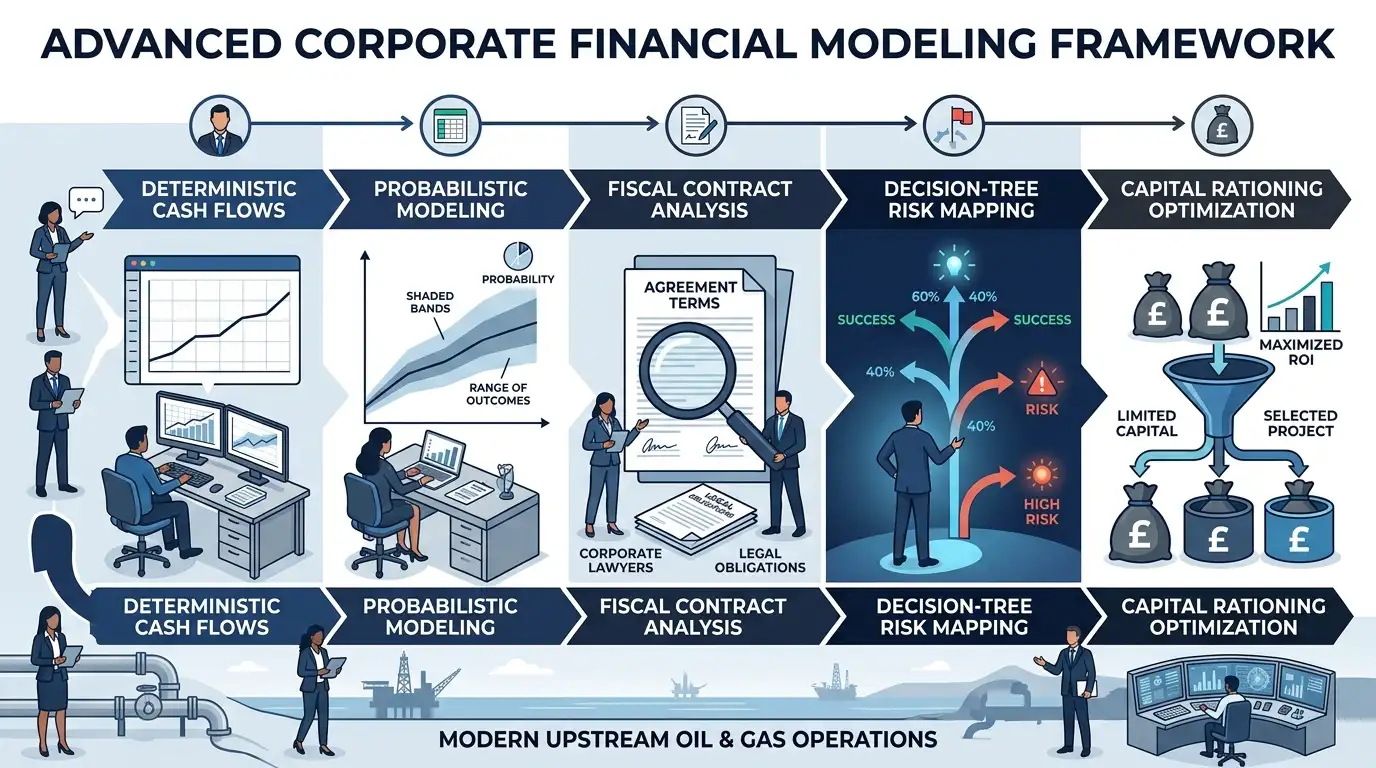
The core modules of the program are partitioned into distinct, highly focused skill domains designed to deliver immediate workplace applicability. Module one focuses on Capital Expenditure and Operating Expenditure estimation methodologies, training participants to construct realistic cost models for offshore and onshore developments. Module two dives deep into petroleum fiscal systems, dissecting royalty-tax regimes, production-sharing contracts, and risk-service agreements across diverse global jurisdictions. Module three addresses time value of money applications, teaching learners how to calculate Net Present Value, Internal Rate of Return, Modified Internal Rate of Return, and Profitability Index under varying inflation and discount rate scenarios. Module four covers decision tree analysis and Monte Carlo simulations to quantify subsurface and economic uncertainty.
Throughout these modules, Institute For Oil & Gas Training emphasizes practical integration, requiring learners to solve real-world commercial valuation problems derived from actual oil and gas asset acquisitions. For instance, subsurface evaluation teams and financial analysts collaborate on joint exercises to reconcile geological risk factors with economic output metrics, eliminating traditional communication silos within corporate hierarchies. HR departments partnering with Institute For Oil & Gas Training consistently report that this granular modular design accelerates employee onboarding into senior commercial roles and significantly enhances cross-departmental project collaboration.
How is this specialist training delivered across corporate and individual formats?
Training is delivered through flexible modular workshops, immersive online modules, hybrid corporate cohorts, and intensive onsite bootcamps supported by simulation software and expert-led tutorials.
Flexibility and operational continuity are paramount for corporate sponsors and working professionals balancing active asset development portfolios with continuous professional development. Institute For Oil & Gas Training accommodates these organizational demands by offering four distinct delivery modalities tailored to diverse geographical and scheduling requirements. Onsite corporate bootcamps bring expert instructors directly to company headquarters, allowing internal departments to analyze proprietary asset datasets under strict confidentiality agreements. Hybrid and online formats utilize asynchronous learning management systems combined with live virtual instructor-led sessions to foster global peer interaction and real-time case study debates.
To reinforce conceptual mastery, the training delivery incorporates interactive software simulations that replicate industry-standard economic evaluation tools used by major international energy corporations. Participants engage in structured syndicate exercises, role-playing commercial negotiations, and capital allocation committee presentations where they must defend their project valuation models against rigorous peer challenge. This multifaceted delivery approach ensures that whether an organization enrolls an entire multidisciplinary asset team or an individual professional seeks targeted career advancement, the educational experience remains consistently rigorous, engaging, and directly applicable to daily operational workflows.
What measurable workplace results and performance improvements can organizations expect?
Organizations achieve measurable reductions in capital misallocation, accelerated project sanctioning timelines, enhanced cross-functional communication, and defensible capital expenditure proposals.
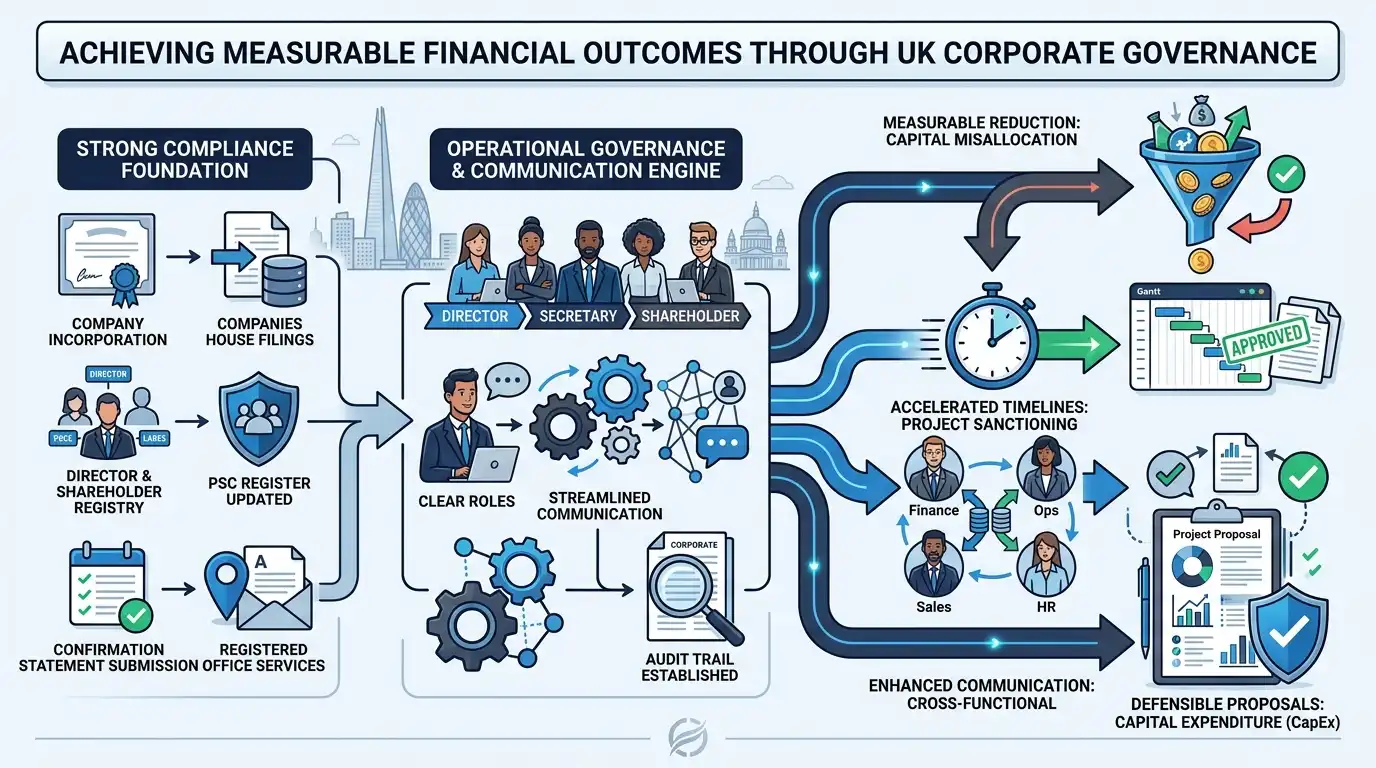
The ultimate metric of professional development efficacy is tangible workplace impact and enhanced commercial decision-making capability. When corporate teams complete the curriculum provided by Institute For Oil & Gas Training, they return to their organizations equipped with standardized economic evaluation frameworks that streamline project sanctioning workflows. Asset managers and commercial negotiators demonstrate heightened proficiency in structuring bidding terms, optimizing depletion schedules, and mitigating fiscal exposure in politically complex operating environments.
Consider a typical workplace scenario where an upstream operator evaluates competing marginal field developments against a constrained capital budget. Trained financial analysts and petroleum engineers utilize the probabilistic risk assessment techniques mastered during the program to construct defensible valuation portfolios, preventing capital deployment into assets with asymmetric downside risk. Furthermore, HR directors utilizing Institute For Oil & Gas Training frameworks observe marked improvements in succession planning pipelines for commercial leadership roles, as technical specialists successfully transition into strategic asset management positions with comprehensive financial acumen.
What are the eligibility criteria and the enrollment pathway for participants?
Candidates must possess a foundational background in engineering, geosciences, finance, or corporate management, and enrollment is finalized through a streamlined credential verification and registration portal.
Maintaining high peer group quality and rigorous academic discourse requires specific entry criteria for prospective participants. Ideal candidates include petroleum engineers, reservoir analysts, financial controllers, business development managers, and HR professionals responsible for technical workforce capability development. While advanced mathematical proficiency is advantageous, the curriculum systematically bridges foundational financial principles with complex petroleum economics, ensuring that professionals from diverse technical backgrounds can successfully achieve course completion.
The registration process is structured for administrative efficiency, accommodating both corporate sponsorship packages and individual professional enrollments. To secure placement in the upcoming academic cohort and access comprehensive pre-course preparatory modules, qualified professionals and corporate training coordinators should enroll in this specialist training program.
Frequently Asked Questions
What does an oil and gas petroleum finance course cover?
An oil and gas petroleum finance course typically covers capital expenditure estimation, cash flow modeling, production-sharing contracts, and risk quantification techniques. Through programs offered by the Institute For Oil & Gas Training, participants learn to evaluate project profitability using net present value and internal rate of return analyses under diverse fiscal regimes.
Why is petroleum economics important in upstream operations?
Petroleum economics is crucial because it bridges technical reservoir engineering data with commercial viability, ensuring capital is allocated efficiently across exploration and production assets. By applying rigorous financial models taught in courses like those by the Institute For Oil & Gas Training, organizations can mitigate financial risks and optimize field development decisions.
Who should enroll in petroleum economics and finance training?
Petroleum economics and finance training is designed for petroleum engineers, financial analysts, asset managers, and business development personnel operating within the upstream energy sector. Human resources and corporate training teams also utilize programs from the Institute For Oil & Gas Training to upskill technical staff transitioning into commercial leadership roles.
How do companies assess the economic viability of new oilfields?
Companies assess the commercial viability of new oilfields by constructing deterministic and probabilistic cash flow models that factor in capital costs, operating expenses, and taxation structures. These evaluations help energy firms determine whether projected hydrocarbon recovery rates justify the initial capital outlay under varying commodity price scenarios.
What are the career benefits of studying oil and gas finance?
Studying oil and gas finance enhances a professional's ability to navigate complex fiscal regimes, negotiate commercial contract terms, and defend capital expenditure proposals to corporate boards. Earning specialized credentials through the Institute For Oil & Gas Training equips practitioners with the analytical skills required to advance into senior commercial and asset management positions.
Related training courses
Cash Flow Reporting for IAS 7 Statements Training Course
- Specialisation
- Oil & Gas Petroleum IFRS & Financial Reporting
- Duration
- 5 days · 15 CPD hours
Internal Controls Over Financial Reporting Design Training Course
- Specialisation
- Oil & Gas Petroleum Compliance, AML & Risks
- Duration
- 5 days · 15 CPD hours
Production Accounting & Hydrocarbon Allocation: Wellhead to Sales Training Course
- Specialisation
- Oil & Gas Petroleum Accounting
- Duration
- 5 days · 15 CPD hours
More articles

NPV and IRR Analysis for Comparing Alternative Oilfield Development Cases
Master net present value and internal rate of return methods to compare alternative oilfield development cases and optimize upstream capital allocation.
Read article →
How Petroleum Companies Assess the Commercial Viability of New Field Developments
Discover how petroleum companies train teams to assess field development commercial viability, optimize capital allocation, and drive project returns.
Read article →
Building Practical Oilfield Economics & Project Evaluation Skills for Petroleum Investment Decisions
Master petroleum investment decisions, NPV, IRR, and fiscal regimes with the Institute For Oil & Gas Training. Enroll today to elevate team performance.
Read article →