
Evaluating alternative upstream capital allocation projects requires robust quantitative metrics to determine economic viability. Upstream asset teams face complex decisions when ranking competing hydrocarbon fields, infrastructure configurations, and phased drilling schedules under strict budget constraints.
Strategic evaluation begins by understanding foundational industry drivers, which are detailed extensively in our guide on How Petroleum Companies Assess the Commercial Viability of New Field Developments. Asset evaluation engineers, subsurface leads, and commercial finance managers must leverage precise financial instruments to balance capital expenditure requirements against long-term production profiles and commodity price volatility.
What is net present value in upstream asset valuation?
Net Present Value represents the sum of all discounted cash flows generated by an oilfield development over its operational lifecycle, subtracting the initial capital expenditure. Net Present Value establishes a direct absolute monetary value addition for a given asset. Upstream projects involve massive front-loaded capital expenditures followed by declining production curves over decades. Discounting future cash flows accounts for the time value of money and the inherent risk profile of oil and gas extraction.
The calculation relies on establishing a discount rate that reflects the corporate cost of capital and specific country risk premiums. Operating expenditure forecasts, abandonment liabilities, and fiscal regime terms directly influence cash flow timing. Positive net present values indicate that a project generates returns exceeding the hurdle rate, thereby increasing total shareholder wealth. Asset teams utilize this metric to compare mutually exclusive field development plans, such as floating production storage and offloading vessels versus tie-back subsea architectures. Higher absolute values do not automatically signal superior capital efficiency when initial outlays differ significantly. Capital rationing scenarios require supplementary metrics to resolve scale disparities between competing upstream assets.
How does internal rate of return measure oilfield investment efficiency?
Internal Rate of Return is the discount rate that sets the net present value of all cash flows from an oilfield development equal to zero. Internal Rate of Return calculates the annualized percentage yield expected from a capital expenditure program. Commercial evaluation teams use this percentage metric to gauge the capital efficiency of alternative drilling campaigns and facility upgrades.
Projects featuring identical net present values often exhibit vastly different internal rates of return due to varying capital expenditure profiles and cash flow timing. High-yield, low-CAPEX brownfield tie-backs frequently generate high percentages that attract near-term capital. Greenfield mega-projects with multi-billion-dollar initial investments yield lower percentages despite delivering massive absolute cash generation.
The metric contains structural limitations when evaluating mutually exclusive projects or non-conventional cash flow profiles with multiple sign changes. Reinvestment rate assumptions embedded within the mathematical derivation can distort the true profitability index of long-cycle assets. Commercial evaluation specialists mitigate these distortions by running simultaneous net present value profiles across multiple commodity price decks. Comprehensive competency development in these analytical methods is delivered through the Institute For Oil & Gas Training program, equipping commercial teams with rigorous valuation frameworks.
When should financial analysts prioritize net present value over internal rate of return?
Net present value must take precedence over internal rate of return when evaluating mutually exclusive field development options of unequal scale. Scale discrepancies render percentage-based yield metrics misleading for corporate portfolio optimization. A smaller asset might yield a stellar return percentage while contributing minimal absolute value to corporate balance sheets. Conversely, a mega-development might offer a modest yield percentage while delivering billions in absolute value.

Evaluation Criterion | Net Present Value Focus | Internal Rate of Return Focus |
Primary Output | Absolute monetary value added | Annualized percentage yield |
Capital Scale Sensitivity | Directly accounts for project size | Ignores absolute capital outlay |
Reinvestment Assumption | Reinvested at the cost of capital | Reinvested at the internal rate |
Multiple Sign Changes | Handles complex cash flows reliably | Prone to multiple mathematical roots |
Primary Decision Utility | Maximizing total corporate wealth | Ranking capital efficiency under limits |
Capital budgeting committees utilize the Institute For Oil & Gas Training curriculum to train asset teams on resolving conflicts between these two core metrics. Upstream portfolios face strict capital caps, making capital rationing an operational reality for asset managers. Maximizing total corporate net present value under capital constraints requires linear programming and profitability index rankings rather than raw yield sorting. Discrepancies between the two metrics emerge clearly when deferred production cases are compared against accelerated depletion profiles. Accelerated production boosts internal rates of return through early cash inflows, yet ultimate recovery factors and reservoir integrity may suffer. Reservoir management strategies must balance peak production rates against long-term pressure maintenance requirements.
How do fiscal regimes impact upstream economic evaluation models?
Fiscal regimes dictate the exact sharing of petroleum revenues between host governments and operating oil companies through contractual and tax structures. Upstream economic models must incorporate complex legal frameworks including production sharing contracts, concessions, and risk-service agreements. Government take calculations directly reshape project net present values and internal rates of return.
Production sharing contracts introduce cost recovery limits, profit oil splits, and state participation rights that alter cash flow timing. Concession systems rely on royalties, petroleum resource rents, and corporate income taxes applied to net profits. Fiscal terms often include sliding scales tied to daily production rates or cumulative project profitability ratios. These sliding scales protect state revenues during high commodity price environments while shielding operators during market downturns.
Economic evaluation models must simulate multi-variable sensitivity matrices incorporating tax tier shifts and sliding scale thresholds. Commercial teams evaluate alternative development cases under shifting fiscal terms to identify regulatory exposure and sovereign risk. Upgrading organizational proficiency in managing these fiscal complexities requires targeted professional development. The Institute For Oil & Gas Training provides deep operational insights into navigating complex international fiscal architectures.
How do commodity price volatility and risk impact project ranking?
Commodity price volatility alters cash flow projections, requiring stochastic modeling and deterministic sensitivity analysis to secure reliable project rankings. Upstream developments operate across multi-decade horizons where oil and gas price assumptions drive project economics. Deterministic sensitivity analysis isolates individual variables like Brent crude benchmarks or Henry Hub gas prices to measure valuation impact.
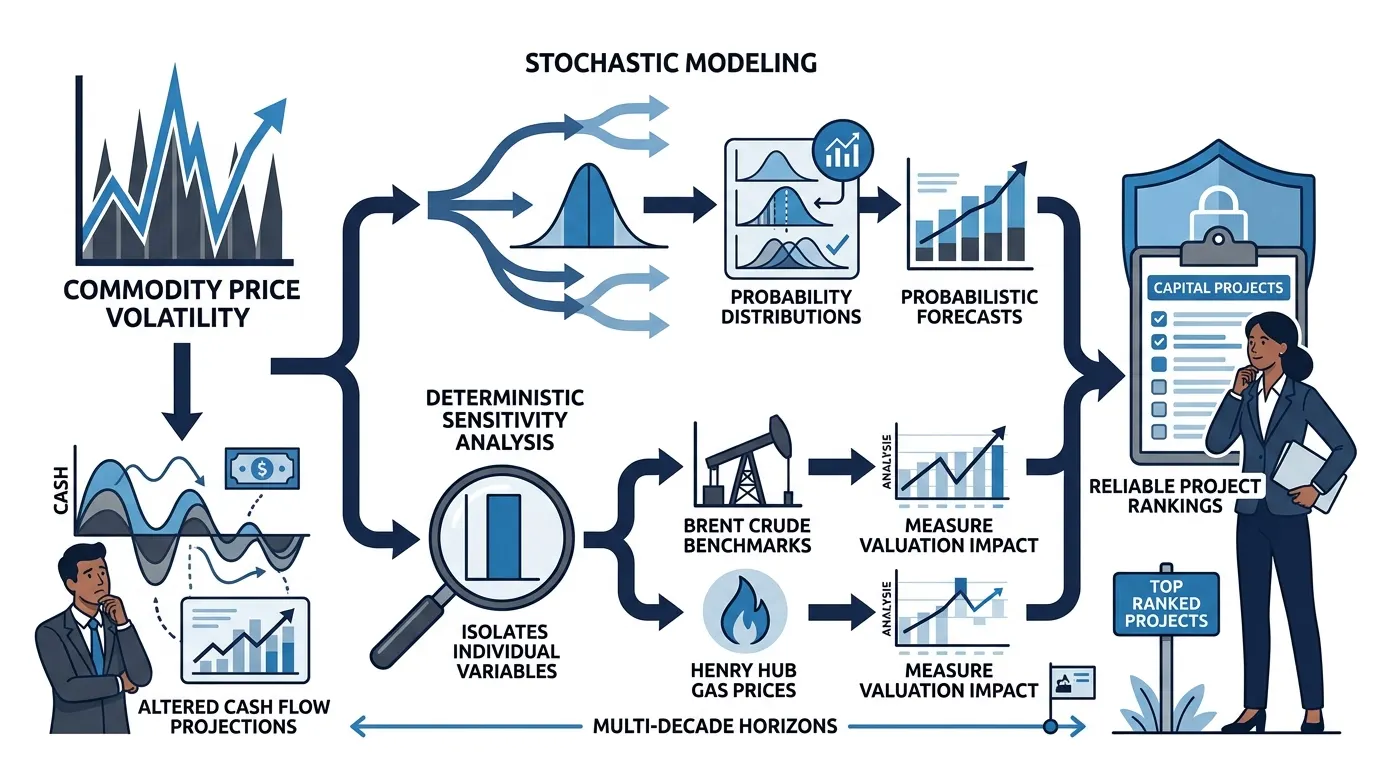
Monte Carlo simulations introduce probability distributions for commodity prices, capital expenditure overruns, and reservoir performance uncertainties. Stochastic modeling generates probabilistic net present value curves and value-at-risk metrics for alternative development cases. Risk management frameworks incorporate hurdle rate adjustments and real options valuation to account for management flexibility. Real options analysis captures the economic value of abandoning, expanding, or temporarily shutting in production during adverse market cycles.
Asset teams utilize these advanced economic evaluation techniques to stress-test capital allocation decisions against severe downside scenarios. Robust commercial governance ensures that capital approvals withstand commodity price cyclicality and maintain long-term balance sheet resilience.
Frequently Asked Questions
What does Oil and Gas Petroleum Finance cover in professional training?
Oil and Gas Petroleum Finance covers upstream capital budgeting, net present value modeling, internal rate of return calculations, and risk assessment methodologies. The Institute For Oil & Gas Training delivers these modules to help commercial teams evaluate multi-million-dollar field development alternatives accurately. Participants learn to navigate complex fiscal regimes, production sharing contracts, and commodity price volatility.
How do finance professionals evaluate upstream oilfield capital projects?
Finance professionals evaluate upstream oilfield capital projects by discounting projected cash flows against specific corporate hurdle rates and cost of capital benchmarks. The Institute For Oil & Gas Training equips analysts with advanced techniques to balance front-loaded capital expenditures against long-term production profiles. This rigorous quantitative approach ensures optimal capital allocation across competing hydrocarbon assets and infrastructure upgrades.
Why is risk analysis essential in petroleum economics and commercial evaluation?
Risk analysis is essential in petroleum economics because multi-decade upstream projects face severe commodity price volatility, subsurface uncertainties, and fiscal shifts. Training programs by the Institute For Oil & Gas Training integrate Monte Carlo simulations and deterministic sensitivity analysis to stress-test project cash flows. These valuation frameworks empower commercial teams to protect asset profitability and corporate balance sheet resilience.
What career roles benefit most from petroleum finance and economics education?
Petroleum finance and economics education benefits commercial managers, asset evaluation engineers, corporate finance analysts, and upstream planning specialists. The Institute For Oil & Gas Training structures its programs to bridge the gap between technical reservoir management and commercial decision-making. Professionals in these roles gain the analytical competencies required to optimize asset portfolios under strict capital rationing constraints.
How do fiscal regimes impact oil and gas petroleum finance models?
Fiscal regimes directly impact oil and gas petroleum finance models by dictating revenue-sharing structures, royalty obligations, and corporate tax rates between operators and host governments. Upstream economic models must incorporate production sharing contracts and sliding-scale mechanisms that alter project net present values. The Institute For Oil & Gas Training provides comprehensive instruction on navigating these complex international legal and regulatory frameworks.
Related training courses
Cash Flow Reporting for IAS 7 Statements Training Course
- Specialisation
- Oil & Gas Petroleum IFRS & Financial Reporting
- Duration
- 5 days · 15 CPD hours
Internal Controls Over Financial Reporting Design Training Course
- Specialisation
- Oil & Gas Petroleum Compliance, AML & Risks
- Duration
- 5 days · 15 CPD hours
Month-End Close Acceleration for Upstream Operations & Cut-Off Training Course
- Specialisation
- Oil & Gas Petroleum Accounting
- Duration
- 5 days · 15 CPD hours
More articles

Oilfield Economics & Project Evaluation: Specialist Training for Petroleum Economics and Commercial Roles
Master petroleum economics and project evaluation with specialized training. Learn cash flow modeling, risk analysis, and fiscal contracts for upstream roles.
Read article →
How Petroleum Companies Assess the Commercial Viability of New Field Developments
Discover how petroleum companies train teams to assess field development commercial viability, optimize capital allocation, and drive project returns.
Read article →
Building Practical Oilfield Economics & Project Evaluation Skills for Petroleum Investment Decisions
Master petroleum investment decisions, NPV, IRR, and fiscal regimes with the Institute For Oil & Gas Training. Enroll today to elevate team performance.
Read article →