
Fiscal sensitivity analysis determines the robustness of upstream petroleum investments by quantifying how changes in government take, tax regimes, and contract terms alter project net present value and internal rate of return. Upstream energy investments operate under high capital expenditure and long gestation periods. Stakeholders must evaluate how variations in state participation, royalty structures, and petroleum revenue taxes impact project viability before committing capital. Understanding the underlying mechanics of fiscal terms prevents capital misallocation in volatile commodity cycles.
Commercial viability depends on more than initial commodity price forecasts and baseline reservoir performance. When evaluating upstream opportunities, professionals examine What Makes an Oilfield Project Economically Attractive Across Different Fiscal Conditions, establishing the foundational economic indicators that separate marginal discoveries from commercial developments. This baseline understanding sets the stage for advanced sensitivity testing, where financial models incorporate contractual shifts and taxation volatility to assess asset resilience.
How do changes in government take alter upstream project cash flow and valuation profiles?
Modifying state participation levels and royalty percentages directly reduces contractor net cash flows, compressing project net present value and altering optimal development timing.
Government take represents the total economic value captured by the host government through taxes, royalties, bonuses, and state equity participation. When petroleum fiscal terms tilt heavily toward the state during high-price environments, contractor cash flows face severe compression. Financial analysts model these shifts by isolating individual tax and royalty variables to observe non-linear impacts on project valuation. A two percent increase in sliding-scale royalties can eliminate double-digit returns on mature fields with declining production profiles.
Corporate finance teams evaluate these exposures using structured sensitivity matrices. In concessions and licenses, royalties act as a top-line burden, taking a fixed or sliding percentage of gross production before operational expenditures are recovered. This structure increases downside risk for operators during low-price cycles, as the state receives revenue even if the project operates at a net loss. Production sharing contracts distribute risk differently through cost recovery limits and profit oil splits. Contractors recover capital expenditures from a designated share of production known as cost oil. The remaining profit oil is split between the government and the contractor based on sliding scales linked to daily production rates or cumulative profitability metrics like the R-factor.
The R-factor measures the ratio of cumulative revenues to cumulative costs. When project revenues outpace expenditures, the R-factor crosses predefined thresholds, triggering higher government profit-share percentages. Sensitivity analysis maps these inflection points to identify the exact production rates or oil prices where state take escalates. Strategic asset planners utilize Developing Oilfield Economics & Project Evaluation Capability Through Specialist Industry Training to build robust financial models that account for these dynamic shifts. This capability enables commercial teams to negotiate stable contract terms that protect downside value while satisfying host government revenue expectations.
What distinguishes production sharing contracts from concessionary systems during fiscal sensitivity testing?
Production sharing contracts insulate investors through cost recovery mechanisms during low-price scenarios, whereas concessionary systems expose project equity holders to immediate top-line royalty burdens.
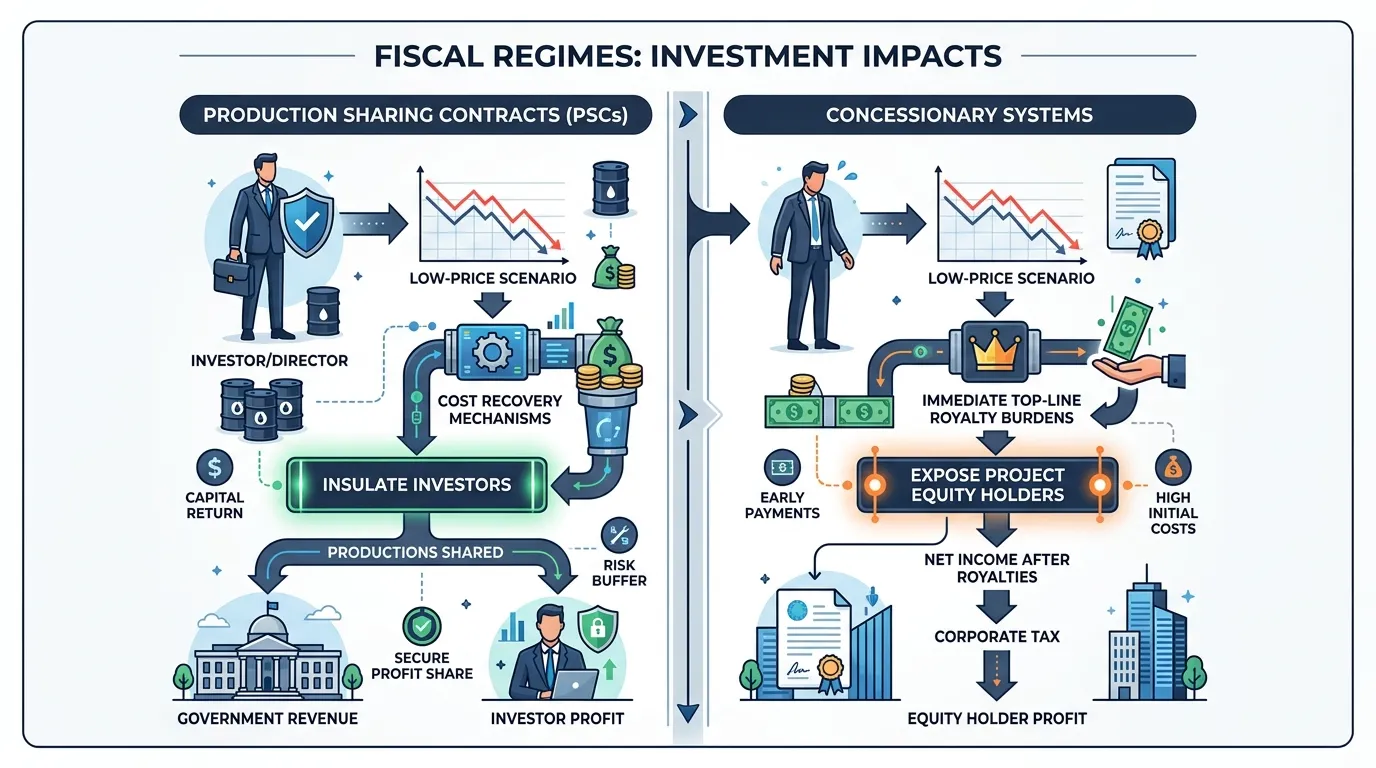
The structural mechanics of petroleum fiscal regimes dictate how risks and rewards are shared between host governments and international energy companies. Concessionary systems grant title to hydrocarbons to the operating company at the wellhead, subject to royalties, corporate income taxes, and specialized petroleum taxes. Under this framework, financial exposure remains concentrated on the operator. If oil prices drop, the top-line royalty remains intact, reducing the cash available for debt service and operational reinvestment. Sensitivity models for concessions focus heavily on breakeven commodity prices under varying tax rates and depreciation schedules.
Conversely, production sharing contracts establish the state as the owner of the hydrocarbons, hiring the contractor as a service provider compensated with a share of production. The cost recovery ceiling dictates the maximum percentage of production the contractor can use to recover capital and operating expenditures. When commodity prices fall, the volume of oil required for cost recovery expands, provided the cost ceiling permits. This mechanism cushions contractor cash flows during market downturns. However, if the cost recovery ceiling is set too low, capital-intensive developments stall because operators cannot recover sunk investments quickly enough to service project finance debt.
Evaluating these distinct legal frameworks requires multidisciplinary expertise across finance, legal, and engineering departments. Human resources and talent development leaders focus on bridging analytical capability gaps through structured Institute For Oil & Gas Training programs that elevate organizational competence in international petroleum fiscal design. Analytical teams test multiple price and cost scenarios to isolate how contract design interacts with macroeconomic volatility. By simulating thousands of Monte Carlo iterations on contract variables, economic modelers pinpoint the exact boundaries where project viability collapses under aggressive fiscal terms.
How do tax variables and fiscal stability clauses mitigate sovereign risk in long-cycle investments?
Contractual fiscal stability clauses freeze the applicable tax regime for a defined period, protecting capital-intensive upstream developments from retroactive legislative changes and sovereign cash flow expropriation.
Upstream petroleum projects require decades from initial exploration to final decommissioning. This extended timeline exposes investments to political shifts, budgetary crises, and regulatory overhauls in host nations. Governments facing fiscal deficits frequently attempt to capture higher rents by introducing windfall profit taxes, increasing corporate income tax rates, or restricting cost recovery allowances. Fiscal stability clauses serve as vital contractual shields, guaranteeing that the economic equilibrium established at contract signing remains protected throughout the project lifecycle.
Sensitivity analysis quantifies the financial exposure of projects operating without stability protection. Analysts model the impact of unexpected tax hikes, such as moving petroleum corporate income tax from standard industrial rates to specialized sector rates exceeding fifty percent. When stability clauses are absent, net present values degrade rapidly under adverse political interventions. Economic models incorporate probabilistic risk adjustments, discounting cash flows to reflect the likelihood of unilateral fiscal modifications by sovereign authorities.
Furthermore, tax deductibility rules for exploration and development expenditures dictate the timing of tax shields. Accelerated depreciation and immediate expensing of intangible drilling costs enhance early-stage cash flows, accelerating payback periods. Sensitivity tests demonstrate that delaying tax deductions or enforcing capitalization rules for exploration outlays extends payback duration by multiple years, lowering project attractiveness for private equity investors and major operators. Asset teams must synthesize these tax variables into comprehensive economic dashboards that guide capital allocation committees during final investment decisions.
Frequently Asked Questions
What is oil and gas petroleum finance?
Oil and gas petroleum finance is the specialized discipline of managing capital allocation, risk assessment, and funding structures for upstream, midstream, and downstream energy assets. Professionals utilize targeted frameworks from the Institute For Oil & Gas Training to evaluate project economics, model complex cash flows, and secure capital for capital-intensive developments. This financial expertise ensures that energy companies optimize debt-to-equity ratios while navigating commodity price volatility and regulatory burdens.
How do petroleum fiscal terms impact project financing decisions?
Petroleum fiscal terms dictate how revenues, risks, and economic rents are distributed between host governments and international energy corporations. When analyzing investment viability, financial analysts at the Institute For Oil & Gas Training examine how sliding-scale royalties, profit oil splits, and cost recovery limits alter project net present value. Understanding these contractual variables allows corporate finance teams to structure bankable debt packages that withstand adverse fiscal shifts.
What are the primary valuation methods used in upstream petroleum economics?
Upstream asset valuation relies heavily on discounted cash flow modeling, net asset value calculations, and probabilistic Monte Carlo simulations to account for geological and economic uncertainties. Practitioners through the Institute For Oil & Gas Training apply these quantitative methods to project future production profiles against capital expenditures and operating costs. These evaluations establish the baseline economic metrics required by investment committees before sanctioning multi-billion-dollar field developments.
Why is sensitivity analysis critical for petroleum investment appraisal?
Sensitivity analysis identifies which financial variables exert the most influence on a petroleum project's rate of return and payback duration. Analysts utilize specialized modules taught by the Institute For Oil & Gas Training to test how fluctuations in commodity prices, discount rates, and government take impact asset resilience. This rigorous stress-testing uncovers potential financial vulnerabilities and guides strategic risk mitigation before capital is deployed.
What skills are essential for career advancement in oil and gas petroleum finance?
Success in upstream financial roles requires advanced proficiency in economic modeling, contract negotiation, tax regime analysis, and capital budgeting. Programs offered by the Institute For Oil & Gas Training bridge technical and commercial skill gaps, equipping finance professionals to manage complex joint venture accounting and sovereign risk. Mastering these core competencies enables practitioners to lead strategic investment decisions across global energy markets.
Related training courses
Risk Management for Upstream & Midstream Projects Fundamentals Training Course
- Specialisation
- Oil & Gas Petroleum Compliance, AML & Risks
- Duration
- 5 days · 15 CPD hours
Cash Flow Reporting for JVs & PSCs Training Course
- Specialisation
- Oil & Gas Petroleum IFRS & Financial Reporting
- Duration
- 5 days · 15 CPD hours
Payment Controls & Treasury Governance for JV Disbursements Training Course
- Specialisation
- Oil & Gas Petroleum Treasury, Cash and Banking
- Duration
- 5 days · 15 CPD hours
More articles

Why NPV Alone Does Not Capture the Full Risk of an Oilfield Investment
Discover why Net Present Value misses oilfield risks. Learn how advanced risk training and fiscal sensitivity analysis improve capital allocation decisions.
Read article →
Developing Oilfield Economics & Project Evaluation Capability Through Specialist Industry Training
Master oilfield economics, fiscal regimes, and project evaluation with specialized training. Improve asset valuation and capital budgeting accuracy.
Read article →
What Makes an Oilfield Project Economically Attractive Across Different Fiscal Conditions
Learn how organizations evaluate petroleum project economics, assess fiscal variables, and close workforce skill gaps through structured corporate training.
Read article →