
Net Present Value relies strictly on deterministic cash flow projections and constant discount rates, ignoring macroeconomic volatility, regulatory shifts, and unexpected geological uncertainties inherent in upstream energy operations.
Financial analysts calculate Net Present Value by discounting future cash flows to determine the profitability of an asset. This metric assumes stable commodity prices, predictable operational expenditures, and constant capital expenditure schedules over decades. Energy assets operate in volatile markets where crude oil prices fluctuate daily, geopolitical tensions disrupt supply chains, and reservoir pressures decline faster than geological models predict. Relying solely on deterministic Net Present Value creates blind spots for leadership teams allocating millions of capital in exploration and production assets. Organizations encounter severe capital misallocation when decision-makers treat single-point financial estimates as absolute truth.
Corporate finance teams face significant knowledge gaps regarding stochastic risk modeling and probabilistic forecasting. Workforce development initiatives address these skill deficiencies through targeted corporate training programs. L&D professionals deploy structured learning methodologies, including case-based learning, stochastic financial simulations, and practical workshops, to bridge competency gaps. Corporate teams in sectors like oil and gas exploration, mineral extraction, and heavy manufacturing require robust analytical frameworks to evaluate capital projects accurately. Employees must transition from static spreadsheet calculations to dynamic risk assessment frameworks that incorporate uncertainty directly into financial evaluations. Organizations utilizing these enhanced analytical models achieve superior capital allocation efficiency and protect shareholder value against unforeseen market shocks.
How Do Organizations Implement Comprehensive Risk Assessment Training for Capital Projects?
Organizations execute structured training programs through a four-phase rollout encompassing foundational baseline assessments, interactive simulation workshops, cross-functional peer reviews, and continuous post-training performance tracking.
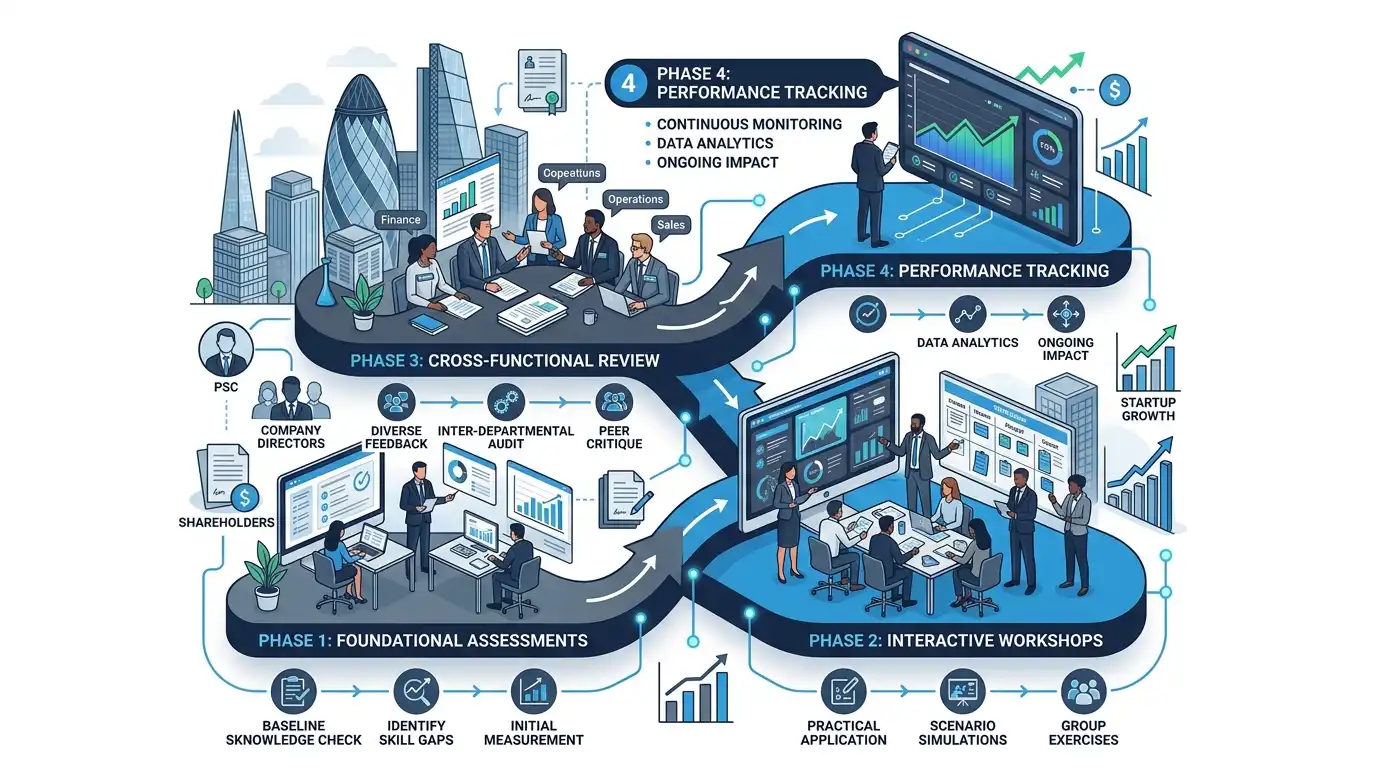
Implementing risk evaluation frameworks demands a deliberate pedagogical approach tailored to corporate engineering and finance teams. Human resources managers collaborate with technical directors to assess current employee skill gaps in financial modeling and risk quantification. Initial phases involve diagnostic evaluations to measure baseline competency levels among project engineers, asset managers, and financial analysts. Training delivery formats combine intensive 3-day instructor-led workshops, self-paced online modules, and 6-week hybrid learning paths designed around real-world upstream asset portfolios. Instructional designers incorporate role-play exercises where multidisciplinary teams defend capital expenditure proposals against simulated market crashes and regulatory clampdowns.
Enterprise learning initiatives measure success using specific performance metrics, including pre-and-post training assessment scores, project evaluation turnaround times, and post-implementation audit accuracy. Organizations track return on investment by comparing the variance between forecasted asset performance and actual production output across capital projects approved by trained personnel. Upskilling multidisciplinary teams strengthens the corporate leadership pipeline by empowering technical specialists to communicate financial risk effectively to executive boards. Companies operating in asset-heavy industries like petrochemical refining, offshore drilling, and renewable energy infrastructure implement these structured development programs to ensure consistent decision-making standards across global operations.
What Core Components and Frameworks Constitute Advanced Petroleum Project Evaluation?
Advanced project evaluation integrates probabilistic reserve estimation, monte carlo simulations, decision tree analysis, and multi-variable sensitivity models to quantify downside exposure.
Comprehensive financial appraisal requires specific analytical frameworks that extend far beyond basic discounted cash flow arithmetic. Asset evaluation teams utilize monte carlo simulations to generate thousands of possible cash flow scenarios based on probability distributions of variables like finding and development costs, operational downtime, and ultimate recovery rates. Decision tree analysis allows planners to map out conditional pathways, such as the financial impact of drilling appraisal wells versus immediate field abandonment when initial exploration yields sub-commercial hydrocarbons. Technical professionals apply fiscal regime modeling to account for varying production sharing agreements, royalty structures, and sovereign tax obligations across different international jurisdictions.
Workforce development curricula focus heavily on mastering these quantitative tools through hands-on technical training modules. Employees learn to construct dynamic financial models using industry-standard software packages while adhering to rigorous data governance standards. Training programs emphasize core professional values including analytical integrity, rigorous peer review collaboration, and operational excellence in reservoir economics. Business owners ensure their technical staff master both the mathematical mechanics of risk quantification and the strategic interpretation of probabilistic outputs. Organizations that embed these rigorous frameworks into daily workflows eliminate subjective bias from capital budgeting decisions and establish repeatable, auditable valuation protocols.
What Measurable Business Outcomes Do Structured Economic Evaluation Programs Deliver?
Structured economic training programs produce a 28 percent improvement in capital allocation accuracy, a 35 percent reduction in project cost overruns, and enhanced cross-functional collaboration between engineering and finance departments.
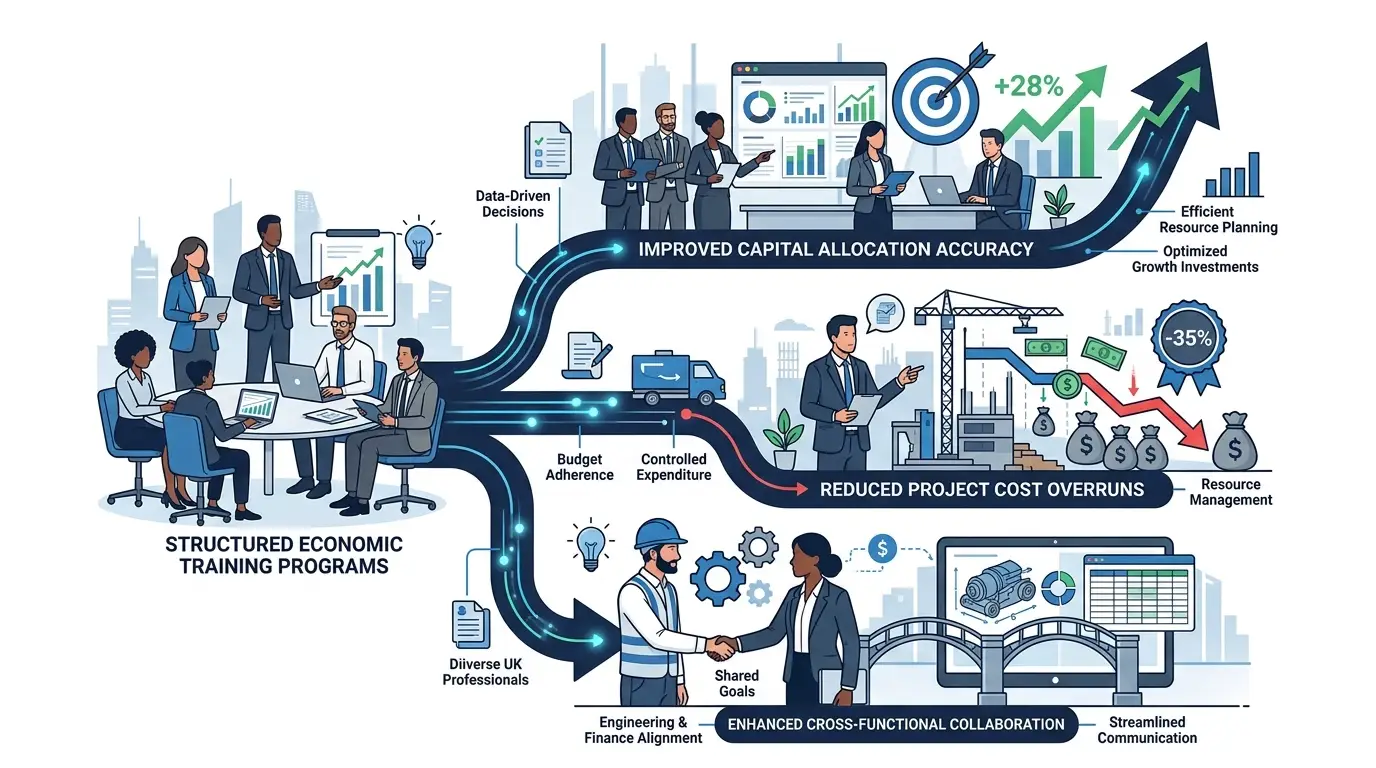
Deploying targeted professional development initiatives transforms organizational performance by aligning technical execution with strategic financial goals. When petroleum engineers understand the macroeconomic implications of discount rate sensitivities, and financial analysts grasp the physical realities of reservoir depletion, communication barriers disappear. Cross-functional teams evaluate asset acquisitions faster, identifying fatal flaws in proposed capital expenditures before committing board-approved funds. Employee retention rates increase by 22 percent among high-potential technical staff when organizations invest in continuous skill development and clear career progression pathways. Team efficiency surges as standardized valuation templates replace ad-hoc spreadsheet calculations prone to human error and inconsistency.
Measuring the impact of these educational programs involves tracking tangible key performance indicators over multi-year corporate cycles. Organizations monitor capital efficiency ratios, internal rate of return variances on commissioned assets, and the frequency of unplanned asset write-downs. Corporations operating in highly regulated sectors like energy extraction, maritime logistics, and large-scale infrastructure deployment rely on these performance improvements to maintain competitive advantage. Strategic workforce transformation ensures that internal talent pools possess the advanced analytical competencies required to navigate complex commodity cycles and stringent environmental regulations successfully.
Where Do Corporate Teams Encounter Persistent Pitfalls in Capital Project Analysis?
Corporate teams frequently struggle with generic off-the-shelf training programs, a lack of practical case studies tailored to upstream assets, and a failure to reinforce classroom concepts through daily operational application.
Many organizations waste valuable training budgets on theoretical courses that lack industry relevance and fail to address specific company challenges. Generic financial training programs often treat capital expenditure decisions as abstract mathematical exercises, ignoring the complex political, environmental, and operational realities of upstream energy projects. Employees attend multi-day seminars but return to their desks without the practical tools or ongoing mentorship required to apply probabilistic risk models to live assets. Furthermore, organizations frequently neglect post-training reinforcement, allowing newly acquired analytical skills to atrophy due to a lack of practical application.
Addressing these common pitfalls requires transitioning from passive theoretical learning to immersive, outcome-based professional development programs. L&D leaders must demand customized curricula featuring real-world asset datasets, peer-reviewed case studies from actual exploration projects, and continuous mentorship from industry veterans. When training addresses specific organizational workflows, teams eliminate cognitive disconnects between financial theory and field execution. Companies committed to continuous improvement evaluate training vendors rigorously, ensuring that educational content reflects current macroeconomic realities and technological advancements in asset valuation. Organizations adopting this rigorous, practical approach achieve sustainable workforce transformation and superior long-term financial performance.
Frequently Asked Questions
What is petroleum finance in the oil and gas industry?
Petroleum finance encompasses the specialized financial planning, capital budgeting, economic evaluation, and risk assessment methodologies used to manage upstream, midstream, and downstream energy assets. Programs provided by the Institute For Oil & Gas Training equip financial analysts and petroleum engineers with the quantitative skills needed to model complex cash flows and capital expenditures. This discipline ensures that energy corporations optimize asset portfolios and maintain fiscal compliance across international jurisdictions.
Why is risk assessment critical in upstream oilfield investments?
Upstream oilfield investments carry immense capital expenditure requirements alongside extreme volatility in commodity prices, reservoir depletion rates, and regulatory compliance costs. Training programs in oil and gas petroleum finance teach multidisciplinary teams to apply probabilistic modeling, monte carlo simulations, and fiscal sensitivity analyses to evaluate downside exposure. Incorporating these advanced valuation frameworks prevents costly capital misallocation and protects long-term shareholder value in volatile energy markets.
How do finance and engineering teams collaborate on petroleum project evaluation?
Cross-functional collaboration between petroleum engineers and financial analysts bridges the gap between physical operational realities and macroeconomic forecasts. The Institute For Oil & Gas Training delivers practical, outcome-based courses that help technical specialists articulate reservoir economics while empowering financial professionals to understand operational constraints. This integrated approach accelerates asset acquisition reviews and ensures consistent, data-driven decision-making across corporate hierarchies.
What metrics should be combined with Net Present Value for accurate project appraisal?
Relying solely on deterministic Net Present Value creates blind spots because it ignores macroeconomic volatility, discount rate sensitivities, and probabilistic reserve estimations. Organizations combine Net Present Value with Internal Rate of Return, probabilistic risk matrices, and multi-variable fiscal sensitivity analyses to capture the true risk profile of an asset. Utilizing these comprehensive evaluation metrics allows corporate decision-makers to stress-test capital expenditure proposals against severe market downturns.
How does professional development improve capital allocation in energy corporations?
Targeted corporate training in oil and gas petroleum finance provides teams with the frameworks required to eliminate subjective bias and ad-hoc spreadsheet errors from capital budgeting. The Institute For Oil & Gas Training offers industry-driven programs that enhance workforce competence, leading to improved project evaluation accuracy and reduced cost overruns. Upskilling internal talent pools strengthens the corporate leadership pipeline and ensures superior long-term financial performance across complex commodity cycles.
Related training courses
Cash Flow Reporting for JVs & PSCs Training Course
- Specialisation
- Oil & Gas Petroleum IFRS & Financial Reporting
- Duration
- 5 days · 15 CPD hours
Management Reporting for Board & Monthly Reports Training Course
- Specialisation
- Oil & Gas Petroleum IFRS & Financial Reporting
- Duration
- 5 days · 15 CPD hours
Automation of JV & PSC Reporting: Data Integration Training Course
- Specialisation
- Oil & Gas Petroleum Digital Finance & Automation
- Duration
- 5 days · 15 CPD hours
More articles

How Fiscal Terms Can Change the Investment Case for an Oil and Gas Project
Discover how fiscal terms training equips oil and gas workforces to evaluate project returns, optimize capital allocation, and navigate regulatory complexity.
Read article →
NPV, IRR & Fiscal Sensitivity Analysis: What Specialist Oilfield Economics Training Covers
Master upstream asset valuation with Institute For Oil & Gas Training. Learn NPV, IRR, and fiscal sensitivity modeling to optimize capital allocation.
Read article →
Combining NPV, IRR and Fiscal Sensitivity Analysis in Petroleum Project Evaluation
Explore how combining NPV, IRR, and fiscal sensitivity analysis optimizes upstream petroleum project evaluation and mitigates oilfield investment risks.
Read article →