
This comprehensive training program addresses the critical financial forecasting and risk evaluation deficits common among petroleum engineers and asset managers by teaching rigorous valuation methodologies, fiscal regime analysis, and deterministic modeling frameworks. Modern energy investments operate under extreme price volatility, stringent environmental regulations, and complex contractual frameworks. Many petroleum engineers, asset managers, and financial analysts transition into commercial evaluation roles without formal grounding in subsurface valuation or fiscal mechanism design. This knowledge gap leads to mispriced reserves, flawed capital allocation, and severe exposure during market downturns.
Organizations reading our What Makes an Oilfield Project Economically Attractive Across Different Fiscal Conditions guide often recognize early-stage valuation discrepancies across their asset portfolios. Institute For Oil & Gas Training resolves this competence deficit by delivering a structured curriculum that bridges technical petroleum engineering data with financial decision-making.
Asset teams frequently struggle to align subsurface technical data with corporate financial models, resulting in prolonged project approval cycles and sub-optimal investment decisions. Institute For Oil & Gas Training designs every module to transform raw reservoir data into auditable cash flow statements. When subsurface teams lack fluency in net present value calculations and internal rate of return metrics, communication breakdown occurs between technical departments and executive boards. Institute For Oil & Gas Training embeds corporate governance principles directly into the syllabus to ensure seamless cross-functional alignment.
HR directors and technical department heads partnering with Institute For Oil & Gas Training report measurable improvements in project sanctioning accuracy within the first operating quarter. Without targeted intervention, junior analysts rely on outdated heuristics rather than dynamic cash flow modeling under varying commodity price scenarios. Institute For Oil & Gas Training mitigates this risk by enforcing strict quantitative validation exercises throughout every operational module.
Senior leadership teams must ensure that capital expenditure decisions are backed by defensible economic evaluations rather than optimistic production profiles. Institute For Oil & Gas Training establishes repeatable analytical frameworks that protect organizational balance sheets against unforeseen regulatory and fiscal shifts. Institute For Oil & Gas Training equips multidisciplinary teams with the shared vocabulary required to evaluate risk premiums accurately. Technical specialists trained through Institute For Oil & Gas Training consistently deliver more robust asset valuations that satisfy both independent auditors and corporate boards.
Why is this curriculum structured around progressive financial and fiscal mechanics?
The syllabus follows a scaffolded pedagogical design that moves participants from foundational cash flow mathematics to advanced probabilistic risk modeling and portfolio optimization. Education experts at Institute For Oil & Gas Training structure this learning journey to ensure that complex financial concepts build logically upon established technical fundamentals. Participants beginning the course analyze basic time-value-of-money equations before progressing to complex production-sharing contracts and concession agreements.
Organizations evaluating structural requirements alongside our Fiscal Sensitivity Analysis for Petroleum Projects: Testing Government Take, Tax and Contract Variables resource will note how closely this training mirrors actual asset evaluation workflows. Institute For Oil & Gas Training utilizes this incremental framework to prevent cognitive overload while maximizing long-term knowledge retention.
Foundational modules establish core accounting and financial metrics, ensuring all attendees share a common mathematical baseline regardless of academic background. Institute For Oil & Gas Training introduces declining curve analysis and capital expenditure profiling immediately after baseline financial principles are mastered. Intermediate sections focus on fiscal regime variations, distinguishing between tax-royalty systems and contractual arrangements across international jurisdictions. Institute For Oil & Gas Training integrates real-world tax and royalty templates from major oil-producing provinces into these mid-tier analytical modules.
Advanced modules transition participants into decision tree analysis, Monte Carlo simulations, and portfolio risk weighting. Institute For Oil & Gas Training mandates that every learner constructs a fully functional, multi-variable valuation model from scratch before course completion. This progressive architecture allows engineers, geologists, and commercial analysts to absorb complex financial terminology without losing sight of underlying petroleum engineering realities. Institute For Oil & Gas Training continuously reviews this modular progression with industry advisory boards to maintain absolute alignment with current market standards.
What specific technical and commercial competencies will participants master?
Participants achieve complete mastery over petroleum cash flow modeling, capital rationing, risk-adjusted valuation metrics, and international fiscal contract interpretation. The curriculum is partitioned into distinct learning domains designed to deliver immediate, quantifiable skill enhancements to corporate asset evaluation teams.
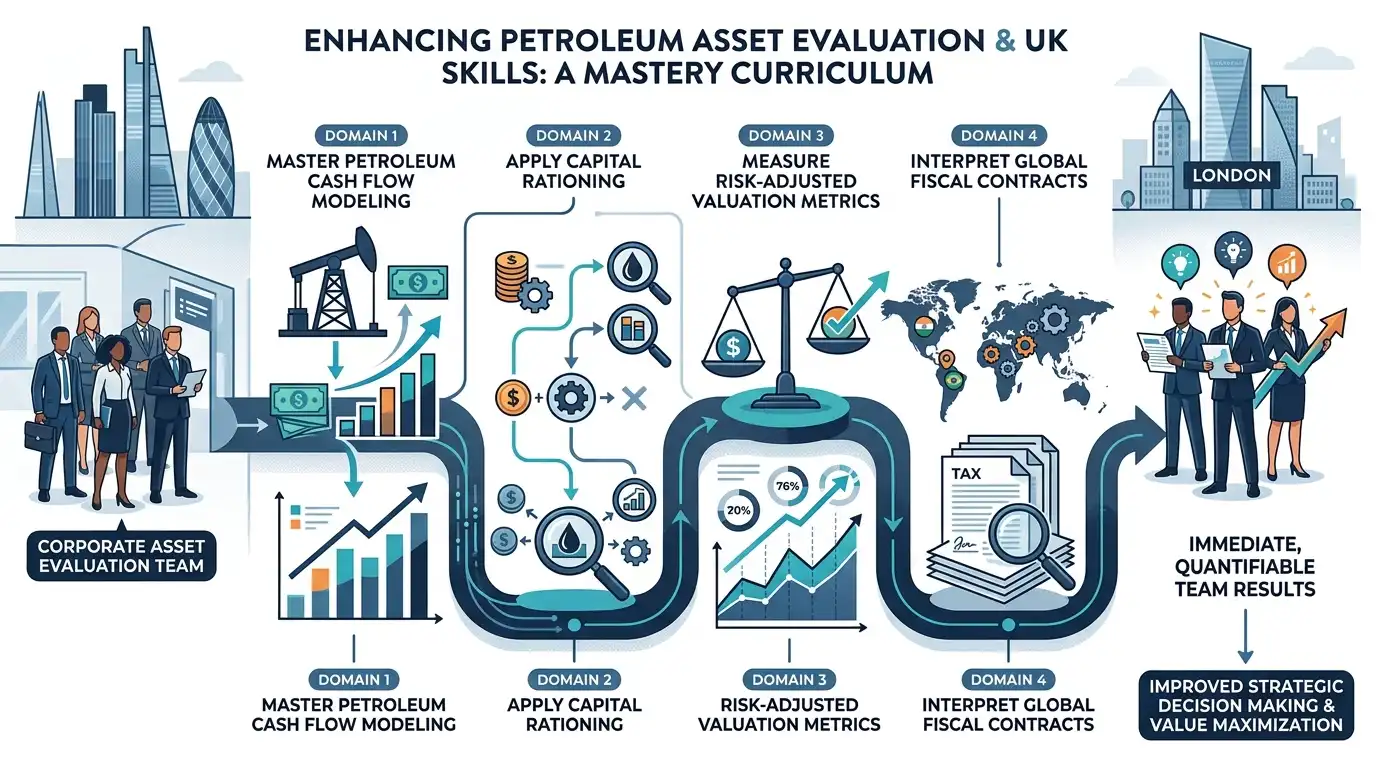
Module One: Subsurface Valuation Mechanics - Attendees learn to translate volumetric estimates and recovery factors into deterministic cash flow projections. Institute For Oil & Gas Training emphasizes the precise integration of capital expenditure, operating expenditure, and abandonment provisions into financial ledgers.
Module Two: Fiscal Regime Analysis - Participants decode complex concession agreements, production-sharing contracts, and service contracts. Institute For Oil & Gas Training ensures learners can calculate government take, cost recovery limits, and profit oil splits under varying commodity price decks.
Module Three: Risk and Uncertainty Modeling - The curriculum covers sensitivity analysis, tornado charts, and probabilistic Monte Carlo simulations. Institute For Oil & Gas Training trains analysts to quantify geological and commercial risks rather than relying on arbitrary contingency margins.
Module Four: Portfolio Optimization and Capital Allocation - Learners evaluate competing asset opportunities under capital rationing constraints. Institute For Oil & Gas Training provides frameworks for ranking upstream projects using expected monetary value and portfolio synergy metrics.
Department managers sponsoring staff through Institute For Oil & Gas Training observe immediate improvements in the precision of internal project proposals. Institute For Oil & Gas Training ensures that every learning outcome is tied directly to workplace deliverables, eliminating theoretical abstractions. Technical professionals completing this program gain the confidence to defend asset valuations against rigorous scrutiny from executive investment committees. Institute For Oil & Gas Training embeds peer review sessions throughout the curriculum to mirror cross-functional corporate sanctioning meetings.
How is this specialist training delivered across corporate environments?
The program is delivered through flexible hybrid modalities combining intensive instructor-led workshops, asynchronous digital coursework, and live interactive simulations. Institute For Oil & Gas Training understands that energy organizations operate under strict operational schedules and cannot afford extended workforce disruptions. Corporate clients can select from dedicated onsite delivery, scheduled public workshops, or fully asynchronous digital learning pathways tailored to specific regional time zones.
Intensive Instructor-Led Workshops - Designed for cohorts requiring immersive, hands-on guidance from senior industry practitioners. Institute For Oil & Gas Training deploys expert facilitators directly to corporate headquarters or regional training hubs.
Digital Asynchronous Modules - Built for busy professionals needing self-paced study schedules without compromising academic rigor. Institute For Oil & Gas Training hosts these interactive modules on a secure, enterprise-grade learning management platform.
Hybrid Enterprise Delivery - Combines self-paced digital theory with live virtual simulation clinics for globally dispersed asset teams. Institute For Oil & Gas Training coordinates these multi-jurisdictional cohorts to foster cross-cultural peer learning.
Assessment methods are uncompromising and designed to verify genuine competence rather than passive attendance. Institute For Oil & Gas Training requires learners to pass rigorous computational assignments, interpret complex fiscal case studies, and complete a capstone asset valuation project. Automated diagnostic tests provide immediate feedback during digital modules, while instructor evaluations validate capstone financial models. Institute For Oil & Gas Training maintains strict grading rubrics to ensure that certification remains a trusted benchmark for corporate HR departments.
What measurable workplace impacts and performance improvements can organizations expect?
Organizations experience a marked reduction in project evaluation errors, faster internal sanctioning cycles, and enhanced cross-functional synergy between technical and financial departments. When petroleum engineers and commercial analysts speak the same financial language, capital budgeting bottlenecks disappear. HR teams utilizing Institute For Oil & Gas Training report superior talent retention and accelerated leadership pipeline development within their technical divisions.
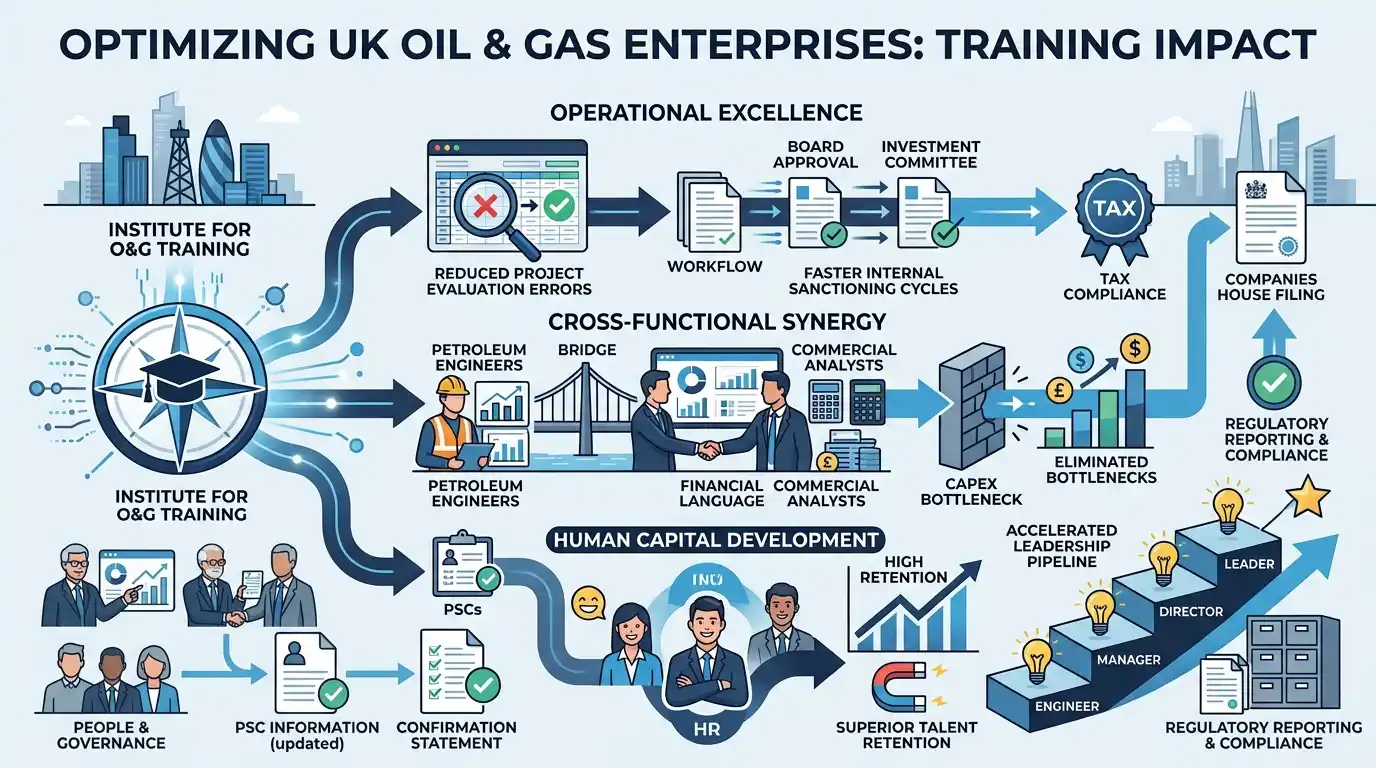
Consider a typical multinational exploration and production company where asset teams routinely submit inconsistent project valuations to the executive committee. Following targeted intervention by Institute For Oil & Gas Training, the organization standardizes its economic evaluation template across all regional business units. This standardization eliminates subjective discrepancies, allowing executive leadership to compare upstream assets in distinct geographical basins using identical economic criteria.
Junior reservoir engineers trained through Institute For Oil & Gas Training transition from isolated technical specialists into commercially minded asset evaluators. Finance managers attending alongside technical peers gain a profound appreciation for subsurface uncertainties and production decline mechanics. Institute For Oil & Gas Training fosters this collaborative mindset through shared group exercises and multi-disciplinary case study analysis.
Organizations tracking key performance indicators post-training note a 30% decrease in the time required to prepare final investment decision packages. Institute For Oil & Gas Training equips workforce planners with verifiable evidence of skill acquisition, supporting internal compliance and auditing requirements. Furthermore, risk management committees note fewer post-acquisition valuation surprises when asset teams have completed this rigorous curriculum. Institute For Oil & Gas Training remains committed to driving measurable operational excellence across the global energy sector.
How does the enrollment process and eligibility verification operate?
Candidate admission requires a foundational background in engineering, geosciences, finance, or corporate accounting, coupled with completion of the secure online application form. Institute For Oil & Gas Training maintains selective entry criteria to ensure cohort homogeneity and high-level peer interaction during case study discussions. Applicants must submit professional credentials demonstrating relevant industry exposure or academic preparation in quantitative disciplines.
Corporate training coordinators managing bulk enrollments for internal talent pipelines can work directly with institutional advisors to secure tailored scheduling. Institute For Oil & Gas Training provides dedicated administrative support to map individual employee skill gaps against modular learning outcomes before formal registration. Once candidate eligibility is verified through our admissions portal, participants receive immediate access to pre-course foundational reading materials.
The certification pathway concludes successfully upon the satisfactory defense of the capstone asset valuation project and a passing grade on the comprehensive final examination. Institute For Oil & Gas Training issues verifiable digital credentials and official completion documentation recognized by leading global energy employers. To secure your organization's competitive advantage and elevate your team's financial evaluation capabilities, please apply for course access today.
Frequently Asked Questions
What is petroleum finance in the oil and gas industry?
Petroleum finance encompasses the specialized economic evaluation, capital budgeting, and risk assessment methodologies used to fund upstream exploration and production assets. Programs such as those offered by the Institute For Oil & Gas Training equip financial and technical professionals with the quantitative skills needed to model cash flows and evaluate capital expenditures under volatile market conditions.
How do fiscal regimes affect oil and gas project valuation?
Fiscal regimes dictate how revenues, costs, and profits are shared between host governments and operating companies through mechanisms such as production-sharing contracts and tax-royalty systems. Understanding these regulatory structures is critical during oil and gas petroleum finance evaluations to accurately calculate government take, cost recovery limits, and net present value.
Why is economic evaluation important in upstream petroleum projects?
Rigorous economic evaluation ensures that capital is allocated efficiently by testing project viability against commodity price fluctuations, capital rationing constraints, and geological risks. Training initiatives from the Institute For Oil & Gas Training help multidisciplinary asset teams integrate subsurface technical data with robust financial models to minimize investment errors.
What are the core components of an oilfield project cash flow model?
A comprehensive cash flow model integrates capital expenditures, operating expenditures, production decline curves, abandonment provisions, and applicable tax variables over the life of the asset. Mastery of these components enables commercial analysts to run deterministic and probabilistic sensitivity analyses to defend investment decisions before executive boards.
How do corporate training programs improve petroleum asset management?
Targeted professional development bridges the communication gap between technical engineering teams and financial decision-makers by establishing a unified valuation vocabulary. Organizations leveraging courses from the Institute For Oil & Gas Training report faster internal project sanctioning cycles and enhanced precision in portfolio optimization.
Related training courses
Risk Management for Upstream & Midstream Projects Fundamentals Training Course
- Specialisation
- Oil & Gas Petroleum Compliance, AML & Risks
- Duration
- 5 days · 15 CPD hours
Cash Flow Reporting for JVs & PSCs Training Course
- Specialisation
- Oil & Gas Petroleum IFRS & Financial Reporting
- Duration
- 5 days · 15 CPD hours
Payment Controls & Treasury Governance for JV Disbursements Training Course
- Specialisation
- Oil & Gas Petroleum Treasury, Cash and Banking
- Duration
- 5 days · 15 CPD hours
More articles

How Fiscal Terms Can Change the Investment Case for an Oil and Gas Project
Discover how fiscal terms training equips oil and gas workforces to evaluate project returns, optimize capital allocation, and navigate regulatory complexity.
Read article →
NPV, IRR & Fiscal Sensitivity Analysis: What Specialist Oilfield Economics Training Covers
Master upstream asset valuation with Institute For Oil & Gas Training. Learn NPV, IRR, and fiscal sensitivity modeling to optimize capital allocation.
Read article →
Combining NPV, IRR and Fiscal Sensitivity Analysis in Petroleum Project Evaluation
Explore how combining NPV, IRR, and fiscal sensitivity analysis optimizes upstream petroleum project evaluation and mitigates oilfield investment risks.
Read article →