
Upstream project viability depends entirely on dynamic field economics, where volatile crude oil prices, shifting production decline curves, and capital expenditure variations determine whether a petroleum asset generates economic rents or triggers financial default.
The global energy market operates within an environment of constant structural volatility. Organizations operating in this sector face complex financial exposures driven by macroeconomic price cycles, reservoir depletion mechanics, and capital allocation pressures. Field economics provides the analytical framework required to evaluate these exposures. Decision-makers must understand that a petroleum asset is not merely a physical reservoir of hydrocarbons. It functions as a complex financial portfolio subject to strict discount rates, tax regimes, and operational expenditure constraints.
When crude oil prices shift from $80 per barrel down to $50 per barrel, asset valuations experience nonlinear contractions. This contraction occurs because operational costs remain largely fixed in the short term, while top-line revenues shrink immediately. Concurrently, production profiles—quantified through decline curve analysis—dictate the volume of hydrocarbons extracted over time. Exponential, hyperbolic, or harmonic decline rates govern the extraction velocity. As reservoir pressure dissipates, production volumes decrease naturally.
Capital costs amplify these economic challenges. Upstream developments require immense upfront capital expenditures, spanning seismic surveys, drilling programs, subsea infrastructure, and facility installation. If capital costs escalate due to supply chain bottlenecks, inflation, or engineering modifications, the hurdle rate for project sanctioning rises sharply. Organizations must therefore evaluate assets through rigorous economic models.
When evaluating these financial complexities, finance teams and technical directors often transition from broad conceptual assessments to deeper asset valuation metrics, as detailed further in Evaluating Oilfield Development Scenarios Through NPV, IRR and Fiscal Sensitivity Analysis. This analytical transition allows teams to quantify risk exposure accurately before committing multi-million-dollar capital budgets.
What Methodologies Do Organizations Use to Train Technical Teams in Economic Evaluation?
Organizations build technical competence in field economics through structured corporate training programs that combine discounted cash flow modeling, deterministic risk assessment, and experiential case studies based on actual upstream assets.
Workforce development in upstream oil and gas economics requires a systematic approach to bridging employee skill gaps. Many technical professionals possess deep engineering or geoscience expertise but lack formal training in financial valuation. To address this deficiency, leading organizations implement structured learning pathways. These training programs incorporate blended learning methodologies, combining instructor-led workshops, asynchronous digital modules, and collaborative group exercises.
Corporate training initiatives begin with baseline diagnostic assessments to gauge current financial literacy among multidisciplinary teams comprising petroleum engineers, asset managers, and commercial analysts. Once skill gaps are identified, organizations deploy targeted training modules focusing on fiscal regimes, production sharing contracts, and concession agreements.
The instructional design emphasizes practical application over passive theory. Participants engage in case-based learning where they analyze historical field developments that faced severe cost overruns or price shocks. Through financial simulations, learners construct cash flow models under varying oil price scenarios. They calculate net present value, internal rate of return, and payback periods for hypothetical deepwater and onshore assets.
Furthermore, role-play exercises simulate corporate investment committees. Technical teams must defend their economic evaluations against rigorous scrutiny from senior leadership. This experiential design ensures that theoretical concepts translate directly into enhanced workplace performance, better capital allocation decisions, and improved cross-functional collaboration between engineering and finance departments.
Which Core Components and Frameworks Define Comprehensive Upstream Training Curricula?
Comprehensive upstream economic training curricula include discounted cash flow mathematics, fiscal contract mechanics, risk management frameworks, and economic modeling software tools delivered through intensive multi-day workshops.
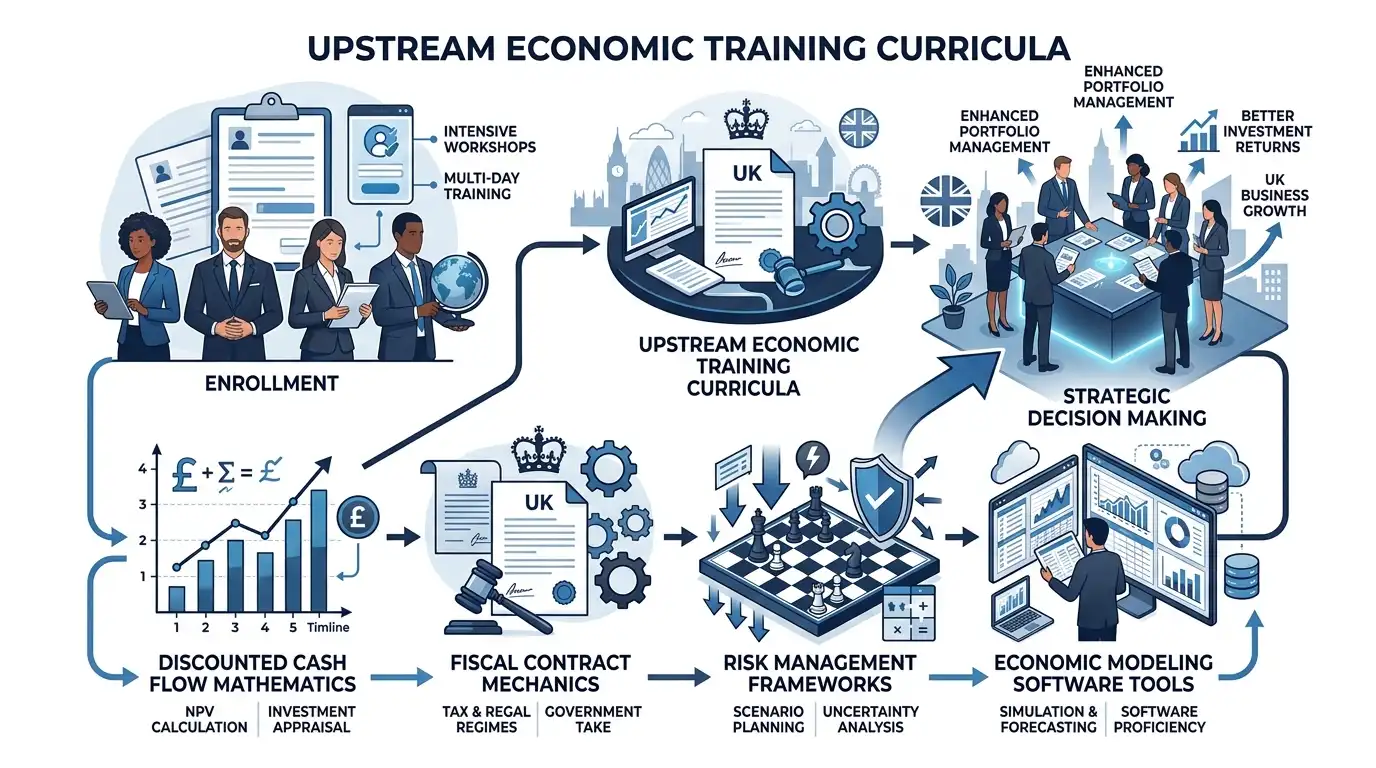
Designing an effective professional development curriculum requires the integration of specific analytical components and technical frameworks. Organizations must ensure that training content covers the full spectrum of upstream value creation. The first core component is financial mathematics. Professionals learn to apply time value of money principles, discount cash flows, and compute net present value across varying economic lifespans.
The second component involves fiscal regime analysis. Training modules cover the structural differences between concession systems and production sharing contracts. Learners study royalty rates, cost recovery limits, profit oil splits, and petroleum resource rent taxes. Understanding these fiscal mechanics is vital because government take directly dictates contractor net cash flows.
The third component centers on cost estimation and categorization frameworks. Participants examine capital expenditure estimation methodologies, contingency planning, abandonment liabilities, and operating expenditure modeling. They utilize industry-standard economic evaluation tools and spreadsheet modeling platforms to execute sensitivity analyses.
Training delivery occurs through structured formats tailored to corporate schedules. Intensive workshops span three to five days of immersive classroom instruction. Online digital modules provide self-paced learning for global workforces, while hybrid learning models combine virtual lectures with face-to-face practical labs. Organizations track training efficacy using performance metrics such as post-training knowledge retention scores, competency rubric evaluations, and subsequent project evaluation accuracy rates.
What Strategic Benefits Do Structured Economic Training Programs Deliver to Enterprises?
Structured economic training programs deliver measurable enterprise benefits, including a 22% reduction in capital allocation errors, enhanced cross-functional team efficiency, and stronger leadership pipelines across technical departments.
Investing in workforce development yields substantial organizational impact. When petroleum engineers and commercial analysts possess a unified understanding of field economics, organizational silos dissolve. Collaboration between subsurface teams and commercial departments improves significantly, resulting in streamlined asset development plans.
Enhanced financial literacy directly impacts corporate performance metrics. Organizations report measurable improvements in project governance. Teams equipped with advanced economic evaluation skills identify fatal flaws in project economics early in the screening phase, preventing unprofitable capital deployment. This analytical rigor reduces capital misallocation by approximately 22% across multi-asset portfolios.
Furthermore, structured training programs strengthen the internal leadership pipeline. Organizations foster a culture of excellence and integrity by ensuring that technical recommendations submitted to executive boards are commercially robust and rigorously tested against commodity price volatility. Employee retention rates increase by 15% among high-potential technical staff when enterprises demonstrate a commitment to continuous professional development and career growth.
Workforce transformation initiatives also enhance industry reputation. Organizations that prioritize practical, outcome-based learning maintain a competitive advantage in attracting top-tier engineering and commercial talent. Teams operate with higher confidence, driving operational efficiency and maximizing asset value throughout the production lifecycle.
How Do Diverse Corporate Teams and Industrial Sectors Apply Field Economic Principles?
Multidisciplinary corporate teams, ranging from subsurface engineers to executive boards, apply field economic principles across diverse asset classes, including mature onshore fields, deepwater basins, and unconventional shale plays.
The application of upstream economic analysis extends across various functional roles within modern corporate environments. Asset managers utilize economic models to optimize well placement and determine optimal plateau durations for mature fields. Subsurface engineers evaluate secondary and tertiary recovery techniques against incremental capital costs to ensure positive net present value generation.
Different industrial sectors and asset classes demand specialized economic frameworks. For instance, unconventional shale developments in regions like North America require rapid-cycle economics characterized by short drilling cycles and high initial decline rates. Conversely, offshore deepwater projects in geographies like the Gulf of Mexico or the North Sea demand long-term capital allocation strategies spanning decades, incorporating complex subsea architecture and stringent environmental compliance expenditures.
Corporate planning departments utilize macroeconomic forecasting tools embedded in economic models to stress-test corporate portfolios against severe commodity price downturns. Business development teams apply these exact frameworks during mergers and acquisitions, conducting rigorous economic due diligence on producing assets and exploration acreage.
Team leaders and department heads leverage training insights to establish standardized Key Performance Indicators across business units. This standardization ensures that asset evaluation methodologies remain consistent, objective, and aligned with overarching corporate strategic goals regardless of geographical location or asset maturity.
What Common Problems and Misconceptions Undermine Upstream Training and Economic Analysis?
Upstream training initiatives and field economic evaluations frequently fail due to generic course content, detachment from real-world asset data, and overreliance on deterministic models that ignore probabilistic risk.
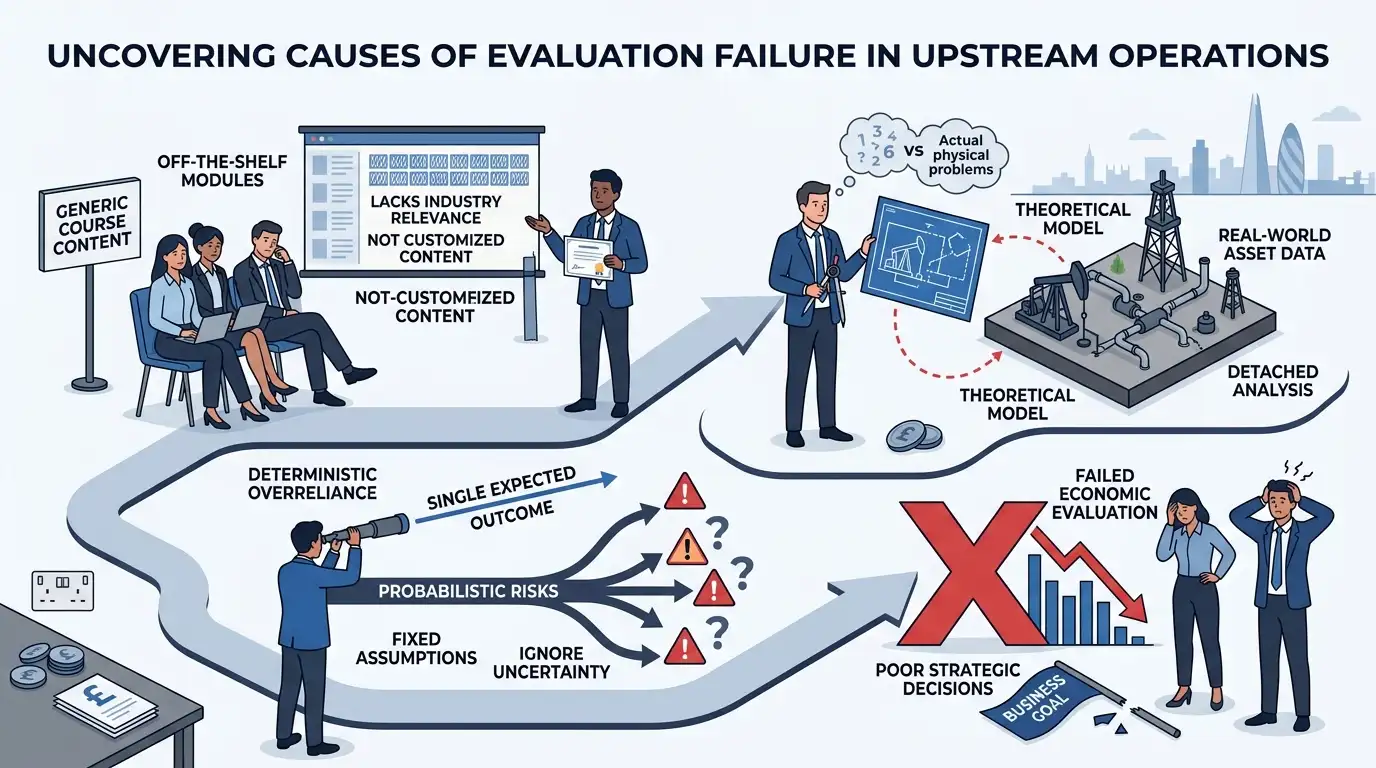
Organizations frequently encounter significant pitfalls when implementing workforce development programs and economic evaluations. A primary problem is the reliance on generic training programs that lack industry-specific context. Generic courses fail to address the unique fiscal, regulatory, and technical complexities of upstream petroleum assets, resulting in low knowledge retention and negligible workplace impact.
Another major misconception is that technical teams do not need commercial acumen. Engineering departments often operate under the assumption that technical success equals economic viability. This mindset ignores critical economic realities such as inflation, discount rate sensitivity, and fiscal ceiling limits. When engineers design complex extraction programs without factoring in capital cost escalation, project economics deteriorate rapidly.
Ineffective training delivery also undermines return on investment. Programs that rely solely on passive lectures without practical simulations or case-based learning fail to develop real-world problem-solving skills. Furthermore, in the realm of economic analysis, decision-makers often fall victim to deterministic bias, relying on single-point price forecasts rather than probabilistic Monte Carlo simulations.
Organizations eliminate these inefficiencies by aligning training content with actual operational challenges. By deploying outcome-based programs that emphasize real-world application, enterprises eradicate skill gaps, ensure rigorous project governance, and drive sustainable performance improvement across their global workforces.
Frequently Asked Questions
What is oil and gas petroleum finance and why is it important?
Oil and gas petroleum finance is a specialized financial discipline focused on managing capital allocation, cash flow modeling, and asset valuation for upstream and downstream energy projects. Through programs offered by the Institute For Oil & Gas Training, professionals learn how commodity price volatility, capital expenditures, and production profiles directly influence project viability. Mastering these financial frameworks enables organizations to optimize investment decisions and mitigate fiscal risks in complex energy markets.
How do organizations evaluate the economic viability of upstream oilfield assets?
Organizations evaluate upstream asset viability by utilizing discounted cash flow modeling to calculate net present value and internal rate of return under various pricing scenarios. The Institute For Oil & Gas Training equips finance and technical teams with the skills to assess production decline curves, fiscal regimes, and operating costs accurately. This rigorous economic sensitivity analysis ensures capital is allocated efficiently across both onshore and offshore developments.
What core skills are taught in professional petroleum finance training programs?
Professional petroleum finance training covers time value of money principles, concession contracts, production sharing agreements, and capital cost estimation methodologies. Courses provided by the Institute For Oil & Gas Training integrate practical case studies and financial simulations to bridge skill gaps between engineering and commercial departments. Participants gain hands-on experience in constructing economic evaluation models that align with real-world corporate needs.
How does oil and gas petroleum finance training improve corporate decision-making?
Training technical and commercial teams in petroleum finance enhances cross-functional collaboration, resulting in streamlined asset development plans and reduced capital allocation errors. By understanding fiscal mechanics and economic risk management, decision-makers at the Institute For Oil & Gas Training corporate clients can rigorously screen projects before committing major budgets. This analytical alignment improves overall project governance and maximizes long-term asset value.
Who should participate in specialized oil and gas finance courses?
Specialized oil and gas finance courses are designed for petroleum engineers, asset managers, commercial analysts, finance professionals, and decision-makers responsible for workforce development. The Institute For Oil & Gas Training delivers tailored programs that help multidisciplinary corporate teams master the economic drivers of modern energy markets. These outcome-based learning pathways support performance improvement and career growth across technical and financial sectors.
Related training courses
Ethics, Governance & Anti-Corruption for Host Governments Training Course
- Specialisation
- Oil & Gas Petroleum Compliance, AML & Risks
- Duration
- 5 days · 15 CPD hours
Internal Controls Over Financial Reporting Design Training Course
- Specialisation
- Oil & Gas Petroleum Compliance, AML & Risks
- Duration
- 5 days · 15 CPD hours
Month-End Close Acceleration for Upstream Operations & Cut-Off Training Course
- Specialisation
- Oil & Gas Petroleum Accounting
- Duration
- 5 days · 15 CPD hours
More articles

NPV and IRR Analysis for Comparing Alternative Oilfield Development Cases
Master net present value and internal rate of return methods to compare alternative oilfield development cases and optimize upstream capital allocation.
Read article →
How Petroleum Companies Assess the Commercial Viability of New Field Developments
Discover how petroleum companies train teams to assess field development commercial viability, optimize capital allocation, and drive project returns.
Read article →
Building Practical Oilfield Economics & Project Evaluation Skills for Petroleum Investment Decisions
Master petroleum investment decisions, NPV, IRR, and fiscal regimes with the Institute For Oil & Gas Training. Enroll today to elevate team performance.
Read article →