
Evaluating petroleum assets requires moving past single-metric assessments to capture the full economic realities of upstream investments. Capital allocation decisions in the oil and gas sector depend on robust financial models that balance profitability, time value of money, and fiscal vulnerability under volatile commodity cycles. Relying exclusively on static financial forecasts exposes organizations to severe capital misallocation, particularly when unexpected regulatory shifts or oil price contractions occur. Understanding Why NPV Alone Does Not Capture the Full Risk of an Oilfield Investment provides essential context on the limitations of traditional discounted cash flow metrics in isolation, highlighting why modern corporate finance demands a multi-faceted evaluative framework. Finance teams and asset managers must integrate Net Present Value, Internal Rate of Return, and fiscal sensitivity modeling to establish a resilient baseline for investment appraisal. This integrated approach ensures that corporate strategy aligns with both macroeconomic exposure and contractual fiscal terms governed by Host Government Contracts (HGCs).
How Do NPV and IRR Differ in Capital Allocation Decisions?
Net Present Value measures absolute wealth generation by discounting future cash flows at a specified hurdle rate, whereas Internal Rate of Return calculates the annualized percentage yield of an asset, identifying the exact discount rate that drives net present value to zero.

Net Present Value serves as the primary gauge of shareholder value creation in capital-intensive upstream developments. It aggregates all discounted cash inflows and outflows over the entire lifecycle of a petroleum field. A positive net present value indicates that the project exceeds the cost of capital, thereby adding tangible value to the enterprise. Large-scale offshore platforms or deepwater developments require massive upfront capital expenditures. Net present value captures the absolute scale of these financial commitments better than percentage-based metrics.
Internal Rate of Return evaluates the efficiency of capital deployment by expressing profitability as an annualized return rate. Asset teams use this metric to rank competing exploration and production opportunities regardless of project scale. However, internal rate of return assumes that intermediate cash flows are reinvested at the same internal rate, which creates distortions for projects with unconventional cash flow profiles. For instance, late-life abandonment expenditures or phased secondary recovery programs can generate multiple internal rate of return values, rendering the metric unreliable on its own.
Corporate finance committees must reconcile these metrics during capital rationing exercises. An upstream project with a high internal rate of return might offer minimal absolute net present value if the capital outlay is small. Conversely, a mega-project with a lower internal rate of return could deliver substantial absolute value to corporate reserves. Human resources and talent development departments within energy firms design specialized upskilling programs to ensure that commercial evaluation teams interpret these metrics accurately. Bridging the gap between technical subsurface data and financial metrics requires structured training initiatives, such as the Specialist Oilfield Economics Training program, which equips corporate analysts with advanced modeling competencies.
Evaluation Metric | Primary Financial Focus | Core Decision-Making Strengths | Inherent Analytical Limitations |
Net Present Value (NPV) | Absolute wealth creation and capital growth | Accounts for project scale and cost of capital | Ignores capital efficiency and reinvestment rate anomalies |
Internal Rate of Return (IRR) | Capital efficiency and percentage yield | Facilitates ranking of mutually exclusive options | Vulnerable to multiple rates and reinvestment fallacy |
Payback Period | Liquidity and capital recovery speed | Highlights immediate financial exposure and risk | Ignores cash flows generated after the payback threshold |
Why Is Fiscal Sensitivity Analysis Essential for Upstream Assets?
Fiscal sensitivity analysis isolates how variations in key economic variables, including commodity prices, production decline rates, and fiscal terms, impact project profitability and contractor take under varying contractual regimes.
Upstream petroleum investments operate within complex fiscal frameworks dictated by Host Governments through Production Sharing Contracts, Concessions, or Risk Service Agreements. These contractual terms dictate how gross revenues are split between the state and the operating consortium. Royalty rates, cost recovery limits, profit oil splits, and petroleum fiscal sliding scales alter the risk-reward profile of an asset. Standard deterministic financial models fail because they assume static macroeconomic conditions across multi-decade asset lifecycles.
Fiscal sensitivity analysis applies deterministic stress tests and probabilistic modeling to identify critical project tipping points. Analysts evaluate how a ten dollar drop in Brent crude prices or a fifteen percent increase in capital expenditures affects the commercial viability of a marginal field. This process uncovers hidden vulnerabilities in cost recovery mechanisms. For example, under strict Production Sharing Contracts, high oil prices accelerate cost recovery, but progressive profit-sharing formulas can significantly increase state take, capping upside potential for the contractor.
Integrating fiscal sensitivity into routine economic evaluations protects corporations from severe downside exposure during market downturns. Organizations that implement rigorous sensitivity frameworks improve their portfolio resilience, ensuring that final investment decisions withstand regulatory changes and price volatility. Human resource directors and technical managers collaborate to build internal capability through targeted learning paths. Enrolling commercial teams in structured professional development via the Specialist Oilfield Economics Training curriculum ensures that financial analysts master the nuances of fiscal modeling and risk quantification.
How Do Production Sharing Contracts Alter Traditional Cash Flow Metrics?
Production Sharing Contracts fundamentally reshape traditional cash flow calculations by separating revenues into cost oil and profit oil, capping recoverable expenditures, and introducing sliding-scale state shares based on daily production rates or cumulative profitability metrics.
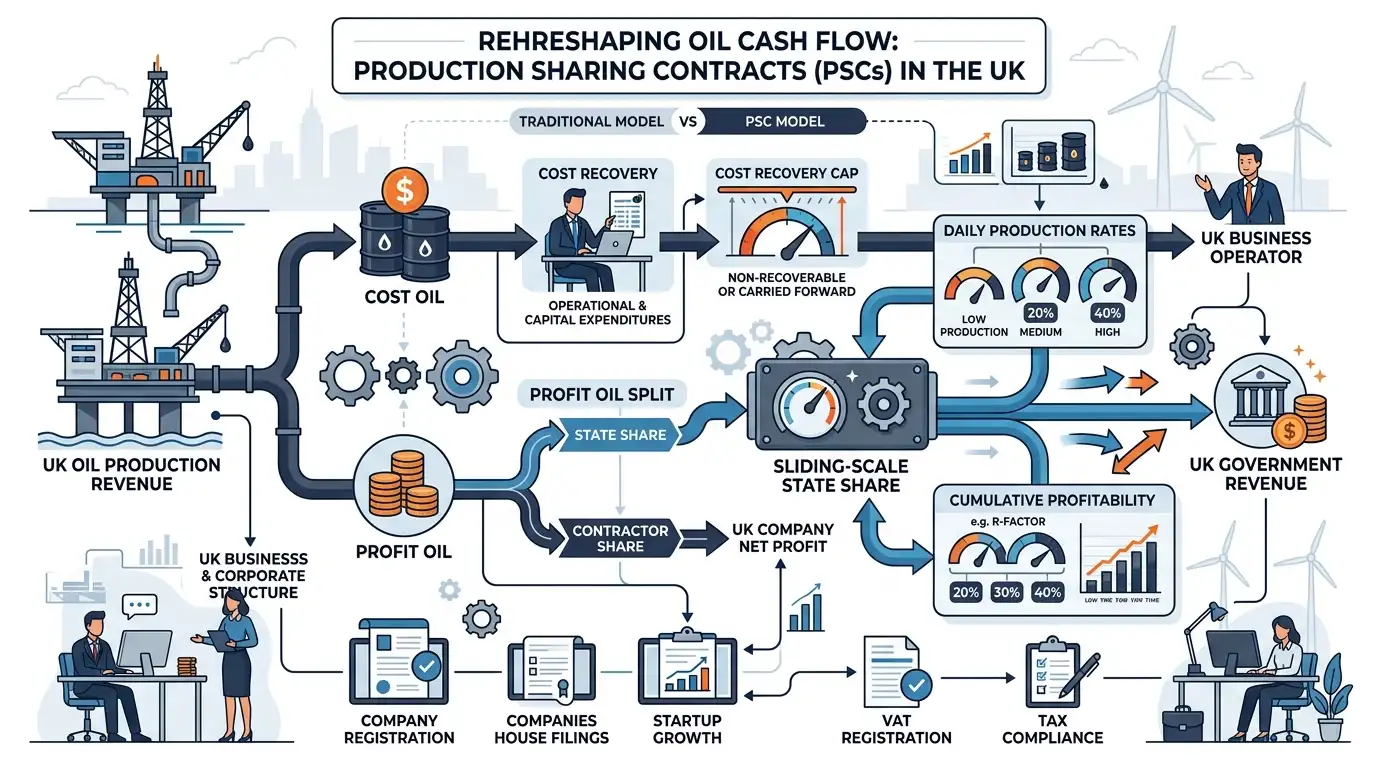
Under a standard concessionary system, the operating company owns the extracted hydrocarbons and pays royalties and taxes to the state. Production Sharing Contracts operate on a different legal and financial basis where the state retains ownership of the petroleum resources in place. The contractor provides upfront capital and technical expertise, recovering costs through a designated share of production known as cost oil. The remaining production, termed profit oil, is split between the host government and the contractor according to negotiated or sliding-scale formulas.
This contractual structure creates non-linear cash flow profiles that distort standard net present value and internal rate of return calculations. Cost recovery limits restrict the proportion of revenue an operator can claim in a single accounting period to cover capital expenditures. If capital costs exceed the annual cost recovery ceiling, the excess carries forward, delaying cash inflows and reducing the net present value of the project. Furthermore, sliding scales tied to R-factor metrics, which measure cumulative revenues against cumulative costs, alter government take dynamically as the project matures.
Evaluating assets governed by Production Sharing Contracts demands advanced analytical competencies from commercial evaluation teams. Financial analysts must simulate complex contractual mechanics alongside traditional discounting techniques. Organizations address internal skill gaps in fiscal modeling by deploying comprehensive capability-building frameworks. Programs like the Specialist Oilfield Economics Training course provide practical instruction on modeling diverse fiscal systems, ensuring that corporate decision-makers accurately assess contractor take and project exposure.
What Frameworks Optimize Decision-Making Under Uncertainty?
Decision-making frameworks under uncertainty integrate Monte Carlo simulations, decision trees, and real options analysis with core net present value and fiscal sensitivity models to quantify downside risk and optimize capital sequencing.
Deterministic valuation assumes single-point estimates for variables such as reservoir size, recovery factor, operating expenditure, and commodity price. In reality, subsurface uncertainties and market volatility introduce wide variance into project outcomes. Modern enterprise risk management employs stochastic modeling, specifically Monte Carlo simulations, to generate thousands of possible economic scenarios. By assigning probability distributions to key input variables, risk analysts produce a distribution of net present value and internal rate of return outcomes rather than a single deterministic figure.
Decision trees assist asset teams in mapping sequential investment choices, such as whether to appraise a discovery, drill an exploratory sidetrack, or abandon the lease following initial well results. Real options analysis extends this concept by treating managerial flexibility as a financial option. Upstream operators possess the valuable right to expand production, mothball facilities during low-price cycles, or abandon fields early. Valuing these operational flexibilities prevents the undervaluation of phased developments.
Implementing these sophisticated evaluation frameworks requires deliberate workforce development strategies. Human resource planners must assess organizational readiness and bridge technical skill gaps across commercial and subsurface departments. Structured learning interventions ensure that project economists and asset managers apply probabilistic techniques consistently. Deploying targeted educational assets, such as the Specialist Oilfield Economics Training initiative, accelerates organizational capability, driving superior capital allocation and measurable business performance in competitive energy markets.
Frequently Asked Questions
What is petroleum finance in the oil and gas industry?
Petroleum finance encompasses the specialized financial planning, capital budgeting, risk assessment, and economic modeling required to fund and manage upstream, midstream, and downstream energy assets. Programs offered by the Institute For Oil & Gas Training equip professionals with the expertise to evaluate complex petroleum investments, manage commodity price volatility, and optimize fiscal regimes.
How do NPV and IRR apply to petroleum project evaluation?
Net Present Value (NPV) and Internal Rate of Return (IRR) are core discounted cash flow metrics used to assess the profitability and capital efficiency of oil and gas ventures. Institute For Oil & Gas Training programs teach analysts how to reconcile absolute wealth creation from NPV with percentage-based returns from IRR under various production-sharing contracts.
Why is fiscal sensitivity analysis important in oil and gas economics?
Fiscal sensitivity analysis evaluates how fluctuations in commodity prices, operating costs, and contractual fiscal terms impact government take and contractor profitability over an asset's lifecycle. Through Oil and Gas Petroleum Finance courses from the Institute For Oil & Gas Training, finance teams learn to model these stress tests to protect upstream investments against severe market downside exposure.
What is the role of a petroleum project economist?
A petroleum project economist models field development cash flows, evaluates capital expenditures, analyzes Host Government Contracts, and runs probabilistic risk simulations to support final investment decisions. The Institute For Oil & Gas Training bridges skill gaps in corporate finance by delivering targeted professional training focused on upstream economic appraisal and fiscal modeling.
How do Production Sharing Contracts impact upstream cash flows?
Production Sharing Contracts (PSCs) split extracted hydrocarbons into cost oil and profit oil, introducing sliding-scale state shares and expenditure recovery limits that create non-linear cash flow profiles. Oil and Gas Petroleum Finance training from the Institute For Oil & Gas Training provides specialists with the advanced methodologies needed to accurately value assets governed by complex contractual frameworks.
Related training courses
Risk Management for Upstream & Midstream Projects Fundamentals Training Course
- Specialisation
- Oil & Gas Petroleum Compliance, AML & Risks
- Duration
- 5 days · 15 CPD hours
Payment Controls & Treasury Governance for JV Disbursements Training Course
- Specialisation
- Oil & Gas Petroleum Treasury, Cash and Banking
- Duration
- 5 days · 15 CPD hours
Automation of JV & PSC Reporting: Data Integration Training Course
- Specialisation
- Oil & Gas Petroleum Digital Finance & Automation
- Duration
- 5 days · 15 CPD hours
More articles

NPV, IRR & Fiscal Sensitivity Analysis Training for Oil & Gas Project Evaluation Professionals
Master NPV, IRR, and fiscal sensitivity analysis for upstream petroleum projects with structured professional training.
Read article →
Assessing Project Returns Under Changing Oil Prices, Costs and Petroleum Fiscal Terms
Evaluate upstream oil and gas project returns under changing commodity prices, cost inflation, and petroleum fiscal terms with expert financial models.
Read article →
How Fiscal Terms Can Change the Investment Case for an Oil and Gas Project
Discover how fiscal terms training equips oil and gas workforces to evaluate project returns, optimize capital allocation, and navigate regulatory complexity.
Read article →