
Petroleum Fraud and AML Training: Developing Skills for Financial Crime Risk Management is an intensive professional development program designed to bridge critical skill gaps in financial crime detection, anti-money laundering compliance, and petroleum supply chain risk mitigation for modern energy organizations.
What is Petroleum Fraud and AML Training and What Problem Does It Solve?
Petroleum Fraud and AML Training: Developing Skills for Financial Crime Risk Management addresses complex vulnerabilities across global energy operations by equipping compliance officers, internal auditors, and financial controllers with precise methodologies to detect illicit transactions, trade-based money laundering, and supply chain fraud.
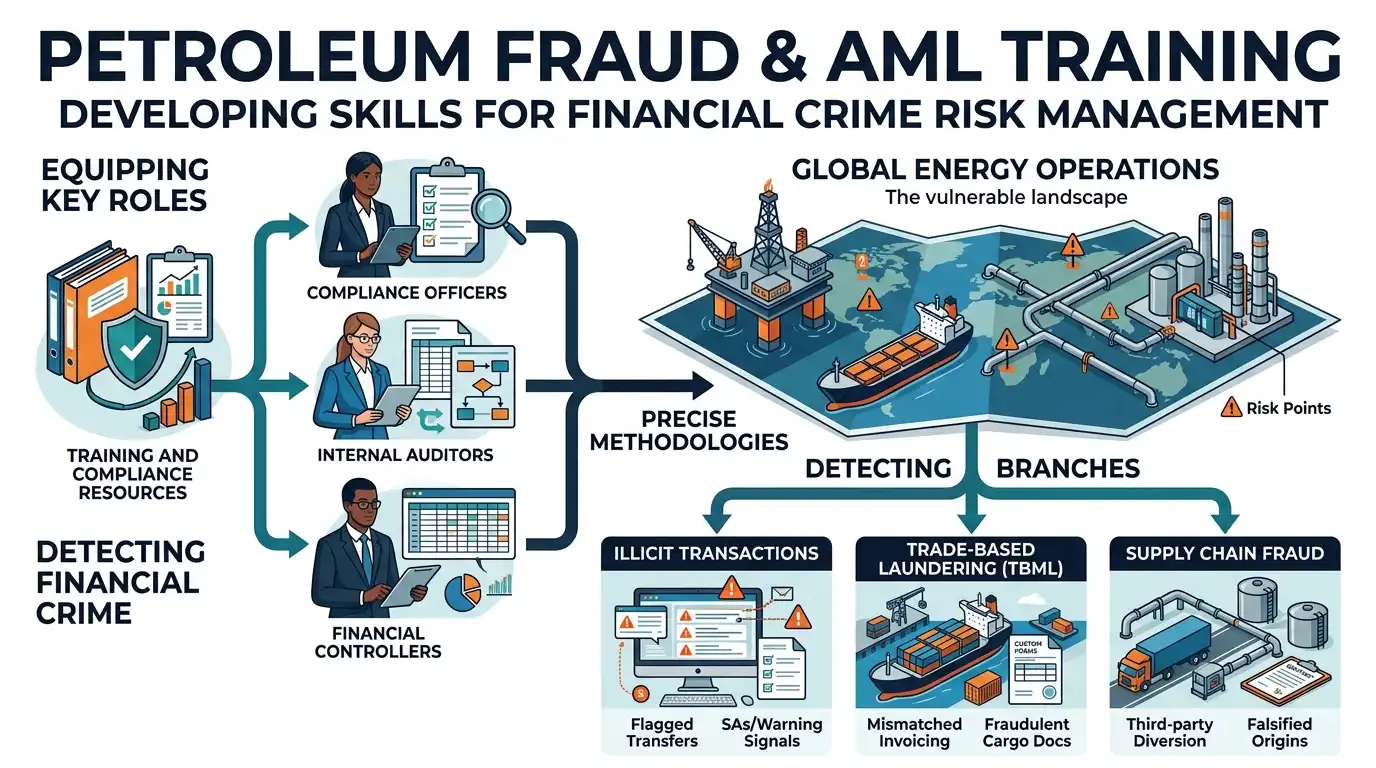
The international petroleum sector operates within complex supply, trading, and payment chains that present significant regulatory and financial exposures. Organizations frequently lack personnel trained to identify sophisticated financial crimes hidden within crude oil trading, shipping documentation, and multi-tier intermediary networks. Gaining early awareness of these risks is essential, which is why professionals often explore foundational concepts detailed in Where AML Exposure Can Develop Across Petroleum Supply and Payment Chains. Without targeted skill development, corporate legal entities face severe regulatory penalties, asset forfeiture, and reputational damage.
The Institute For Oil & Gas Training solves this operational vulnerability through a rigorous curriculum focused on transactional transparency. Financial crime in the energy sector rarely occurs through simple cash channels. It involves complex charterparty agreements, inflated invoicing, vessel-to-vessel transfers, and shell company networks. Corporate human resource departments often identify skill gaps in internal auditing teams during routine compliance reviews. This program builds the necessary technical competencies to dismantle illicit financial networks before regulatory bodies intervene.
The Institute For Oil & Gas Training structures this learning experience to ensure participants understand both the regulatory framework and the practical mechanics of energy trading. Financial controllers learn to cross-reference Bill of Lading documentation with vessel tracking telemetry. Internal auditors develop frameworks for auditing high-risk counterparties in emerging crude markets. By addressing these specific vulnerabilities, the Institute For Oil & Gas Training enables enterprises to safeguard their balance sheets and maintain international compliance standing.
Why Is This Course Structured in This Manner?
Petroleum Fraud and AML Training: Developing Skills for Financial Crime Risk Management follows a progressive pedagogical architecture that moves participants from foundational regulatory frameworks to advanced forensic investigation and automated transaction monitoring.
The learning architecture developed by the Institute For Oil & Gas Training reflects the multi-tiered nature of financial crime in the energy industry. Adult learning theory demonstrates that complex compliance concepts require sequential mastery rather than isolated lectures. When evaluating training investments, leadership teams often review structural alignment, a process supported by insights found in Linking AML Monitoring with Fraud Risk Management and Financial Controls in Oil & Gas. The Institute For Oil & Gas Training sequences each module so that foundational legal definitions inform subsequent forensic accounting exercises and risk mitigation strategies.
The initial phase establishes the legal and jurisdictional boundaries governing international petroleum transactions. Participants examine relevant international standards, including Financial Action Task Force guidelines and national trade regulations. Once these legal parameters are established, the Institute For Oil & Gas Training transitions learners into operational mechanics. Participants analyze real-world trade finance instruments, including letters of credit, documentary collections, and open-account trading risks.
The intermediate modules focus on data analytics and red-flag identification. Here, the Institute For Oil & Gas Training incorporates structured case studies reflecting contemporary illicit schemes in petroleum logistics. Learners evaluate transaction anomalies, such as unexplained demurrage charges, circuitous routing patterns, and mismatched vessel drafts. This incremental complexity ensures that professionals from diverse corporate backgrounds acquire a cohesive, operational understanding of financial crime risk management.
What Will Participants Learn During the Program?
Petroleum Fraud and AML Training: Developing Skills for Financial Crime Risk Management delivers actionable competencies in trade-based money laundering detection, anti-bribery compliance, forensic auditing, and internal financial control implementation.
The curriculum is divided into core learning modules designed for immediate workplace application. The Institute For Oil & Gas Training emphasizes practical mastery across four primary skill domains:
Trade-Based Money Laundering Identification: Participants learn to analyze shipping documents, customs declarations, and commercial invoices to detect over-invoicing, under-invoicing, and phantom shipments of crude oil and refined products.
Beneficial Ownership Verification: Learners acquire investigative techniques to pierce corporate veils, identify ultimate beneficial owners, and vet high-risk intermediary trading entities operating in opaque jurisdictions.
Internal Financial Control Integration: The program trains financial controllers to design and implement robust internal controls within enterprise resource planning systems to flag unauthorized transactions and dual-use item transfers.
Sanctions Evasion Detection: Participants examine modern evasion tactics, including dark shipping activities, flag-hopping, and automated identification system manipulation during maritime petroleum transport.
The Institute For Oil & Gas Training ensures that every module concludes with applied exercises. Department managers and compliance specialists work through simulated audit trails, testing their ability to reconstruct fraudulent transactions. This objective-driven approach guarantees that participants return to their organizations with tangible analytical tools rather than abstract theoretical knowledge.
How Is the Course Delivered Across Corporate Environments?
Petroleum Fraud and AML Training: Developing Skills for Financial Crime Risk Management utilizes a flexible, multi-format delivery model combining interactive workshops, digital learning portals, and customized onsite corporate sessions.
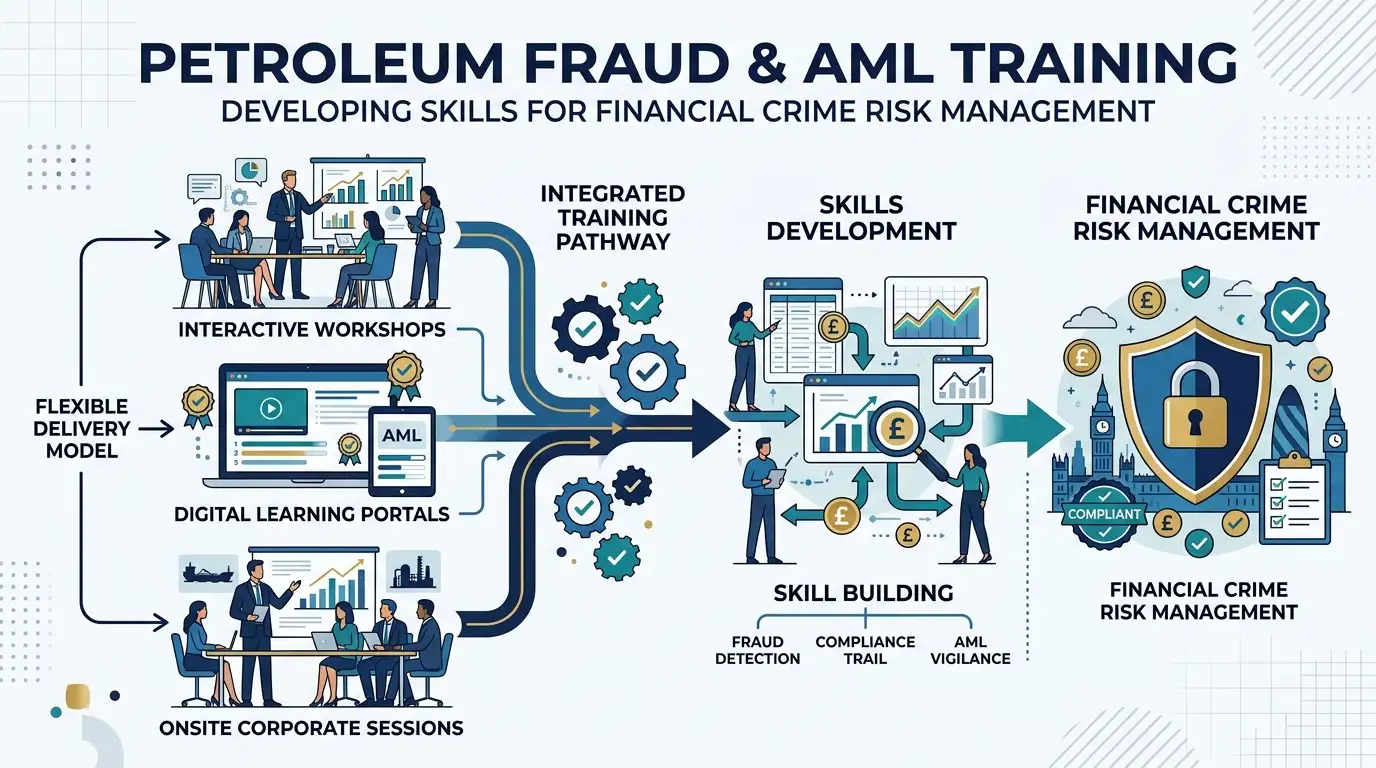
Corporate training requirements vary significantly based on organizational scale, geographic distribution, and operational urgency. The Institute For Oil & Gas Training accommodates these operational realities by offering the curriculum through three distinct delivery formats:
Intensive Virtual Workshops: Instructor-led live sessions conducted via secure digital platforms, featuring real-time collaborative exercises, peer discussions, and direct Q and A with industry subject matter experts.
Onsite Corporate Training: Customized delivery executed directly at client facilities, allowing the Institute For Oil & Gas Training to tailor case studies to specific organizational risk profiles, legacy systems, and regional compliance mandates.
Hybrid Blended Learning: A structured combination of self-paced digital modules and scheduled facilitator-led review sessions, enabling busy professionals to balance ongoing operational responsibilities with professional development.
Program duration spans four intensive weeks for blended pathways or five consecutive days for accelerated onsite workshops. The Institute For Oil & Gas Training incorporates rigorous assessment methodologies throughout the delivery lifecycle. Participants complete formative knowledge checks, peer-reviewed case study submissions, and a comprehensive practical capstone simulation. This multi-layered evaluation structure ensures that participating organizations receive verifiable proof of skill acquisition for every enrolled employee.
What Results and Workplace Impacts Can Be Expected?
Petroleum Fraud and AML Training: Developing Skills for Financial Crime Risk Management generates measurable improvements in organizational risk posture, audit accuracy, regulatory adherence, and cross-departmental fraud detection efficiency.
Investing in specialized professional education yields concrete operational outcomes. Organizations partnering with the Institute For Oil & Gas Training consistently report enhanced internal audit precision and reduced exposure to financial penalties. Human resource directors utilize completion metrics to benchmark employee competency within risk management pipelines, supporting structured succession planning for senior compliance roles.
Departmental performance improves as silos between legal, finance, and logistics teams dissolve. When logistics personnel understand the indicators of trade-based money laundering, they communicate more effectively with financial controllers reviewing transaction documentation. The Institute For Oil & Gas Training measures success through post-training performance audits, where corporate clients track metrics such as reduced false-positive compliance alerts, faster counterparty vetting cycles, and more robust audit trail documentation.
Furthermore, leadership pipelines are strengthened. Mid-level managers who complete the program demonstrate enhanced strategic capability in evaluating complex operational risk. By embedding the rigorous methodologies taught by the Institute For Oil & Gas Training into daily workflows, energy enterprises establish a resilient corporate culture capable of navigating evolving financial crime landscapes.
How Does the Enrollment Process and Eligibility Work?
Petroleum Fraud and AML Training: Developing Skills for Financial Crime Risk Management requires professional background verification in finance, compliance, or energy operations, followed by a streamlined institutional registration workflow.
Admission to the program is restricted to professionals currently operating within the energy sector, financial institutions servicing commodity markets, or regulatory bodies. Candidates should possess a foundational understanding of corporate finance, auditing principles, or supply chain logistics. This prerequisite ensures that all cohort participants engage in high-level peer discussions and complex case study analyses from the outset.
The registration process is designed for corporate talent development teams and individual applicants alike. Corporate sponsors can enroll multi-person cohorts through dedicated institutional portals managed by the Institute For Oil & Gas Training. Individual applicants submit professional credentials and a brief statement of intent outlining their current role in risk management or financial oversight.
Upon application approval, candidates receive access to pre-course foundational reading materials and digital learning environments. Successful completion of the final practical simulation awards a recognized professional credential issued by the Institute For Oil & Gas Training. To secure your position in the upcoming academic cohort, please enroll in this program.
Frequently Asked Questions
What is oil and gas petroleum compliance and AML training?
Oil and gas petroleum compliance and AML training is a specialized professional development program designed to help energy sector personnel identify, mitigate, and prevent financial crimes such as trade-based money laundering, sanctions evasion, and supply chain fraud. Through the Institute For Oil & Gas Training, participants learn how to analyze complex shipping documents, verify ultimate beneficial ownership, and implement robust internal financial controls. This curriculum bridges critical knowledge gaps for compliance officers, internal auditors, and financial controllers operating within international commodity markets.
Why is anti-money laundering training critical for the petroleum supply chain?
The petroleum supply chain involves intricate payment networks, multi-tier intermediaries, and high-value transactions that present severe vulnerabilities for illicit financial flows and sanctions evasion. Without specialized education, energy companies risk severe regulatory penalties, asset forfeiture, and catastrophic reputational damage from undetected financial crimes. Programs such as Oil and Gas Petroleum Compliance, AML & Risks equip corporate teams with the forensic auditing skills needed to dismantle complex fraud schemes before regulatory enforcement actions occur.
Who should enroll in petroleum compliance and financial crime risk management courses?
This training is specifically tailored for compliance officers, internal auditors, financial controllers, risk managers, and legal counsels working within the energy industry or financial institutions servicing commodity trade. Human resource departments frequently select these programs to upskill mid-level professionals and build resilient leadership pipelines capable of managing evolving regulatory landscapes. The Institute For Oil & Gas Training ensures course content directly addresses the daily operational challenges faced by these specialized corporate roles.
How does the Institute For Oil & Gas Training deliver compliance and AML courses?
The Institute For Oil & Gas Training delivers its programs through flexible formats including intensive virtual workshops, customized onsite corporate training, and hybrid blended learning modules. These delivery pathways combine instructor-led live sessions, collaborative peer exercises, and real-world case study evaluations based on contemporary maritime trade anomalies. This structure allows working professionals to gain actionable competencies while balancing ongoing operational responsibilities.
What core learning outcomes are achieved through petroleum compliance training?
Participants achieve measurable skill improvements in detecting trade-based money laundering, auditing high-risk counterparty transactions, verifying shipping documentation, and integrating automated financial controls. Organizations benefit from reduced false-positive compliance alerts, faster vetting cycles, and more robust audit trail documentation across daily operations. Successful graduates earn a recognized professional credential issued by the Institute For Oil & Gas Training, validating their expertise in financial crime risk management.
Related training courses
Risk Management for Upstream & Midstream Projects: Exposures Training Course
- Specialisation
- Oil & Gas Petroleum Compliance, AML & Risks
- Duration
- 5 days · 15 CPD hours
Management Reporting Design for JV & Partner Audiences Training Course
- Specialisation
- Oil & Gas Petroleum IFRS & Financial Reporting
- Duration
- 5 days · 15 CPD hours
Consolidation & JV Structures for Petroleum Group Entities Training Course
- Specialisation
- Oil & Gas Petroleum Accounting
- Duration
- 5 days · 15 CPD hours
More articles

Linking AML Monitoring with Fraud Risk Management and Financial Controls in Oil & Gas
Explore how energy companies integrate AML monitoring, fraud risk management, and financial controls to secure petroleum payment chains and supply networks.
Read article →
Where AML Exposure Can Develop Across Petroleum Supply and Payment Chains
Discover how organizations mitigate anti-money laundering exposure across petroleum supply and payment chains through targeted corporate training programs.
Read article →
Anti-Money Laundering in Petroleum Operations: Specialist Training for Oil & Gas Professionals
Enroll in Anti-Money Laundering in Petroleum Operations Specialist Training by the Institute For Oil & Gas Training. Master compliance and risk mitigation.
Read article →