
Anti-money laundering monitoring, fraud risk management, and internal financial controls operate as interconnected defenses within the petroleum sector. Organizations combat sophisticated financial crimes by merging surveillance systems, transactional checks, and corporate oversight into a unified governance model. Modern energy enterprises face complex payment chains, cross-border asset transfers, and multi-layered supply networks that expose vulnerabilities to illicit financial flows.
Professionals exploring foundational concepts can review Where AML Exposure Can Develop Across Petroleum Supply and Payment Chains to understand the underlying mechanisms of financial risk in the energy sector. Integrating these investigative mechanisms protects balance sheets from regulatory penalties, asset seizures, and reputational damage.
How do anti-money laundering monitoring systems integrate with internal financial controls in petroleum operations?
Anti-money laundering monitoring systems integrate directly with internal financial controls by establishing continuous automated oversight of ledger entries, vendor disbursements, and trade finance transactions against pre-defined behavioral baselines and regulatory thresholds.
Petroleum accounting departments manage high-volume capital flows across international jurisdictions. Supply chain transactions involve complex invoicing schedules, charter party agreements, and joint-venture capital calls that complicate traditional ledger reconciliation. Financial controllers deploy automated transaction monitoring software that flags anomalies such as split invoicing, over-invoicing for charter vessels, and payments routed through high-risk offshore intermediaries. These surveillance tools feed data directly into enterprise resource planning platforms, ensuring that accounting entries comply with corporate anti-fraud mandates.
Internal controls mandate dual-authorization protocols for wire transfers exceeding specific monetary thresholds. Compliance teams map these control checkpoints directly to anti-money laundering alert parameters. When a transaction triggers a high-risk compliance alert, the enterprise resource planning system freezes the associated payment workflow pending forensic review by the internal audit department. This programmatic linkage prevents illicit disbursements from clearing the ledger, closing the gap between preventative financial controls and detective compliance monitoring.
Corporate governance structures rely on clear segregation of duties between operational procurement teams and financial approval authorities. Treasury personnel operate independent of commercial negotiation units to prevent unauthorized vendors from entering the vendor master file. Automated validation routines cross-reference vendor bank accounts against international sanctions lists before disbursement processing occurs. Finance committees review exception reports generated by these surveillance tools on a monthly basis, ensuring that control failures receive immediate remediation.
Energy corporations standardize their financial control frameworks across all operating subsidiaries to eliminate jurisdictional blind spots. Operating in regions with elevated corruption indices requires enhanced due diligence protocols for local service providers, rig operators, and customs brokers. Financial accountants reconcile physical cargo delivery reports with bill of lading documentation and settlement invoices. Discrepancies between physical asset movement and financial settlements trigger mandatory investigations by forensic accountants, protecting the enterprise from trade-based money laundering schemes.
What distinguishes fraud risk management from traditional compliance monitoring in oil and gas corporations?
Fraud risk management focuses on proactive identification and mitigation of intentional deception, asset misappropriation, and corruption by internal or external actors, whereas compliance monitoring centers on adhering to statutory regulations and external reporting mandates.
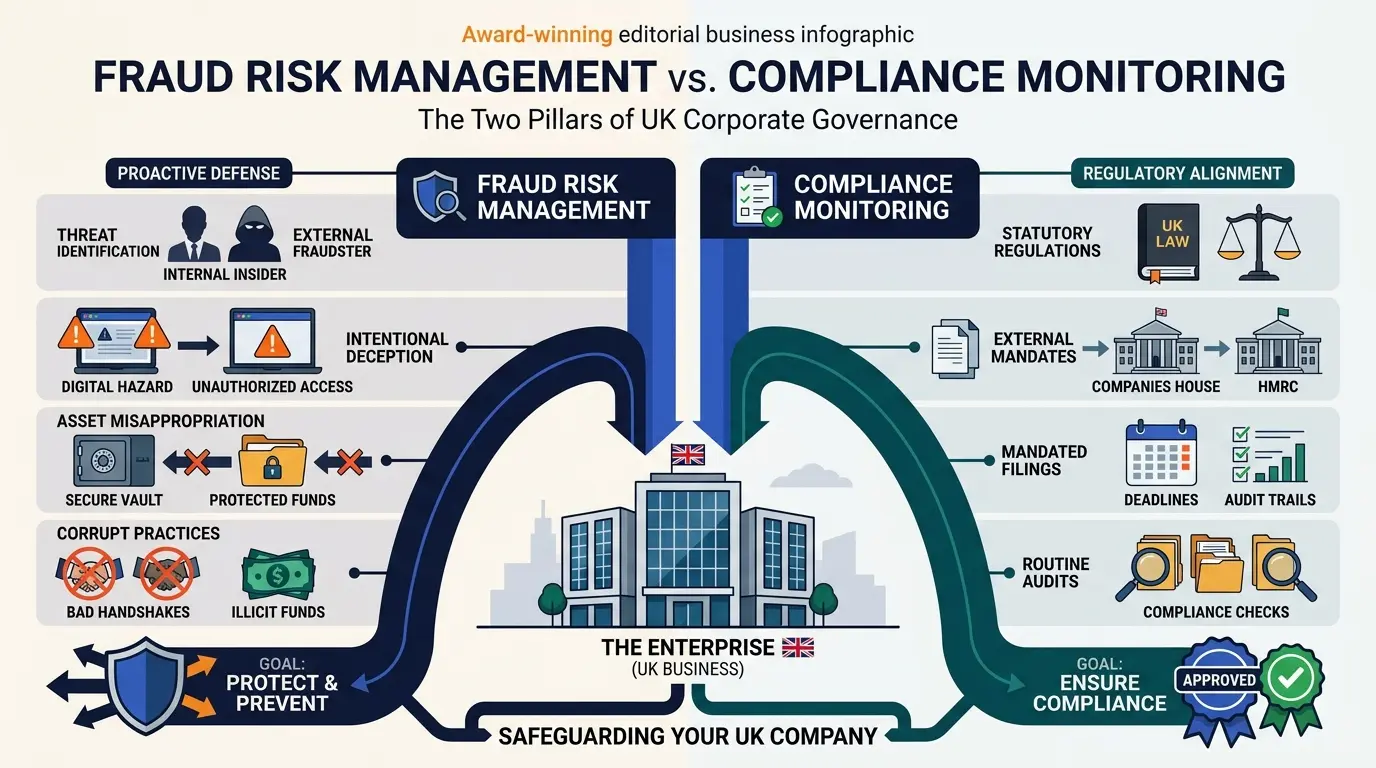
Traditional compliance monitoring operates on a reactive or rules-based framework designed to satisfy regulatory reporting obligations under statutory frameworks such as the Proceeds of Crime Act or the Foreign Corrupt Practices Act. Compliance officers track metric indicators such as the percentage of completed due diligence files, the volume of filed suspicious activity reports, and the timely renewal of vendor licenses. These metrics measure procedural adherence rather than the actual containment of financial loss or criminal infiltration.
Fraud risk management deploys psychological profiling, behavioral analytics, and forensic data mining to uncover deliberate schemes designed to circumvent standard operating procedures. Forensic investigators analyze procurement patterns, expense report anomalies, and inventory shrinkage data to detect ghost vendor setups, kickback schemes, and bribery networks. While compliance monitoring asks whether a transaction followed the documented approval workflow, fraud risk management asks whether the underlying commercial rationale for the transaction is legitimate or fictitious.
Organizations utilize structured risk assessment matrices to quantify exposure across operational business units. Upstream exploration divisions face distinct fraud risks compared to downstream retail distribution networks. Upstream projects involve large-scale capital expenditures on seismic data, drilling contracts, and pipeline construction, creating opportunities for bid-rigging and inflated contractor billing. Downstream operations involve high-volume cash transactions and retail fuel pricing schemes that attract skimming and unauthorized discounting.
Internal audit teams execute continuous testing methodologies to evaluate the design and operating effectiveness of anti-fraud controls. Data analytics tools screen procurement databases for duplicate invoice numbers, sequential purchase order creation, and common bank routing numbers across distinct supplier profiles. These investigations identify systemic control weaknesses that permit illicit actors to extract value from the enterprise. Resolving these vulnerabilities requires specialized professional capabilities, which corporate learning officers address through targeted programs such as Petroleum Fraud and AML Training: Developing Skills for Financial Crime Risk Management.
Energy companies incorporate anti-fraud metrics into executive performance scorecards to align leadership incentives with risk mitigation objectives. Business unit managers assume direct accountability for the financial integrity of their operations, including the prompt resolution of audit findings and the enforcement of ethical codes of conduct. Internal whistleblowing channels provide confidential reporting mechanisms for employees to disclose suspected financial misconduct without fear of retaliation, accelerating the detection of fraudulent activities before financial damage escalates.
How do cross-border payment structures and trade finance mechanisms create vulnerabilities for illicit financial flows?
Cross-border payment structures and trade finance mechanisms create vulnerabilities for illicit financial flows through opaque ownership chains, complex letter of credit arrangements, and the valuation difficulties inherent in global petroleum commodities trading.
International oil trading involves multiple intermediaries, charterers, and agents operating across varied regulatory jurisdictions. Transactions frequently utilize letters of credit issued by commercial banks in emerging markets, where transparency standards diverge from international benchmarks. Illicit actors exploit these structural complexities by interposing shell companies between the upstream producer and the end-buyer. These intermediaries issue inflated invoices for brokerage fees, transport logistics, or technical advisory services, siphoning capital out of legitimate corporate structures.
Trade-based money laundering relies on the misrepresentation of the price, quantity, or quality of petroleum products transported across borders. Criminal networks execute over-invoicing schemes to justify the transfer of funds from high-tax jurisdictions to offshore accounts. Conversely, under-invoicing allows entities to smuggle products without paying appropriate customs duties and royalties to sovereign governments. Energy finance teams counter these techniques by implementing rigorous market price benchmarking, independent surveyor weight verification, and comprehensive beneficial ownership screening for all trade counterparties.
Correspondent banking networks utilized by international energy firms enforce rigorous screening protocols to prevent the processing of illicit proceeds. Financial institutions analyze payment message fields for suspicious keywords, high-risk country indicators, and non-standard routing instructions. Treasury departments maintain dedicated desks that review international wire transfers for compliance with international trade sanctions and anti-money laundering legislation. Any payment routed through an unauthorized entity triggers an immediate compliance hold and subsequent investigation.
Joint-venture structures in developing energy markets introduce additional governance challenges for financial controllers. International oil companies frequently partner with state-owned enterprises or local private entities to execute large-scale extraction projects. Disbursing operational expenditures through joint-venture cash calls requires robust auditing rights and transparent accounting practices. Implementing integrated enterprise resource planning systems across all partner entities ensures that project costs match underlying vendor deliverables and prevent the diversion of project funds.
Organizations mitigate trade finance risks by enforcing stringent documentation standards for all physical commodity movements. Shipping manifests, certificates of origin, and independent inspection reports must reconcile with financial settlement terms before letters of credit reach final payment execution. Compliance officers cross-reference vessel identification numbers against international maritime databases to verify that transport entities are not subject to economic sanctions or involved in illicit ship-to-ship crude oil transfers.
How do enterprise resource planning systems and automated transaction monitoring deter financial crime?
Enterprise resource planning systems and automated transaction monitoring deter financial crime by centralizing financial data, enforcing hard-stop workflow controls, and executing real-time algorithmic analysis to detect unauthorized account modifications and suspicious transaction patterns.
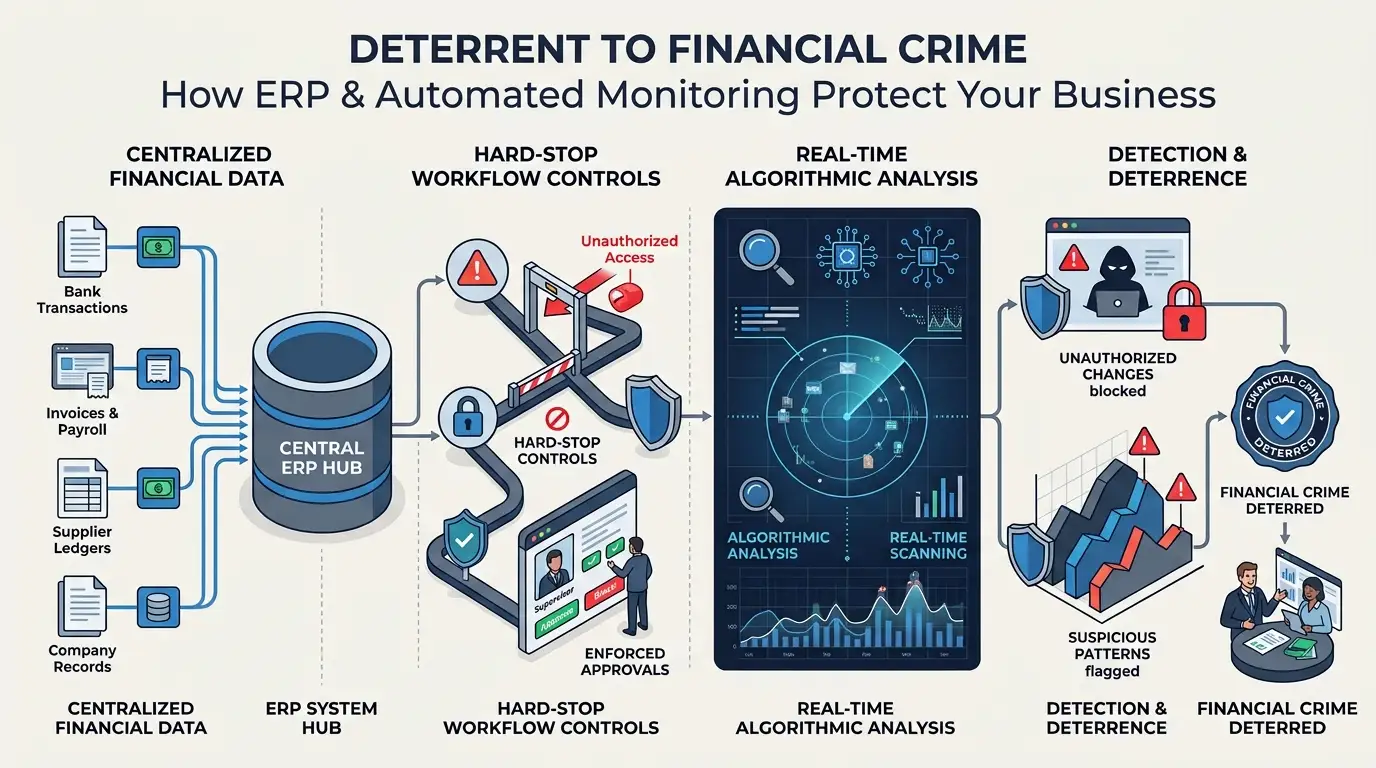
Modern energy corporations depend on centralized enterprise resource planning architectures to maintain a single source of financial truth across global operations. These platforms integrate procurement, accounting, human resources, and treasury functions into a unified database. Centralization eliminates the risk of unauthorized off-ledger accounting entries maintained by local business units. System administrators restrict user access permissions based on the principle of least privilege, ensuring that accounting personnel cannot simultaneously initiate and approve financial disbursements.
Automated transaction monitoring engines analyze millions of daily ledger entries using rule-based algorithms and machine learning models. These systems evaluate payment velocity, geographic risk indicators, and counterparty risk scores without manual intervention. When an anomalous transaction occurs, the monitoring platform generates an automated alert, routes the case to the appropriate compliance analyst, and logs the investigative audit trail for regulatory inspection.
Continuous auditing tools execute automated script routines against the enterprise database to identify segregation of duties violations. For example, the system flags instances where a single user profile possesses the authority to create a new vendor profile and subsequently approve invoices generated by that same vendor. Resolving these control deficiencies requires structured workforce development initiatives, delivered through programs such as the Institute For Oil & Gas Training, which equips financial personnel with the competencies needed to design and maintain resilient internal control environments.
Data analytics platforms empower forensic accountants to visualize complex transaction networks and identify hidden relationships between seemingly unrelated vendors. Social network analysis tools map common directors, shared physical addresses, and identical banking particulars across multiple supplier entities. Uncovering these connections exposes shell company networks established by corrupt insiders or external criminal syndicates attempting to defraud the enterprise.
Organizations measure the operational effectiveness of their enterprise resource planning controls through key performance indicators, including the percentage of automated invoice matches, the volume of segregation of duties violations detected and resolved, and the average time required to clear transaction monitoring alerts. Continuous optimization of these automated defense mechanisms ensures that financial crime risk management evolves alongside emerging technological threats and increasingly sophisticated criminal methodologies.
Frequently Asked Questions
How does petroleum compliance integration mitigate financial crime risks in the energy sector?
Institute For Oil & Gas Training delivers specialized programs that align anti-money laundering frameworks with internal financial controls to safeguard petroleum supply chains. Comprehensive oil and gas petroleum compliance, AML & risks training equips corporate finance teams to detect shell companies, trade-based money laundering, and suspicious cross-border payment flows.
What are the key regulatory requirements for anti-money laundering in upstream oil and gas operations?
Upstream operations require rigorous vendor due diligence, beneficial ownership screening, and continuous auditing of joint-venture capital calls to satisfy international statutory mandates. Energy corporations implement automated transaction monitoring to align ledger entries with regulatory thresholds and prevent illicit capital extraction across international borders.
How do internal financial controls prevent trade-based money laundering in petroleum shipping?
Financial controllers enforce dual-authorization protocols and independent surveyor weight verifications to reconcile physical cargo movements with commercial settlement invoices. These detective and preventative controls ensure that over-invoicing, charter party discrepancies, and unauthorized offshore intermediaries are identified before payment execution.
Why is specialized financial crime risk training necessary for energy sector accounting personnel?
Standard compliance monitoring often fails to uncover sophisticated fraud schemes designed to circumvent traditional corporate approval workflows. Targeted workforce education enables accounting professionals to deploy behavioral analytics, data mining, and forensic techniques that isolate anomalies within complex enterprise resource planning ledgers.
What role do enterprise resource planning systems play in petroleum fraud risk management?
Centralized enterprise resource planning architectures enforce strict segregation of duties and hard-stop workflow controls that restrict user permissions across global operations. Continuous automated script routines screen procurement databases for duplicate invoices, common bank routing numbers, and segregation of duties violations.
Related training courses
Segregation of Duties in Finance & ERP Systems Training Course
- Specialisation
- Oil & Gas Petroleum Compliance, AML & Risks
- Duration
- 5 days · 15 CPD hours
Management Reporting Design for JV & Partner Audiences Training Course
- Specialisation
- Oil & Gas Petroleum IFRS & Financial Reporting
- Duration
- 5 days · 15 CPD hours
Consolidation & JV Structures for Petroleum Group Entities Training Course
- Specialisation
- Oil & Gas Petroleum Accounting
- Duration
- 5 days · 15 CPD hours
More articles

Petroleum Fraud and AML Training: Developing Skills for Financial Crime Risk Management
Master financial crime risk management and AML compliance for the energy sector with specialized training from Institute For Oil & Gas Training.
Read article →
Where AML Exposure Can Develop Across Petroleum Supply and Payment Chains
Discover how organizations mitigate anti-money laundering exposure across petroleum supply and payment chains through targeted corporate training programs.
Read article →
Anti-Money Laundering in Petroleum Operations: Specialist Training for Oil & Gas Professionals
Enroll in Anti-Money Laundering in Petroleum Operations Specialist Training by the Institute For Oil & Gas Training. Master compliance and risk mitigation.
Read article →