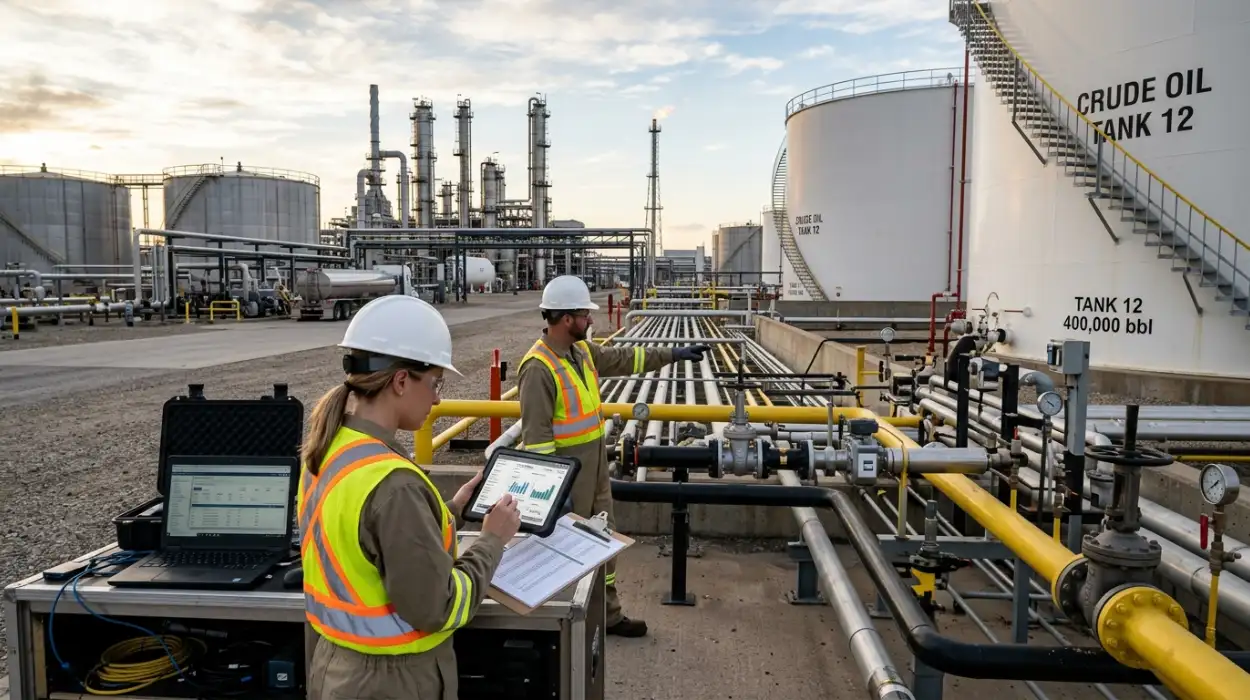
Inventory valuation, stock movements, and materials costing in the petroleum sector govern financial accuracy across complex supply chains. Energy enterprises handle high-value assets across remote exploration sites, processing refineries, and distribution terminals. Financial controllers, supply chain directors, and operational managers must evaluate how material flows interact with balance sheets and income statements. Precision in cost accounting prevents margin erosion caused by volatile commodity prices and expensive logistical overhead.
Organizations often begin their evaluation by examining foundational concepts, such as How Materials Management Influences Cost Control in Petroleum Operations for broader awareness before tackling advanced valuation techniques. Material movements in upstream and downstream facilities require robust tracking mechanisms to capture landed costs accurately. Without systematic valuation frameworks, petroleum organizations face audit discrepancies, distorted profitability metrics, and miscalculated capital expenditures.
How Does Inventory Valuation Impact Financial Reporting in Petroleum Enterprises?
Inventory valuation dictates the accuracy of balance sheets and taxable income by determining how enterprises assign historical or current market costs to drilling equipment, tubular goods, and refined petroleum products.
Petroleum accounting relies on established valuation methodologies to manage assets subject to extreme price volatility. Financial teams implement Specific Identification, First-In First-First-Out (FIFO), or Weighted Average Cost methods depending on asset characteristics and regulatory mandates.
Upstream exploration companies often utilize Specific Identification for specialized drilling assemblies and high-grade casing pipes. This method matches exact acquisition costs to specific projects, ensuring precise capital expenditure tracking for joint venture billing. Downstream refineries handle continuous fluid flows, making Weighted Average Cost or FIFO more practical for crude oil and refined product inventories.
Valuation frameworks must account for lower of cost or net realizable value rules. When global crude benchmarks decline, petroleum enterprises must write down inventory carrying values to reflect current market realities. This adjustment protects financial statements from overstating assets but introduces immediate earnings volatility.
Internal audit teams scrutinize valuation models to ensure compliance with International Financial Reporting Standards (IFRS) or Generally Accepted Accounting Principles (GAAP). Discrepancies in valuation directly skew cost of goods sold (COGS) figures, misleading executive leadership regarding true operational efficiency. Strategic asset management requires enterprise resource planning systems integrated directly with field inventory modules to capture price adjustments instantly.

Complex stock movements are driven by multi-tiered logistics networks, remote geographic deployments, and high-frequency transfers between rigs, warehouses, and export terminals.
Supply chain operations in the petroleum sector involve continuous physical movement of consumables, spare parts, and hydrocarbons. Tracking these movements requires rigorous documentation to prevent shrinkage, misplacement, and unauthorized usage at remote operational sites.
Stock movements generally follow distinct trajectories across the operational lifecycle. Upstream drilling campaigns generate heavy inbound logistics flows for drilling muds, chemicals, and heavy machinery. Midstream pipeline networks require constant monitoring of line-fill volumes and intermediate storage facility balances. Downstream refining operations demand precise tracking of feedstock intake and finished product distribution across tanker trucks and marine vessels.
Each transfer point represents a potential risk for accounting variance. Operational teams utilize barcode scanning, radio-frequency identification tags, and automated tank gauging systems to record inventory custody transfers. When field personnel execute stock transfers without updating enterprise resource planning ledgers, financial controllers face month-end reconciliation bottlenecks.
Mitigating these variances requires cross-functional collaboration between logistics supervisors and finance departments. Structured corporate education, such as the Inventory & Materials Accounting: What to Expect from Specialist Oil & Gas Accounting Training, equips operational and financial teams with the analytical capabilities needed to manage complex stock movement ledgers. Personnel learn to reconcile physical counts with perpetual inventory records, eliminating discrepancies before they reach executive dashboards.
How Do Enterprises Execute Materials Costing Across Upstream, Midstream, and Downstream Sectors?
Materials costing integrates purchase prices, freight tariffs, insurance, customs duties, and handling fees into a comprehensive landed cost figure assigned to every operational asset.
Calculating true materials cost in the energy industry extends far beyond the initial purchase order value. Procurement teams must account for total landed costs, which include hazardous material transport surcharges, port storage fees, and international tariff compliance.
Upstream operators face unique costing challenges when provisioning offshore drilling rigs. Transporting specialized completion equipment via charter vessels or heavy-lift helicopters inflates acquisition expenses. Accounting frameworks must allocate these supplementary logistics costs proportionally across the inventory items being delivered.
Midstream pipeline operators calculate materials costing based on line maintenance spares, corrosion inhibitors, and metering station components. These items directly impact operational uptime, making accurate costing essential for preventive maintenance budgeting.
Downstream facilities focus costing efforts on catalytic cracking inputs, additives, and maintenance repair operations supplies. Refineries operate under tight margins, meaning minor errors in materials costing distort product profitability analyses.
To achieve precision, finance departments deploy advanced cost-accounting frameworks supported by continuous professional development. Organizations utilize enterprise training initiatives, including the Institute For Oil & Gas Training, to bridge skill gaps between field engineers and corporate accountants. These programs emphasize practical modeling techniques that ensure every freight charge and handling fee is correctly allocated to the appropriate cost center.

Strategic optimization frameworks balance inventory holding costs against stockout risks by applying demand forecasting, vendor-managed inventory agreements, and rigorous classification models.
Excess inventory ties up vital working capital, while stockouts halt multi-million-dollar drilling operations. Petroleum enterprises utilize structured inventory optimization models to maintain equilibrium between operational readiness and financial liquidity.
ABC analysis serves as a foundational classification framework for energy inventories. Category A encompasses high-value, critical path items such as blowout preventer components and specialized valves, requiring stringent security and continuous monitoring. Category B includes moderate-value items with steady consumption rates, managed via periodic review systems. Category C covers low-value operational consumables managed through bulk reorder thresholds.
Vendor-managed inventory agreements shift holding costs to equipment suppliers while guaranteeing immediate availability at operational bases. This approach reduces warehouse carrying costs and minimizes the administrative burden of purchase order processing.
Effective inventory governance requires continuous capability building within supply chain teams. When organizations invest in targeted workforce development, they cultivate analytical competence needed to interpret valuation variances and optimize stock turnover ratios. Strategic alignment between financial accounting and operational logistics ensures sustainable cost control across all asset classes.
Frequently Asked Questions
What does oil and gas petroleum accounting involve?
Oil and gas petroleum accounting encompasses specialized financial tracking, cost allocation, and inventory valuation for upstream, midstream, and downstream operations. At the Institute For Oil & Gas Training, professional programs teach finance and supply chain teams how to manage joint venture billing, production sharing agreements, and depletion calculations accurately.
How do upstream and downstream accounting differ in the petroleum sector?
Upstream accounting focuses heavily on exploration, drilling capitalization, and field development costs, whereas downstream accounting deals with refining, distribution, and product margin analysis. The Institute For Oil & Gas Training provides tailored coursework to help financial controllers master these distinct operational frameworks and regulatory reporting standards.
Why is accurate inventory valuation critical for petroleum companies?
Precise inventory valuation ensures that balance sheets and taxable income correctly reflect the fluctuating market costs of crude oil, refined products, and high-value drilling assets. Through specialized training with the Institute For Oil & Gas Training, accounting professionals learn how to apply FIFO, weighted average, and specific identification methods to prevent financial misstatements.
What are the main challenges in petroleum materials costing?
Petroleum materials costing is complicated by remote logistics, hazardous transport surcharges, international customs duties, and multi-tiered supply chain transfers. The Institute For Oil & Gas Training equips industry practitioners with analytical methodologies to capture total landed costs and allocate expenditures correctly across operational cost centers.
How can energy enterprises improve financial compliance in their supply chains?
Energy enterprises enhance financial compliance by integrating enterprise resource planning software with field inventory modules and investing in targeted workforce education. The Institute For Oil & Gas Training delivers industry-driven corporate programs that bridge the gap between field logistics and corporate accounting to streamline audit readiness.
Related training courses
Upstream Cost Classification: Exploration to Production Phases Training Course
- Specialisation
- Oil & Gas Petroleum Accounting
- Duration
- 5 days · 15 CPD hours
Inventory & Materials Accounting: Drilling Consumables & Stock Training Course
- Specialisation
- Oil & Gas Petroleum Accounting
- Duration
- 5 days · 15 CPD hours
Fixed Assets & Capital Projects: AFE & Impairment Training Course
- Specialisation
- Oil & Gas Petroleum Accounting
- Duration
- 5 days · 15 CPD hours
More articles

Building Practical Oilfield Economics & Project Evaluation Skills for Petroleum Investment Decisions
Master petroleum investment decisions, NPV, IRR, and fiscal regimes with the Institute For Oil & Gas Training. Enroll today to elevate team performance.
Read article →
Evaluating Oilfield Development Scenarios Through NPV, IRR and Fiscal Sensitivity Analysis
Master oilfield development evaluation through NPV, IRR, and fiscal sensitivity analysis. Optimize upstream capital allocation with expert training.
Read article →
Why Oil Price, Production Profiles and Capital Costs Change Field Economics
Discover how oil price volatility and capital costs drive field economics. Learn corporate training strategies for upstream project valuation.
Read article →