
Inventory Valuation, Stock Movements and Materials Costing in Oil & Gas Operations represents a critical discipline for organizations seeking financial stability across complex supply chains. Institute For Oil & Gas Training delivers this specification-driven curriculum to address complex financial leakage points in petroleum infrastructure.
When organizations examine How Materials Management Influences Cost Control in Petroleum Operations, they frequently uncover significant expenditure variances arising from unrecorded stock movements, ambiguous material transfers between offshore platforms and onshore warehouses, and outdated valuation methodologies. These operational vulnerabilities stem directly from a persistent gap between technical warehouse management and financial accounting departments. Field supervisors track physical pipe, drilling mud, and spare equipment using operational metrics, while finance teams rely on delayed ledger entries. This operational disconnect creates valuation discrepancies, inflates carrying costs, and exposes enterprises to severe compliance risks during external financial audits. Institute For Oil & Gas Training resolves this systemic operational challenge by establishing a unified accounting framework that bridges physical materials handling with rigorous general ledger control. By standardizing asset tracking protocols, this training methodology enables corporate finance departments to monitor asset depreciation, optimize inventory holding thresholds, and enforce strict accountability across every tier of the petroleum supply chain.
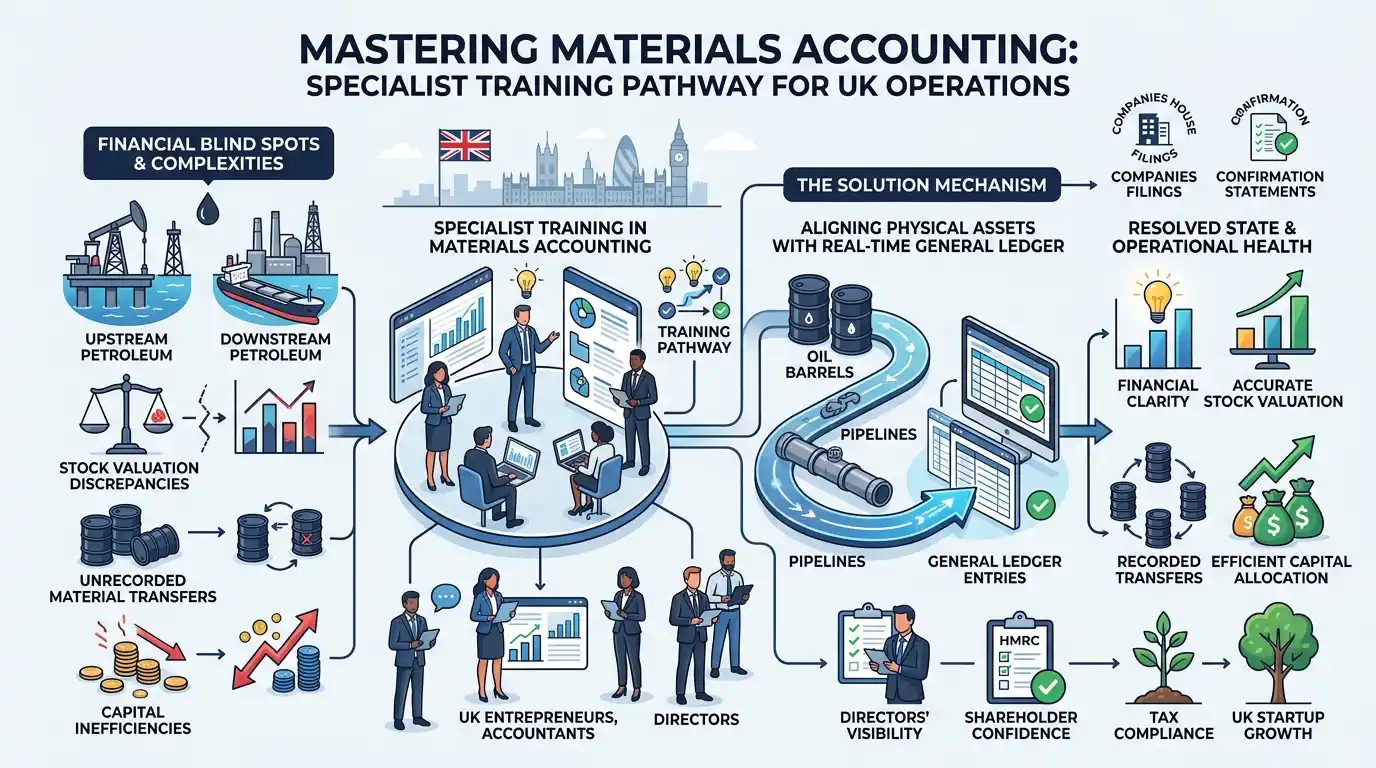
Specialist training in materials accounting eliminates financial blind spots by aligning physical asset movements with real-time general ledger entries, directly resolving stock valuation discrepancies, unrecorded material transfers, and capital inefficiencies across upstream and downstream petroleum operations.
Accounting for materials in the oil and gas sector presents unique logistical and valuation challenges due to the high-value, hazardous, and mobile nature of capital assets. Traditional corporate accounting frameworks often fail when applied to remote drilling sites, shared offshore storage yards, and long-lead-time procurement cycles. When field personnel execute emergency transfers without updating central ERP systems, finance teams encounter unaccounted inventory shrinkage and distorted cost-of-goods-sold calculations.
Institute For Oil & Gas Training designed this curriculum to eliminate these operational vulnerabilities through systematic ledger reconciliation. HR teams and operational managers frequently deploy this training when internal audits reveal recurring variances between physical stock counts and financial balance sheets. By standardizing how stock movements are categorized and valued, the program prevents the accumulation of obsolete inventory and reduces unnecessary capital lockup in warehouse stockyards.
Enterprise decision-makers utilize Institute For Oil & Gas Training frameworks to establish clear accountability matrices between procurement teams, warehouse supervisors, and corporate controllers. The curriculum addresses specific regulatory compliance requirements under international financial reporting standards for extractive industries, ensuring that asset impairment write-downs and depletion costs are calculated with absolute mathematical precision.
Why is the course structured this way?
The curriculum follows a progressive modular architecture that transitions participants from foundational inventory principles to advanced valuation mechanics and enterprise-wide financial reporting, ensuring complete comprehension before tackling complex multi-currency logistics scenarios.
Educational design within Institute For Oil & Gas Training relies on a cumulative learning model where each module builds directly upon previously mastered competencies. Adult professional education in technical sectors requires immediate workplace applicability combined with rigorous theoretical grounding. Therefore, the syllabus begins with baseline stock identification protocols and progresses systematically through transit accounting, cost allocation methodologies, and final financial statement disclosure.
Corporate talent development directors value this structured approach because it accommodates professionals from diverse organizational backgrounds. Whether participants originate from financial auditing, supply chain logistics, or plant administration, the standardized progression ensures uniform baseline competency. Institute For Oil & Gas Training incorporates diagnostic assessment checkpoints at the conclusion of each learning phase, verifying that participants have fully absorbed complex valuation rules prior to advancing to high-level managerial simulations.
The logical flow of the training minimizes cognitive overload by isolating distinct operational phases. For instance, temporary storage accounting is examined independently from permanent inventory write-offs, allowing participants to analyze distinct risk profiles without analytical confusion. This systematic architecture ensures that upon course completion, attendees can immediately reconstruct broken audit trails and implement robust internal controls within their respective departmental structures.
What will participants learn?
Participants master comprehensive inventory valuation techniques, physical-to-perpetual stock reconciliation methods, materials costing under fluctuating market conditions, and advanced auditing protocols designed specifically for high-value petroleum assets.
The educational journey within Institute For Oil & Gas Training is divided into four core skill domains that address every facet of petroleum materials accounting. Module one focuses on baseline asset identification and classification. Participants learn to categorize specialized tubular goods, wellhead components, and consumables in accordance with international accounting standards.
Module two addresses stock movement mechanics and transit accounting. Attendees analyze the financial impact of inter-company transfers, consignment stock management, and third-party warehouse liabilities. Practical exercises train participants to account for goods in transit between onshore staging areas and offshore drilling rigs, preventing revenue leakage during cross-border logistics operations.
Module three covers valuation methods, including FIFO, weighted average cost, and specific identification models under volatile commodity pricing environments. Participants calculate inventory lower-of-cost-or-net-realizable-value adjustments and manage impairment provisions for damaged or obsolete stock.
Module four integrates these technical mechanics into corporate financial reporting. Institute For Oil & Gas Training ensures attendees understand how inventory metrics influence EBITDA, working capital ratios, and capital expenditure disclosures. Corporate finance departments leverage these specific skill gains to streamline annual audit preparations and defend asset valuations before regulatory authorities.
How is the course delivered?
Delivery formats combine intensive instructor-led workshops, digital interactive simulations, and hybrid enterprise modules tailored to accommodate active operational schedules for global petroleum workforce deployments.
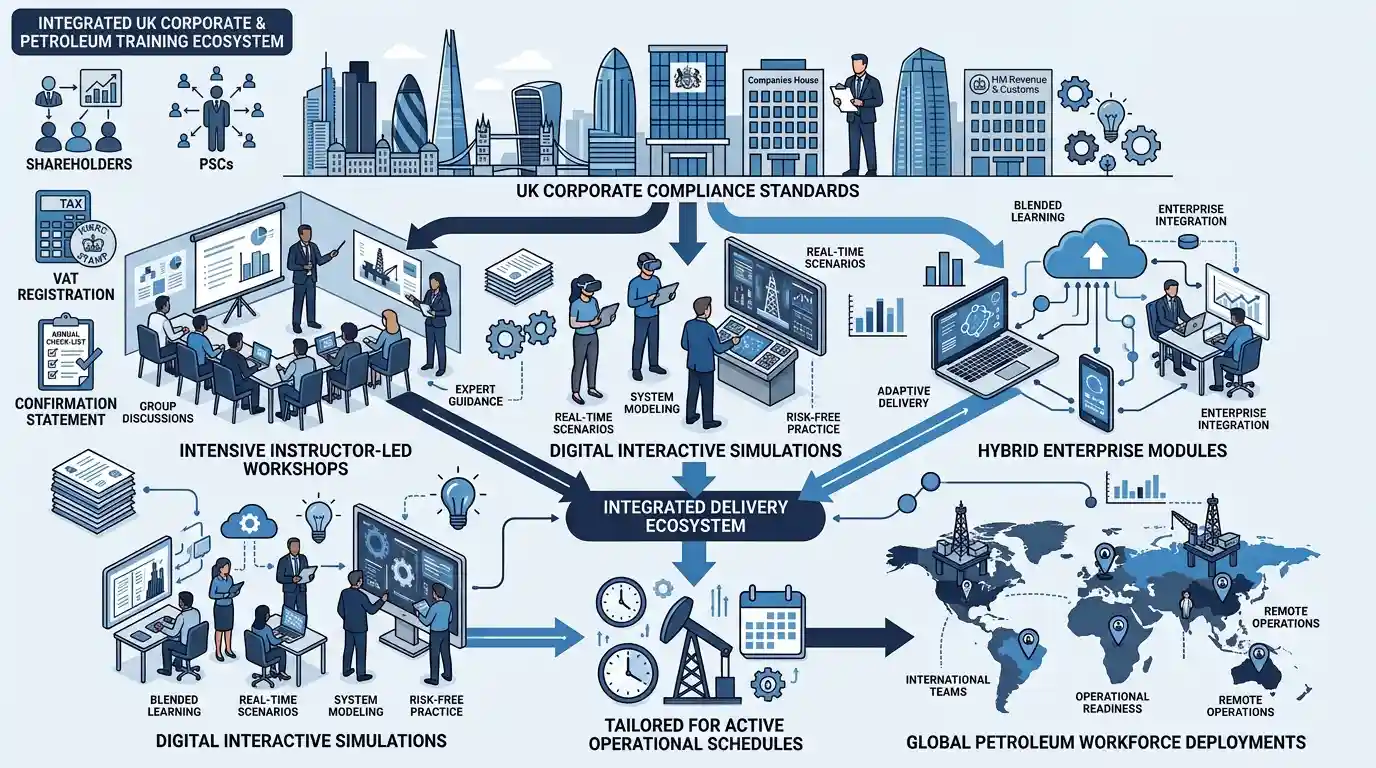
Flexibility and operational continuity remain primary considerations when organizations schedule workforce development initiatives. Institute For Oil & Gas Training offers versatile delivery modalities, including structured onsite corporate workshops, live virtual instructor-led sessions, and hybrid models that blend self-paced digital modules with intensive practical case study evaluations.
Onsite delivery allows specialized instructors to evaluate an organization’s legacy ERP workflows and physical warehouse layouts directly, tailoring practical exercises to match proprietary enterprise software configurations. Conversely, virtual delivery utilizes advanced collaborative workspaces, digital whiteboards, and simulated enterprise resource planning environments to replicate real-time multi-branch accounting scenarios.
Training duration is optimized for maximum knowledge retention without inducing operational fatigue among participating professionals. Standard program completion requires forty intensive contact hours distributed across one or two weeks, depending on the chosen delivery format. Institute For Oil & Gas Training maintains rigorous attendance tracking and interactive participation standards throughout all delivery channels, ensuring that remote attendees achieve parity with traditional classroom participants.
What results can be expected?
Measurable workplace transformations include a reduction in inventory discrepancy rates, accelerated month-end financial closing cycles, enhanced internal audit compliance, and improved inter-departmental collaboration between supply chain and finance teams.
Organizations investing in structured training experience immediate, quantifiable improvements in their financial reporting accuracy and asset utilization metrics. When warehouse supervisors and financial controllers share a common technical vocabulary, historical friction points—such as disputed stock write-offs and delayed invoice matching—are largely eliminated.
Departmental managers utilizing frameworks taught by Institute For Oil & Gas Training report a notable decrease in audit preparation time and a corresponding reduction in external audit adjustment recommendations. Furthermore, optimized inventory holding levels release trapped working capital, allowing corporate treasuries to reallocate funds toward strategic exploration and development initiatives.
HR leadership teams track these performance improvements through standardized pre- and post-training competency evaluations, monitoring key performance indicators such as stock reconciliation velocity and error frequency in materials ledger entries. Institute For Oil & Gas Training provides the empirical performance benchmarks necessary to validate training ROI and support internal leadership pipeline promotions.
How does enrollment work?
Admission requires professional foundational experience in corporate finance, accounting, or supply chain management, followed by a streamlined digital application process and verification of organizational sponsorship.
Target candidates for this specialized curriculum include corporate accountants, internal auditors, supply chain analysts, warehouse managers, and financial controllers operating within the energy sector. Applicants must demonstrate a basic working knowledge of general ledger accounting principles and familiarity with enterprise resource planning software environments.
The admission process is designed for immediate administrative clearance. Candidates begin by submitting professional background credentials and organizational affiliation details through the official registration portal. Institute For Oil & Gas Training academic advisors review applications within forty-eight hours to verify prerequisite alignment and ensure optimal peer group composition.
Upon successful application approval, participants receive secure access to preparatory digital reading materials and pre-assessment diagnostic tools. Organizations registering multi-person cohorts receive dedicated account management support to coordinate scheduling across diverse geographical operations. To secure professional certification and validate institutional competency, candidates must complete all module assessments and pass the final practical simulation examination. Take the next step in professional development and apply for course access to secure your placement in the upcoming academic cohort.
Frequently Asked Questions
What are the core components of oil and gas petroleum accounting?
Oil and gas petroleum accounting encompasses specialized financial tracking methods for exploration, development, production, and abandonment activities. At the Institute For Oil & Gas Training, programs focus on critical operational areas such as joint venture auditing, production sharing contracts, and depletion calculations. These practices ensure regulatory compliance and accurate financial reporting across upstream and downstream energy sectors.
How does successful petroleum accounting differ from standard corporate accounting?
Petroleum accounting requires distinct valuation methodologies due to high-risk capital investments, remote asset locations, and complex regulatory frameworks like successful efforts or full cost accounting. Institute For Oil & Gas Training courses instruct professionals on how to manage specialized transactions including mineral rights leasing, production royalties, and asset retirement obligations. This domain-specific expertise allows finance teams to properly evaluate long-term exploration expenditure against fluctuating commodity markets.
Why is specialized oil and gas petroleum training essential for corporate finance teams?
Specialized training bridges the gap between field-level operational logistics and corporate general ledger management to prevent financial leakage and valuation errors. Programs delivered by the Institute For Oil & Gas Training equip accountants with the analytical tools needed to optimize inventory holding costs and streamline multi-currency audit trails. Organizations utilize these targeted competencies to enhance inter-departmental collaboration between supply chain personnel and corporate controllers.
What are the primary regulatory standards governing petroleum accounting practices?
Petroleum accounting operations must strictly adhere to international financial reporting frameworks alongside specialized industry standards established by regulatory bodies like the US Securities and Exchange Commission or global equivalents. Curriculum modules from the Institute For Oil & Gas Training provide rigorous instruction on compliance mandates concerning reserve recognition, impairment testing, and environmental restoration liabilities. Mastery of these standards safeguards enterprises against severe financial penalties and audit discrepancies.
How can professionals advance their expertise in oil and gas petroleum accounting?
Professionals can elevate their technical competence by enrolling in structured, specification-driven courses that focus on advanced financial modeling, materials costing, and risk assessment methodologies. The Institute For Oil & Gas Training offers comprehensive professional development pathways designed for financial controllers, internal auditors, and supply chain analysts within the energy sector. These targeted educational formats ensure measurable skill improvements and strengthen organizational leadership pipelines.
Related training courses
Petroleum Industry Accounting Fundamentals: Successful Efforts vs Full-Cost Training Course
- Specialisation
- Oil & Gas Petroleum Accounting
- Duration
- 5 days · 15 CPD hours
Hydrocarbon Accounting & DVR Excellence: Refinery Operations Training Course
- Specialisation
- Oil & Gas Petroleum Accounting
- Duration
- 5 days · 15 CPD hours
Fixed Assets & Capital Projects: Wells to Facilities Training Course
- Specialisation
- Oil & Gas Petroleum Accounting
- Duration
- 5 days · 15 CPD hours
More articles
Building Practical Oilfield Economics & Project Evaluation Skills for Petroleum Investment Decisions
Master petroleum investment decisions, NPV, IRR, and fiscal regimes with the Institute For Oil & Gas Training. Enroll today to elevate team performance.
Read article →
Evaluating Oilfield Development Scenarios Through NPV, IRR and Fiscal Sensitivity Analysis
Master oilfield development evaluation through NPV, IRR, and fiscal sensitivity analysis. Optimize upstream capital allocation with expert training.
Read article →
Why Oil Price, Production Profiles and Capital Costs Change Field Economics
Discover how oil price volatility and capital costs drive field economics. Learn corporate training strategies for upstream project valuation.
Read article →