
The Fraud Risks in Petroleum Operations Training program is a rigorous, decision-stage professional education course designed to eliminate critical skill gaps in financial compliance, asset tracking, and internal control enforcement across high-stakes energy organizations. By bridging technical petroleum engineering workflows with advanced risk management frameworks, the curriculum addresses pervasive corporate vulnerabilities including procurement fraud, inventory misstatement, meter tampering, joint venture billing discrepancies, and unauthorized capital expenditure allocation. Professionals and organizational teams gain the analytical rigor required to detect anomalies, audit complex supply chains, and protect multi-million-dollar operational budgets against sophisticated illicit manipulation.
Modern energy enterprises operate within decentralized environments where traditional auditing techniques frequently fail to capture dynamic operational discrepancies. Supply chain transparency is consistently compromised by siloed departmental communication between technical field engineers, procurement officers, and corporate finance divisions. When technical supervisors lack foundational financial oversight training, procurement irregularities, fake vendor shell companies, and fraudulent measurement tickets remain undetected for extended financial quarters.
The Institute For Oil & Gas Training directly resolves these structural vulnerabilities through comprehensive educational engineering. By establishing rigorous competence standards across corporate departments, the Institute For Oil & Gas Training ensures that participating organizations move beyond reactive compliance models. Instead, internal teams build proactive detection capabilities that secure operational integrity from the drill-bit to the refinery gate.
Organizations often experience severe financial leakage due to inadequately trained personnel managing complex joint-operating agreements and international crude allocations. The Institute For Oil & Gas Training constructs its foundational pillars around eliminating these specific organizational blind spots. Human resources departments and department heads utilize the Institute For Oil & Gas Training methodologies to upskill multidisciplinary teams, thereby aligning technical field operations with strict fiduciary standards.
Why is this course structured this way?
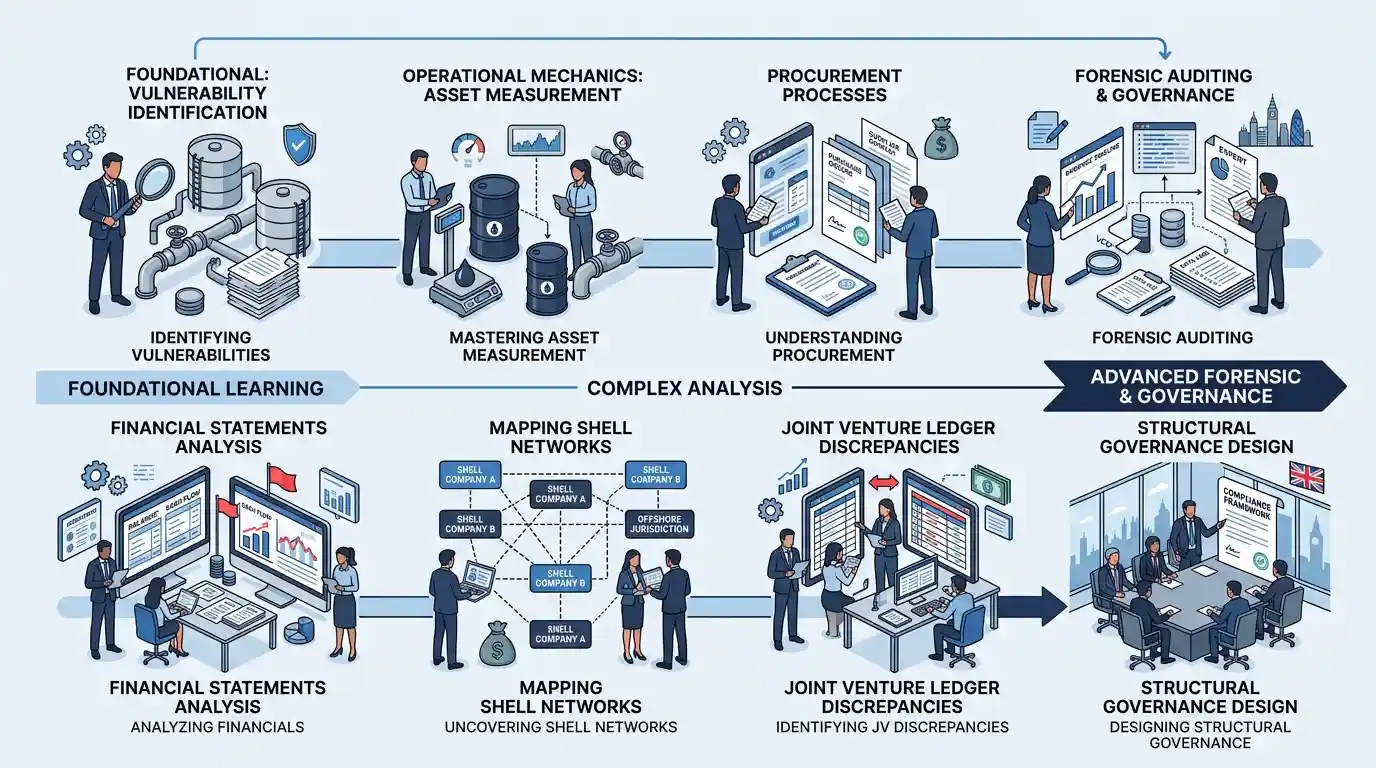
The curriculum follows a strict cognitive progression from foundational vulnerability identification to advanced forensic auditing and structural governance design. This pedagogical architecture reflects real-world operational workflows within the petroleum sector, ensuring that participants first master asset measurement and procurement mechanics before analyzing complex financial statements, shell company networks, and joint venture ledger discrepancies.
Building robust professional competence requires moving beyond theoretical compliance lectures into applied operational environments. As professionals evaluate intermediate investigation techniques, they can cross-reference methodologies detailed within Forensic Accounting Approaches for Investigating Fraud in Oil & Gas Transactions to deepen their technical proficiency in asset tracking and transactional ledger reconstruction.
The Institute For Oil & Gas Training curates each instructional module to match the exact decision-making cadence required by energy sector leaders. The curriculum design philosophy emphasizes practical application over passive learning, ensuring participants retain complex investigative mechanisms.
To maintain this standard of excellence, the Institute For Oil & Gas Training integrates rigorous evaluation checkpoints throughout the learning journey. These checkpoints validate that corporate learners can successfully execute risk assessments under simulated high-pressure operational conditions before applying them within their home organizations.
What will participants learn?
Participants achieve absolute mastery over petroleum-specific financial risk indicators, master meter-ticket verification, uncover procurement collusion schemes, and execute comprehensive internal control audits tailored to upstream exploration and downstream distribution networks. The learning modules systematically build competence in detecting asset misdirection, validating joint-interest billing statements, and designing infallible corporate anti-fraud policies.
Module 1: Anatomy of Petroleum Supply Chain Vulnerabilities
Mapping upstream, midstream, and downstream financial touchpoints.
Identifying high-risk procurement nodes and vendor onboarding loopholes.
Analyzing historical petroleum fraud cases and regulatory enforcement actions.
Module 2: Metering, Measurement, and Inventory Reconciliation
Evaluating custody transfer points and automated measurement systems.
Detecting physical inventory shrinkage versus accounting discrepancies.
Investigating falsified production reports and volumetric tampering schemes.
Module 3: Joint Venture Billing and Capital Expenditure Audits
Uncovering over-billing, misallocated overhead, and fictitious charges in joint-operating agreements.
Reviewing Authorizations for Expenditure (AFE) for scope creep and kickback indicators.
Reconciling partner ledgers using systematic data verification protocols.
Module 4: Corporate Governance and Anti-Fraud Program Design
Implementing whistleblower protocols tailored to high-risk remote operational sites.
Establishing zero-tolerance internal control frameworks and segregation of duties.
Training cross-functional teams on ethical decision-making and compliance enforcement.
Through these specialized learning divisions, professionals gain the precise technical capabilities required to secure modern energy operations against sophisticated financial exploitation.
How is the course delivered?
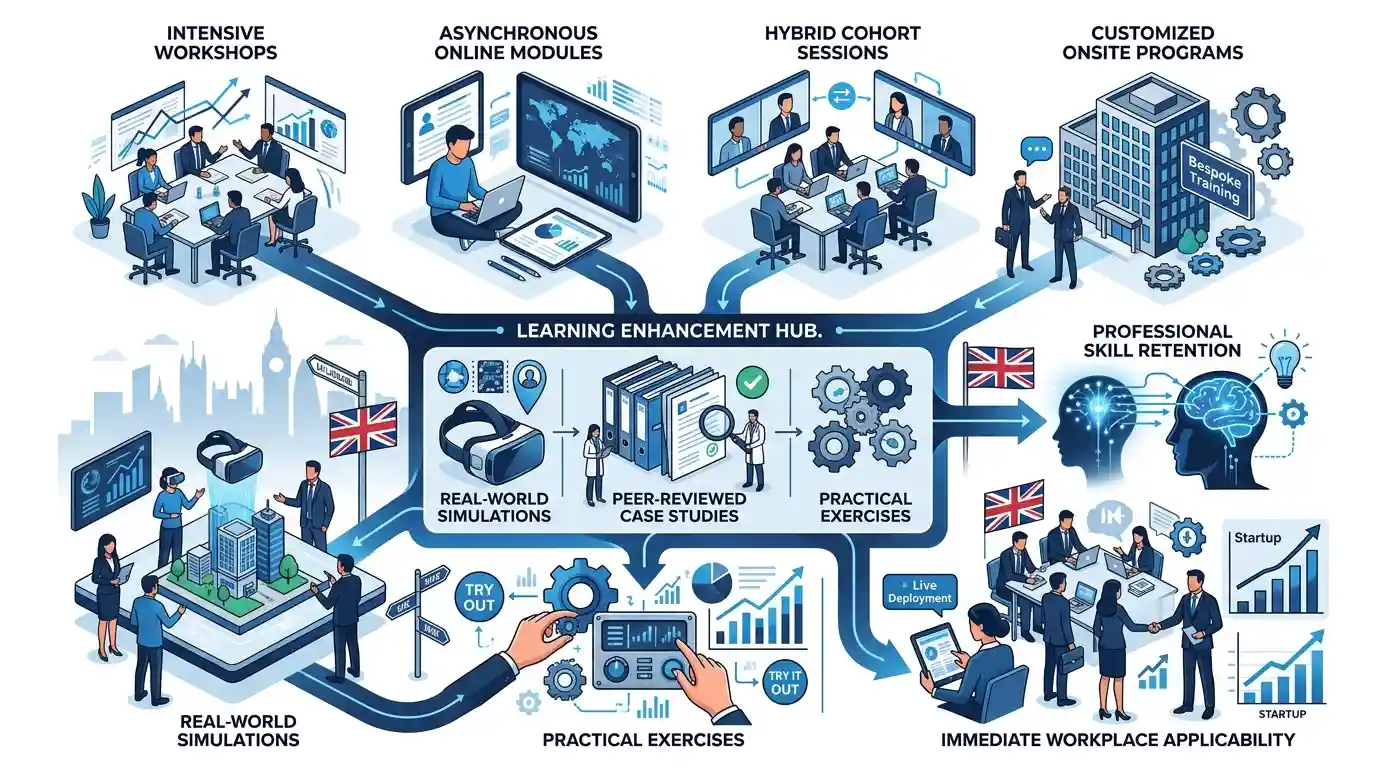
The training program is delivered through flexible, high-impact formats including intensive interactive workshops, asynchronous online modules, hybrid cohort sessions, and customized onsite corporate programs tailored to specific organizational workflows. Each delivery format incorporates real-world simulation scenarios, peer-reviewed case studies, and practical exercises designed to maximize professional skill retention and immediate workplace applicability.
Corporate scheduling constraints require adaptable educational architectures. The Institute For Oil & Gas Training accommodates diverse institutional needs by offering modular pacing options that allow working professionals to balance daily responsibilities with advanced skill acquisition.
Onsite delivery models allow instructors to evaluate specific corporate infrastructure directly, adapting simulation cases to match proprietary enterprise resource planning systems. Meanwhile, digital learning pathways ensure distributed global teams access identical high-grade educational content without operational interruption.
What results can be expected?
Organizations experience measurable improvements in internal control efficacy, a dramatic reduction in procurement leakages, enhanced cross-departmental collaboration between technical and financial teams, and the establishment of robust leadership pipelines capable of navigating complex regulatory landscapes. Participants leave the program equipped to immediately audit operational ledgers, identify red flags, and protect institutional capital.
When HR teams and department managers invest in workforce transformation, the return on investment manifests across multiple operational metrics. Internal audit cycles become significantly faster and more accurate, reducing the dwell time of fraudulent activities within corporate ledgers. Furthermore, participants cultivate enhanced professional confidence, positioning themselves for senior leadership roles in compliance, risk management, and operational oversight.
How does enrollment work?
Admission to the program requires basic professional experience in energy operations, finance, internal audit, or human resources management, paired with a commitment to completing all simulation assessments and practical evaluations. Candidates submit their professional credentials through the institutional portal for eligibility review, followed by selection of their preferred delivery format and final course registration.
Securing professional advancement within the energy sector requires proactive commitment to operational excellence. Qualified professionals, HR directors, and corporate teams ready to transform their organizational risk posture can enroll in this program today to secure their place in the upcoming academic cohort.
Frequently Asked Questions
What is covered in the Oil and Gas Petroleum Compliance, AML & Risks program?
The Institute For Oil & Gas Training provides comprehensive modules focusing on anti-money laundering regulations, fraud detection, and regulatory adherence tailored specifically for petroleum operations. Participants learn how to mitigate financial vulnerabilities across upstream, midstream, and downstream supply chains using practical risk management frameworks.
Why is petroleum compliance and anti-money laundering training essential for energy professionals?
Energy enterprises operate within complex international markets where illicit financial flows and procurement fraud pose severe operational and legal threats. Specialized education from the Institute For Oil & Gas Training equips internal audit teams and managers with the necessary tools to enforce strict fiduciary standards and prevent costly violations.
How do oil and gas companies identify financial risks and AML vulnerabilities?
Organizations deploy forensic auditing techniques, meter-ticket verification protocols, and joint-venture ledger reconciliations to uncover discrepancies in high-stakes transactions. Courses offered by the Institute For Oil & Gas Training train professionals to recognize red flags such as shell companies, inflated invoices, and volumetric tampering.
Who should enroll in Oil and Gas Petroleum Compliance, AML & Risks courses?
Compliance officers, internal auditors, human resources personnel, and technical managers in the energy sector benefit directly from specialized risk management education. The Institute For Oil & Gas Training designs its curriculum to bridge the gap between technical field operations and corporate financial governance.
What are the career benefits of completing a petroleum compliance and risk management certification?
Completing advanced training validates a professional's expertise in navigating intricate regulatory landscapes and safeguarding corporate capital against sophisticated illicit manipulation. Graduates from the Institute For Oil & Gas Training are well-positioned for leadership roles in compliance, risk assessment, and corporate governance within the global energy industry.
Related training courses
Regulatory Compliance for Petroleum Entities Training Course
- Specialisation
- Oil & Gas Petroleum Compliance, AML & Risks
- Duration
- 5 days · 15 CPD hours
Segregation of Duties in Finance & ERP Systems Training Course
- Specialisation
- Oil & Gas Petroleum Compliance, AML & Risks
- Duration
- 5 days · 15 CPD hours
Management Reporting Design for JV & Partner Audiences Training Course
- Specialisation
- Oil & Gas Petroleum IFRS & Financial Reporting
- Duration
- 5 days · 15 CPD hours
More articles

How Revenue, Inventory and Production Data Can Reveal Fraud Indicators
Learn how corporate training empowers teams to use revenue, inventory, and production data to detect operational fraud in oil and gas sectors.
Read article →
Developing Petroleum Fraud Risk Skills Through Specialist Oil & Gas Training
Master forensic accounting, vendor auditing, and procurement fraud detection with specialized oil and gas training. Enroll your team today.
Read article →
Detecting Procurement, Vendor and Payment Irregularities Through Forensic Accounting
Discover how forensic accounting detects procurement fraud, vendor collusion, and payment irregularities in capital-intensive energy operations.
Read article →