
Evaluating capital projects in the upstream energy sector requires rigorous modeling of dynamic variables that directly dictate asset profitability. Upstream asset evaluation differs fundamentally from standard corporate finance because cash flows face simultaneous exposure to commodity price volatility, capital expenditure inflation, and contractual government take mechanisms. Stakeholders must understand How Fiscal Terms Can Change the Investment Case for an Oil and Gas Project before structuring long-term asset models, as government take structures dictate how baseline revenues transform into realized net cash flows. Asset teams evaluate whether field developments remain economically viable when crude benchmarks shift downward while operational expenses escalate. This evaluative process determines asset prioritization, resource allocation, and portfolio resilience across diverse global basins.
How Do Fluctuating Crude Prices and Cost Inflation Impact Upstream Project Net Present Value?
Fluctuating crude prices and cost inflation directly erode upstream project net present value by compressing operating margins while simultaneously inflating capital expenditure requirements during development phases.
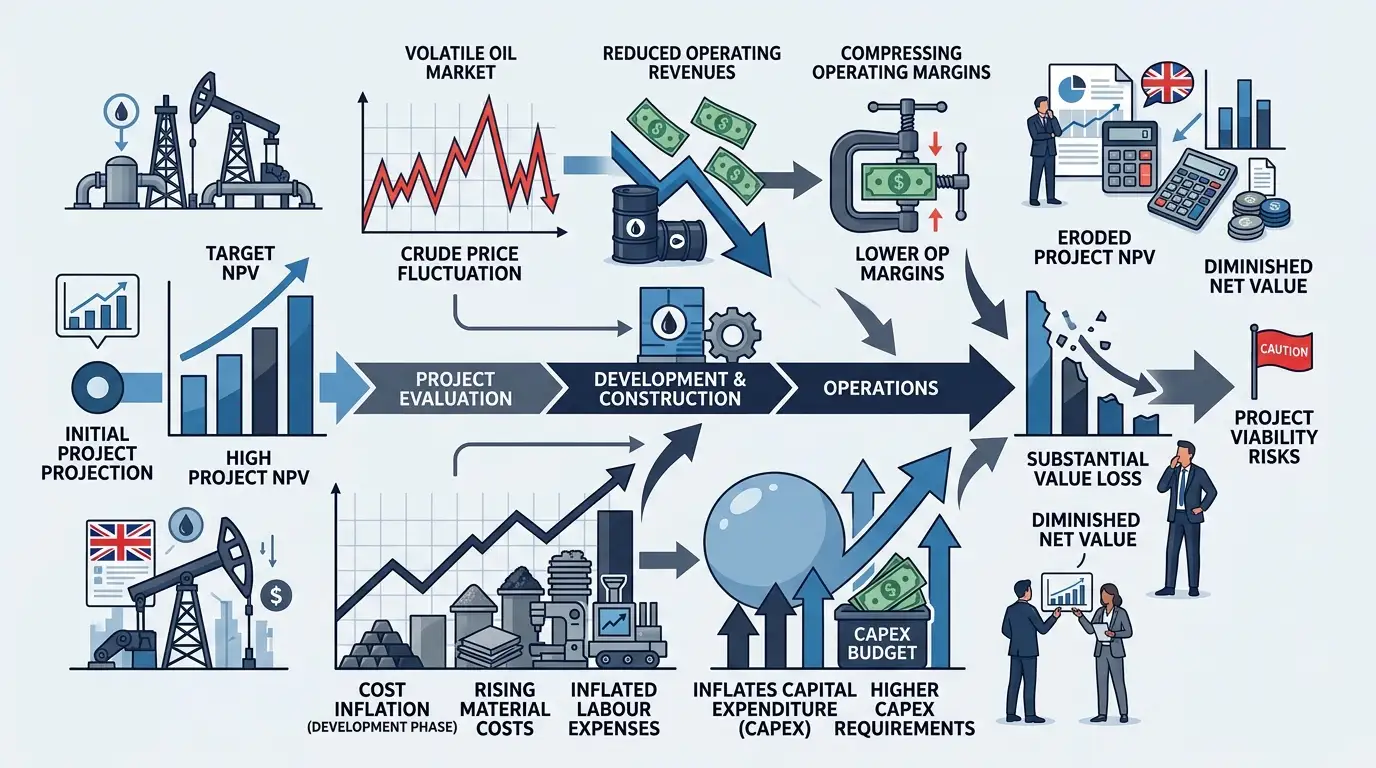
Asset profitability depends heavily on the realized price differential relative to the break-even threshold defined at final investment decision. When crude benchmarks decline unexpectedly, baseline cash inflows contract immediately. Concurrently, high-demand cycles inflate drilling contractor rates, tubular steel prices, and specialized engineering services. This dual pressure widens capital intensity while shrinking operating revenue. Upstream project evaluation models must incorporate probabilistic sensitivity distributions rather than static deterministic forecasts. Corporate finance teams rely on advanced analytical methods to quantify downside risk exposure. Workforce competence directly dictates modeling accuracy. Organizations deploy targeted capability building through the Institute For Oil & Gas Training to ensure evaluation teams accurately model complex macroeconomic volatility. Financial analysts simulate thousands of price and cost trajectories using Monte Carlo frameworks to establish robust probability curves for net present value outcomes. Projects featuring high initial capital outlays and extended plateau periods exhibit extreme sensitivity to early-year price drops. Deferring production or optimizing well placement schedules helps mitigate negative cash flow impacts during low-price environments. Asset teams also renegotiate service contracts and defer non-essential appraisal drilling to protect baseline liquidity. Rigorous sensitivity matrices expose the exact commodity price tipping points where field developments transition from value-accretive assets to value-destroying liabilities.
Mechanics of Capital Expenditure Overruns
Capital expenditure overruns stem from engineering changes, geotechnical surprises, and supply chain bottlenecks that materialize after project sanction. Estimating early-stage capital requirements involves inherent uncertainty due to subsurface complexity and limited appraisal data. Project managers address these variances by incorporating contingency buffers ranging between 10% and 25% of total baseline expenditure. When actual expenditures exceed these allowances, project payback periods extend significantly. This delay reduces the internal rate of return and compromises corporate capital efficiency metrics. Asset evaluation frameworks must isolate controllable operational variances from exogenous macroeconomic inflation drivers.
Operational Expenditure Resilience Strategies
Operating expenditure management focuses on maintaining field uptime and optimizing chemical, power, and logistics consumption. Mature assets face rising water-cut levels that elevate lifting costs per barrel over time. Asset managers combat this trend through predictive maintenance schedules, facility debottlenecking, and automation technologies. Lowering baseline operating expenditure protects net margins during severe crude price downturns. Evaluating cost structures requires rigorous benchmarking across regional analogue fields to identify performance gaps and efficiency opportunities.
How Do Different Petroleum Fiscal Terms Alter Government Take and Contractor Profitability?
Petroleum fiscal terms fundamentally alter government take and contractor profitability by redistributing gross revenues through royalties, bonuses, production-sharing mechanisms, and corporate income taxes. Host governments design fiscal frameworks to capture economic rents while offering sufficient financial incentives to attract foreign direct investment and high-risk exploration capital. Concessionary systems grant mining rights to international oil companies in exchange for royalties and taxes, leaving operators with full ownership of extracted hydrocarbons. Conversely, production-sharing contracts assign operational control to the contractor while dividing net petroleum output between the state and the consortium after cost recovery limits are satisfied. Risk service contracts reimburse contractors with fixed or variable fees tied to production performance, insulating operators from direct commodity price exposure but limiting upside participation. Financial evaluators utilize specialized frameworks like NPV, IRR & Fiscal Sensitivity Analysis Training for Oil & Gas Project Evaluation Professionals to master the intricate mechanics of fiscal regime modeling and asset valuation. Government take fluctuates dynamically across these systems depending on profitability indicators such as the R-factor or rate of return thresholds. Progressive fiscal terms increase state take when commodity prices surge or field productivity exceeds expectations. This mechanism dampens windfall profits for contractors during high-price cycles. Regressive fiscal terms rely heavily on production-based royalties and surface acreage fees, which impose severe cash flow burdens on marginal or declining fields during low-price environments. Evaluating asset returns requires mapping cash flows through exact contractual formulas to capture the nuances of cost recovery ceilings, uplift allowances, and uplift depreciation schedules.
Royalty Regimes and Economic Impact
Royalty mechanisms charge a fixed or sliding-scale percentage of gross production or revenue prior to cost deductions. Governments favor royalties because they guarantee immediate revenue streams upon first oil production, regardless of project profitability or operator cost overruns. For marginal fields with high extraction costs, inflexible royalty structures create severe economic distress. Operators mitigate this risk by negotiating sliding-scale royalties tied directly to daily production rates or prevailing Brent or WTI benchmark prices.
Production Sharing Mechanisms and Cost Recovery
Production sharing contracts utilize cost recovery pools to reimburse operators for exploration, development, and operating expenditures. Contractual limits restrict the percentage of total production allocated to cost recovery during any given accounting period, known as the cost stop. Excess revenue, designated as profit oil or profit gas, undergoes a pre-agreed split between the host government and the contractor group. High capital intensity projects require extended cost recovery periods, which alter the timing of cash flows and influence corporate hurdle rates.
How Do Dynamic Fiscal Sensitivities and Cost Pressures Influence Final Investment Decisions?
Dynamic fiscal sensitivities and cost pressures influence final investment decisions by redefining hurdle rates, capital allocation limits, and portfolio risk profiles across international assets.
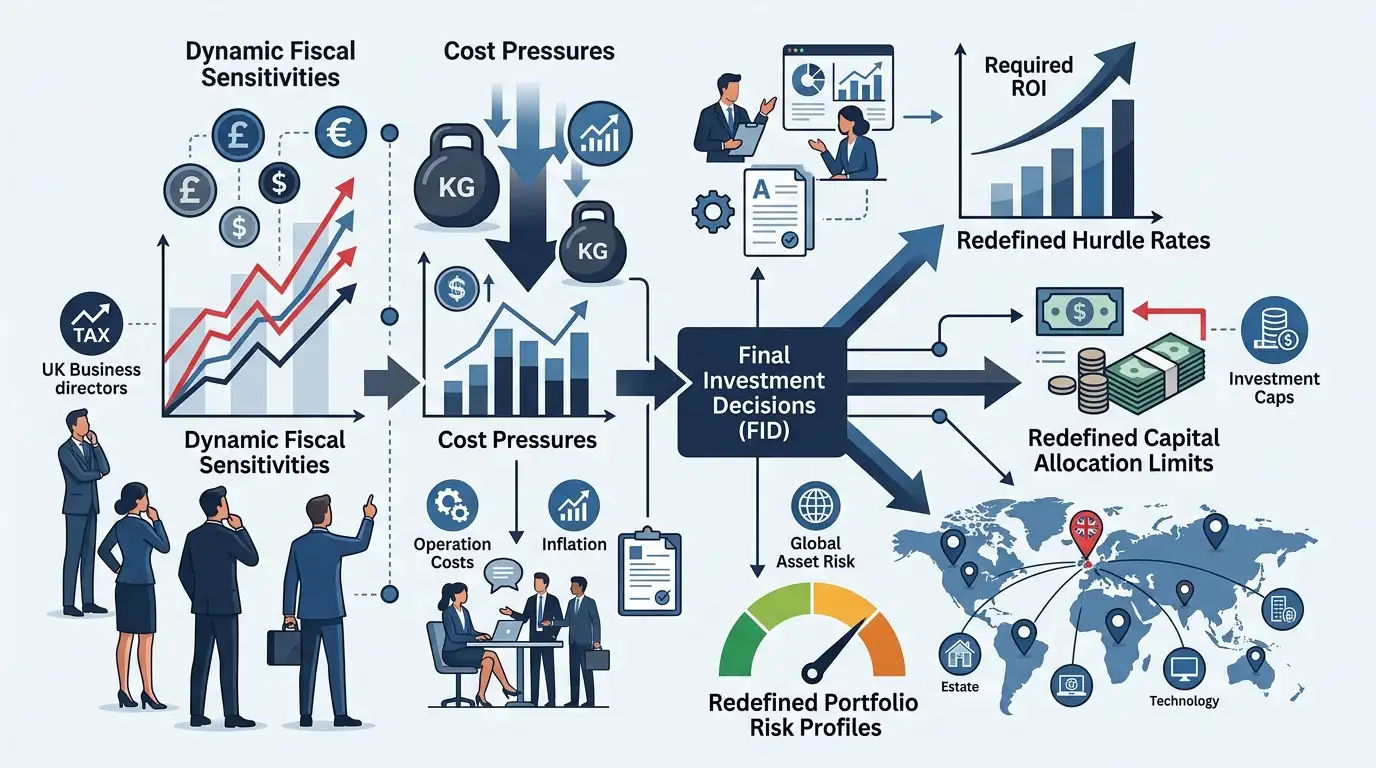
Management boards evaluate competing global opportunities through strict capital rationing criteria. Projects must clear specific internal rate of return hurdles that incorporate country risk premiums, geopolitical stability indices, and fiscal regime volatility scores. When fiscal terms include stringent profit-sharing sliding scales or punitive tax rates, the upside potential of high-impact discoveries diminishes. Consequently, corporate decision-makers redirect capital toward jurisdictions offering stable regulatory frameworks and favorable fiscal terms. Evaluating project returns under changing conditions demands integrated models where subsurface engineers, commercial negotiators, and financial analysts collaborate continuously. Scenario planning exercises test asset resilience against sustained low-price environments coupled with high inflation. Asset teams apply real options valuation to assess the strategic flexibility of abandoning, expanding, or temporarily shutting in production assets. This multidisciplinary approach ensures that final investment decisions reflect complete risk transparency rather than optimistic baseline assumptions. Organizations institutionalize these evaluation competencies through continuous professional development programs. Building internal expertise in fiscal modeling and economic sensitivity analysis prevents costly capital misallocation and protects long-term shareholder value in volatile commodity markets.
Portfolio Capital Allocation Frameworks
Capital allocation strategies balance high-risk, high-reward frontier exploration with low-risk, cash-generative brownfield developments. Portfolio managers utilize probabilistic aggregation to evaluate how individual asset returns correlate with macro commodity price cycles. Diversification across diverse fiscal regimes cushions corporate cash flows against localized regulatory changes or adverse tax amendments. Strategic asset pruning divests marginal properties burdened by regressive fiscal terms, reallocating capital toward core developments with superior net present value resilience.
Real Options in Upstream Asset Management
Upstream assets inherently possess embedded real options that traditional discounted cash flow models fail to capture fully. These options include the flexibility to delay development drilling, expand processing capacity upon successful appraisal, or abandon uneconomic fields prematurely. Quantifying the economic value of operational flexibility enhances decision-making accuracy under severe price uncertainty. Asset evaluation professionals integrate decision trees and binomial pricing models to value operational contingencies explicitly within project economics.
Frequently Asked Questions
What topics are covered in oil and gas petroleum finance training?
The Institute For Oil & Gas Training covers essential topics such as upstream asset valuation, capital expenditure modeling, production-sharing contracts, and fiscal sensitivity analysis. Participants learn to navigate complex petroleum fiscal terms and evaluate net present value under volatile commodity price conditions.
Who should attend petroleum finance courses for the energy sector?
Commercial analysts, financial controllers, project managers, and HR teams in the energy sector benefit greatly from these programs. The curriculum is tailored for professionals responsible for capital allocation, economic modeling, and investment decision-making in upstream operations.
How do petroleum fiscal terms impact project investment decisions?
Petroleum fiscal terms dictate how gross revenues are distributed between host governments and contractors through royalties, taxes, and profit-sharing mechanisms. Understanding these contractual frameworks allows financial teams to accurately project net cash flows and assess asset profitability before final investment decisions.
Why is sensitivity analysis critical for upstream oil and gas projects?
Upstream projects face continuous exposure to crude price fluctuations, inflation, and unexpected capital expenditure overruns. Conducting robust sensitivity analysis using advanced financial modeling helps organizations quantify downside risks and identify project break-even points.
What is the delivery format of the Institute For Oil & Gas Training programs?
The Institute For Oil & Gas Training delivers practical, industry-driven professional programs designed to bridge workforce skill gaps in corporate environments. These courses combine real-world case studies with measurable business outcomes to enhance strategic workplace development.
Related training courses
Payment Controls & Treasury Governance for JV Disbursements Training Course
- Specialisation
- Oil & Gas Petroleum Treasury, Cash and Banking
- Duration
- 5 days · 15 CPD hours
Automation of JV & PSC Reporting: Process Candidates Training Course
- Specialisation
- Oil & Gas Petroleum Digital Finance & Automation
- Duration
- 5 days · 15 CPD hours
Automation of JV & PSC Reporting: Data Integration Training Course
- Specialisation
- Oil & Gas Petroleum Digital Finance & Automation
- Duration
- 5 days · 15 CPD hours
More articles

NPV, IRR & Fiscal Sensitivity Analysis Training for Oil & Gas Project Evaluation Professionals
Master NPV, IRR, and fiscal sensitivity analysis for upstream petroleum projects with structured professional training.
Read article →
How Fiscal Terms Can Change the Investment Case for an Oil and Gas Project
Discover how fiscal terms training equips oil and gas workforces to evaluate project returns, optimize capital allocation, and navigate regulatory complexity.
Read article →
NPV, IRR & Fiscal Sensitivity Analysis: What Specialist Oilfield Economics Training Covers
Master upstream asset valuation with Institute For Oil & Gas Training. Learn NPV, IRR, and fiscal sensitivity modeling to optimize capital allocation.
Read article →