
Petroleum companies and contractors face unique money laundering vulnerabilities because high-value capital expenditures, complex joint-venture structures, and cross-border procurement provide structural concealment opportunities for illicit financial flows. Global energy markets operate through opaque supply chains where third-party intermediaries, massive engineering contracts, and multi-jurisdictional licensing agreements create significant exposure to illicit capital injection. Understanding these structural mechanisms requires looking at How Financial Crime Risks Extend Beyond Operational Fraud in Oil & Gas to grasp how traditional asset misappropriation evolves into sophisticated international layering schemes.
The extractive sector relies heavily on state-owned enterprises, private equity backers, and tiered subcontracting networks. This ecosystem inherently generates enormous cash flow velocity. Illicit actors exploit this velocity by inserting shell companies into engineering, procurement, and construction tenders. These shell entities invoice for unperformed services or inflated equipment costs.
Contractors operating in remote regions frequently handle legitimate cash transactions for local operational expenses. Financial criminals weaponize these cash-heavy environments to bypass standard banking controls. When procurement officers lack specialized detection frameworks, illicit funds merge seamlessly with legitimate upstream revenues.
Regulatory scrutiny focuses heavily on traditional financial institutions, yet energy supply chains remain primary targets for trade-based money laundering. Over-invoicing and phantom shipments allow criminal syndicates to transfer value across international borders without triggering automated banking flags. Compliance teams must analyze every tier of their supply chain to identify beneficial ownership anomalies.
Mitigating these risks demands a departure from generic corporate compliance policies. Petroleum executives must map every high-value transaction against known typology indicators. Without rigorous vetting of local partners, upstream operators risk severe legal liabilities, asset forfeiture, and catastrophic reputational damage.
How Can Organizations Evaluate Anti-Money Laundering Frameworks Across High-Value Transactions?
Organizations evaluate anti-money laundering frameworks across high-value transactions by assessing beneficial ownership transparency, third-party vetting rigor, and automated trade finance surveillance mechanisms. Effective evaluation requires measuring how rapidly compliance systems identify anomalous invoicing patterns, flag politically exposed persons, and verify the economic rationale behind massive capital outlays.
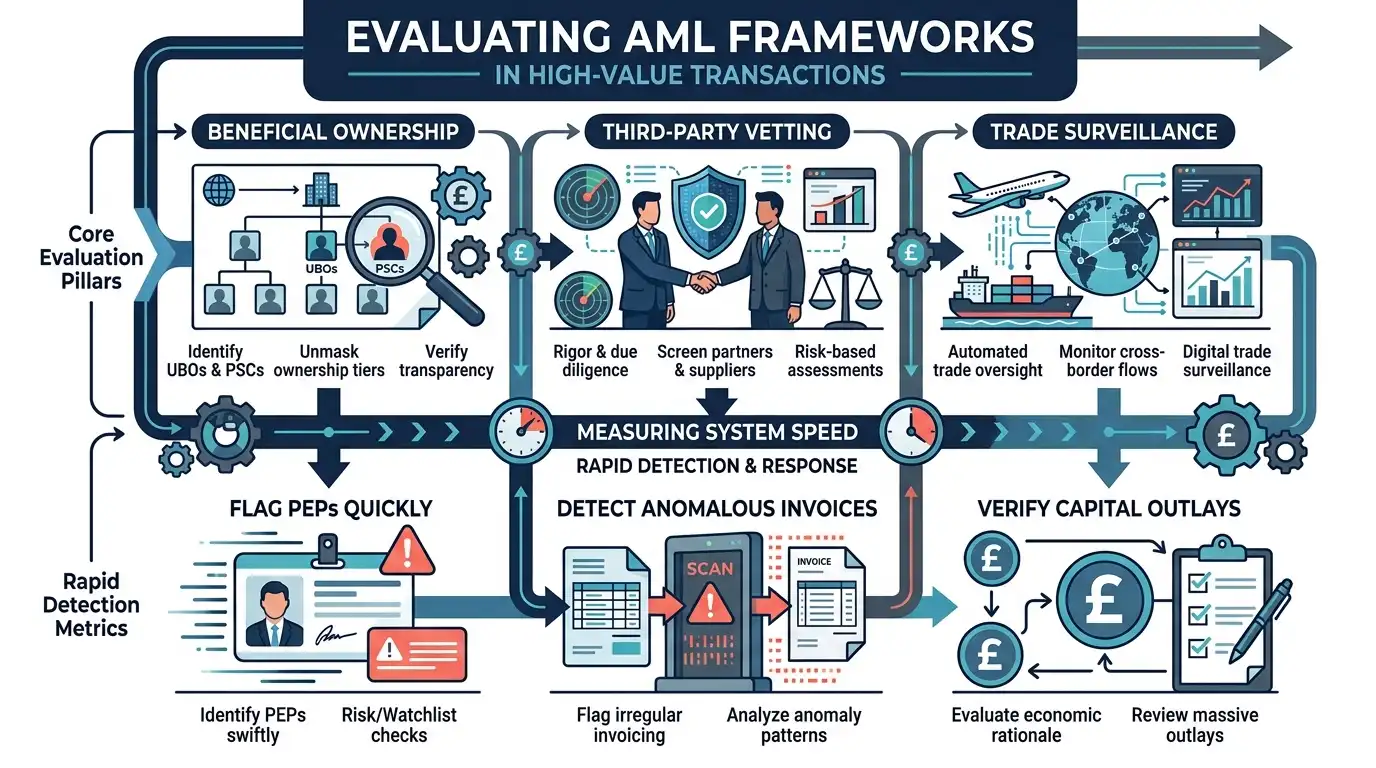
Energy firms manage multi-billion-dollar vendor ecosystems where manual oversight fails completely. Modern evaluation frameworks depend on data analytics engines capable of cross-referencing shipping documentation with real-time commodity pricing benchmarks. When a contractor bills for specialized drilling equipment at rates exceeding market norms by defined statistical thresholds, the system must generate immediate compliance holds.
Corporate governance structures must mandate comprehensive due diligence before releasing milestone payments on engineering contracts. This evaluation process involves dissecting corporate registries across multiple tax havens to uncover ultimate beneficial owners. When a contractor hides behind anonymous trust structures, compliance officers must enforce strict refusal of service protocols regardless of project criticality.
Procurement departments play a frontline role in this evaluation matrix. Personnel must receive targeted instruction on spotting red flags such as rapid corporate restructuring, frequent changes in banking details, and payments routed through unrelated third-party jurisdictions. Organizations utilizing the Anti-Money Laundering in Petroleum Operations: Specialist Training for Oil & Gas Professionals curriculum systematically eliminate these operational blind spots.
Evaluation Metric | Baseline Standard | Advanced Operational Standard |
Beneficial Ownership Verification | Annual registry checks | Automated continuous monitoring of registry updates |
Transaction Surveillance | Post-payment audit sampling | Real-time invoice-to-market price reconciliation |
Third-Party Risk Scoring | Static risk categorization | Dynamic scoring based on geopolitical and transactional velocity |
Vetting Turnaround Time | 10 to 15 business days | Under 24 hours via integrated screening APIs |
What Training Methodologies Deliver Measurable Competence in Regulatory Compliance?
Training methodologies deliver measurable competence in regulatory compliance through simulation-based scenario analysis, practical transaction auditing exercises, and role-specific risk calibration modules. Traditional lecture-based compliance seminars fail because they do not replicate the high-pressure negotiation environments where money laundering pressures manifest.
Human resource leaders and compliance directors must transition from passive compliance awareness to active operational capability. Adult learning theory demonstrates that compliance personnel retain complex regulatory frameworks best when solving simulated trade-based laundering cases derived from real-world enforcement actions. Participants analyze authentic bills of lading, complex wire transfer chains, and layered shell company structures to build diagnostic confidence.
Organizations measuring the return on investment from compliance education track specific performance indicators. These metrics include reduction in false-positive alert rates, acceleration of vendor onboarding verification, and successful identification of high-risk shell entities during pre-tender stages. Effective programs embed continuous assessment loops rather than one-off annual certification modules.
Learning Delivery Model | Knowledge Retention Rate | Implementation Cost | Speed to Operational Competence |
Traditional Classroom Lectures | Low (under 30 percent) | Moderate | Slow (weeks of transition) |
Static E-Learning Modules | Moderate (40 to 50 percent) | Low | Moderate (days) |
Simulation-Driven Workflows | High (80 to 90 percent) | High | Rapid (immediate deployment) |
The Anti-Money Laundering in Petroleum Operations: Specialist Training for Oil & Gas Professionals program utilizes these high-retention simulation methodologies. By immersing participants in realistic upstream contracting scenarios, organizations ensure their workforce moves beyond theoretical understanding into active risk mitigation.
How Do Compliance Gaps Impact Cross-Border Contracting and Joint-Venture Integrity?
Compliance gaps impact cross-border contracting and joint-venture integrity by exposing firms to extraterritorial regulatory enforcement, freezing international capital flows, and triggering mandatory partnership dissolutions. When an upstream operator engages a tainted contractor in a joint venture, regulatory authorities across multiple jurisdictions can impose crippling financial penalties.
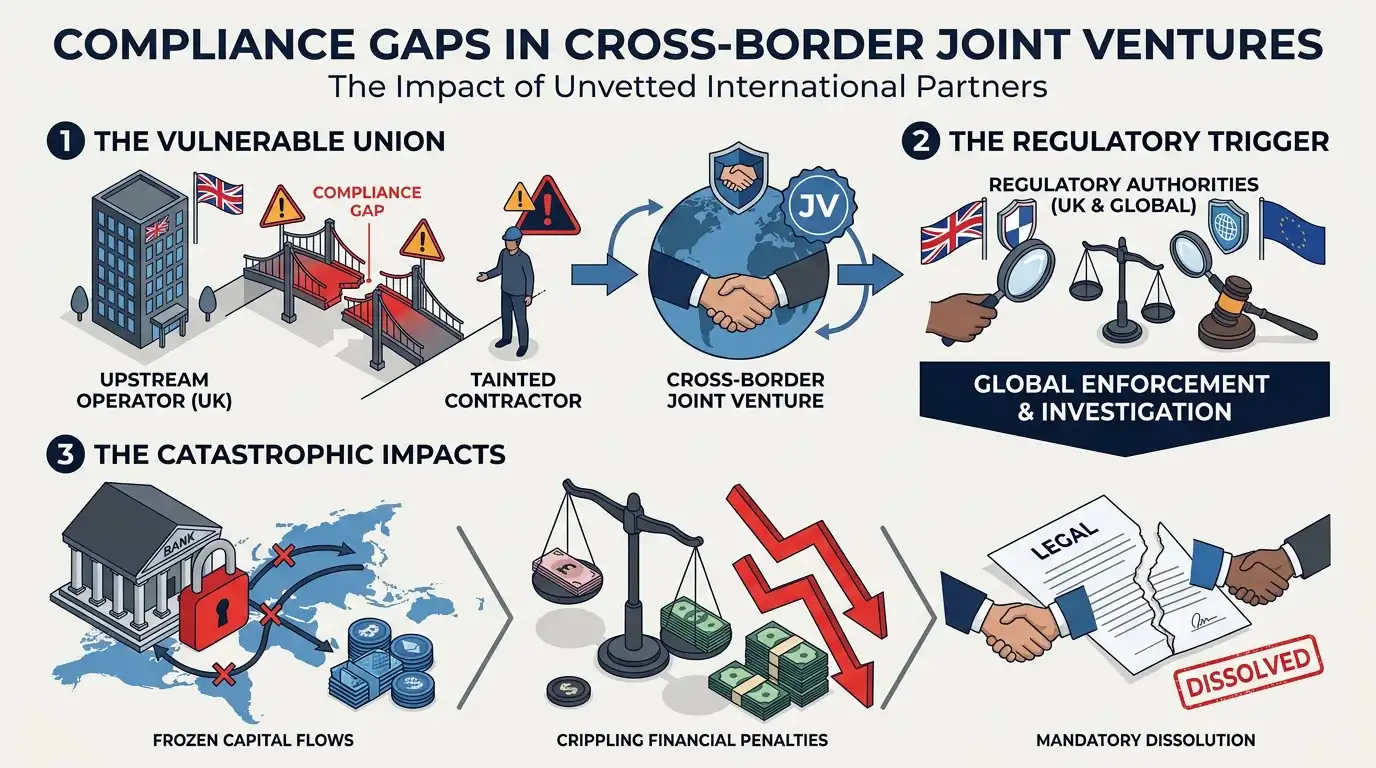
International energy projects frequently involve consortiums spanning diverse legal jurisdictions. If one partner maintains lax anti-money laundering controls, the entire operational vehicle becomes vulnerable to illicit infiltration. Regulatory bodies such as the US Department of Justice and the UK Serious Fraud Office prosecute transnational firms regardless of where the underlying illicit transaction occurred.
Joint-venture agreements must incorporate strict compliance covenants that grant partners unhindered audit rights over financial books and subcontractor registries. When compliance gaps allow illicit funds to co-mingle with joint operating account revenues, project operators face immediate asset freezes and catastrophic operational delays.
Mitigating these exposures requires standardized compliance competencies across all participating entities. Human resource departments must coordinate cross-functional training initiatives that align legal, procurement, and engineering teams under a unified risk taxonomy. The Anti-Money Laundering in Petroleum Operations: Specialist Training for Oil & Gas Professionals framework provides the precise structural alignment required to secure complex multi-party energy ventures against illicit capital infiltration.
Frequently Asked Questions
What are the main money laundering risks in the petroleum sector?
The petroleum sector faces significant money laundering risks due to high-value capital expenditures, complex joint-venture structures, and cross-border procurement that enable illicit capital concealment. The Institute For Oil & Gas Training addresses these vulnerabilities through specialized Oil and Gas Petroleum Compliance, AML & Risks programs designed to help compliance teams identify trade-based financial anomalies.
How do oil and gas companies detect trade-based money laundering?
Companies detect trade-based money laundering by utilizing automated surveillance engines that cross-reference shipping documentation, engineering invoices, and third-party pricing against real-world commodity benchmarks. Implementing comprehensive Oil and Gas Petroleum Compliance, AML & Risks frameworks allows corporate auditors to rapidly flag inflated procurement costs and unverified shell entities.
Why is beneficial ownership transparency critical for petroleum contractors?
Beneficial ownership transparency is critical because anonymous trust structures and multi-layered subcontracting networks allow illicit actors to hide the true origins of funds entering upstream energy projects. The Institute For Oil & Gas Training emphasizes rigorous vetting protocols within its Oil and Gas Petroleum Compliance, AML & Risks curriculum to ensure contractors maintain fully transparent corporate registries.
What compliance training methods work best for energy sector workforces?
Simulation-based scenario analysis and practical transaction auditing exercises deliver the highest knowledge retention and operational competence for energy compliance personnel. Through programs focused on Oil and Gas Petroleum Compliance, AML & Risks, the Institute For Oil & Gas Training equips human resources and legal teams to handle high-pressure negotiation and vendor onboarding environments effectively.
How do compliance gaps impact international oil and gas joint ventures?
Compliance gaps expose international joint ventures to severe extraterritorial regulatory enforcement, massive financial penalties, and mandatory operational shutdowns from global authorities. Adopting structured Oil and Gas Petroleum Compliance, AML & Risks strategies ensures that all participating entities in a cross-border consortium uphold rigorous anti-corruption and anti-money laundering standards.
Related training courses
Risk Management for Upstream & Midstream Projects: Exposures Training Course
- Specialisation
- Oil & Gas Petroleum Compliance, AML & Risks
- Duration
- 5 days · 15 CPD hours
Management Reporting Design for JV & Partner Audiences Training Course
- Specialisation
- Oil & Gas Petroleum IFRS & Financial Reporting
- Duration
- 5 days · 15 CPD hours
Consolidation & JV Structures for Multi-Country Groups Training Course
- Specialisation
- Oil & Gas Petroleum Accounting
- Duration
- 5 days · 15 CPD hours
More articles

Linking AML Monitoring with Fraud Risk Management and Financial Controls in Oil & Gas
Explore how energy companies integrate AML monitoring, fraud risk management, and financial controls to secure petroleum payment chains and supply networks.
Read article →
Where AML Exposure Can Develop Across Petroleum Supply and Payment Chains
Discover how organizations mitigate anti-money laundering exposure across petroleum supply and payment chains through targeted corporate training programs.
Read article →
Anti-Money Laundering in Petroleum Operations: Specialist Training for Oil & Gas Professionals
Enroll in Anti-Money Laundering in Petroleum Operations Specialist Training by the Institute For Oil & Gas Training. Master compliance and risk mitigation.
Read article →